Introduction
A single PCB failure in a flight-critical system doesn't just cause a warranty claim. It can ground a fleet, delay a launch window, or put a mission at risk.
Yet many engineering and procurement teams still treat AS9100 as a box to check rather than a standard that shapes every stage of a build. They know it's "the aerospace certification," but not what it actually demands from a manufacturing partner.
This guide breaks down what AS9100 requires, how it changes PCB design, material selection, and testing, and what to look for when vetting an aerospace PCB manufacturer. If you're sourcing boards for navigation, communication, or flight control hardware, this is the vetting framework you need.
Key Takeaways
- AS9100 layers aerospace-specific risk management, traceability, and configuration control on top of ISO 9001
- Every production stage falls under AS9100—from material sourcing through First Article Inspection and final test
- Single-source, AS9100-certified manufacturers reduce documentation gaps versus multi-vendor builds
- Upfront compliance costs offset the far higher cost of field failures in flight-critical hardware
What Is AS9100 Certification for Aerospace PCB Manufacturing?
AS9100 is the quality management standard for the aviation, space, and defense supply chain. The International Aerospace Quality Group first published the standard's underlying framework in 1998, with SAE International issuing the original AS9100 in November 1999. The current revision, AS9100D, dates to September 2016 and builds directly on ISO 9001:2015.
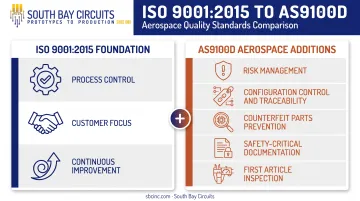
AS9100 doesn't replace ISO 9001. It adds aerospace-specific requirements on top of it, including:
- Risk management at each stage of the production process
- Configuration control and full material/process traceability
- Counterfeit parts prevention across the supply chain
- Safety-critical documentation and human factors controls
AS9100 vs. ISO 9001: What's the Difference?
Every AS9100-certified facility meets full ISO 9001 requirements. The aerospace standard then adds controls ISO 9001 doesn't cover in the same depth.
Those extras include first-article inspection, defective-product reporting, contingency planning, and stricter marking and traceability rules that follow the product through its entire lifecycle.
South Bay Circuits (SBC) maintains both credentials as part of a layered quality system: ISO 9001:2015 certification (Certificate #10000903 QM15, valid through August 2027) alongside AS9100 aerospace compliance. That pairing means the same facility is accountable to both frameworks at once, not treating aerospace work as a bolted-on process.
Why zero-defect tolerance matters: NASA defines reliability as a product functioning within specified limits, for a specified period, under real lifecycle conditions. There is no universal industry-wide defect rate for aerospace PCBs. The operating principle is simpler: a board in a navigation or flight control system doesn't get a second chance mid-flight. That is the standard AS9100 enforces.
Key AS9100 Requirements That Shape Aerospace PCB Production
AS9100 doesn't live in a binder. It shows up in specific, auditable practices on the shop floor.
Risk management. AS9100D requires organizations to identify, assess, and mitigate risk at every stage, from material sourcing through process control and final delivery. That evaluation is ongoing and built into the quality system, not a one-time checklist.
Configuration management and traceability. Manufacturers must maintain full material and process traceability with documented revision control. If a component or process step changes, that change has to be tracked so nonconforming parts never reach a customer.
Counterfeit parts prevention. Electronics account for a disproportionate share of known counterfeit incidents in the supply chain, representing roughly 82% of documented counterfeit events according to NQA's analysis. AS9100 requires controlled sourcing processes to keep suspect parts out. SBC addresses this by pulling components strictly from the customer's approved Bill of Materials and Approved Vendor List. Every line item gets an internal part number tracked through the MRP/ERP system, linking manufacturer, part number, and inventory status for full traceability.
AS9102 First Article Inspection (FAI). This is documented proof that a manufacturing process can consistently produce parts meeting design specifications. A new FAI gets triggered by:
- A production lapse of more than two years
- A design change affecting the part
- A significant change to the manufacturing process
SBC provides an AS9102 First Article Inspection Report upon request at the time of purchase order for aerospace customers.
On-time delivery and supplier control. AS9100 requires ongoing monitoring of supplier and subcontractor performance, with monitoring intensity scaled to risk. That means critical suppliers get reviewed far more frequently than low-risk ones.
How AS9100 Standards Impact PCB Design, Materials, and Testing
Compliance isn't just paperwork. It changes how boards are designed, which materials go into them, and how thoroughly they get tested before they ship.
Material Selection for Harsh Environments
Aerospace PCBs face temperature swings, vibration, and altitude pressure changes that consumer-grade boards never encounter. That demands laminates with specific thermal and dielectric properties.
For reference, Isola's P95/P25 polyimide laminate is rated for a glass transition temperature of 260°C, with X/Y-axis CTE of 13-14 ppm/°C and total expansion of just 1.5% between 50°C and 260°C. Laminate choice is matched to the mission profile and customer drawing—not pulled from a generic spec sheet.
SBC's material options for these applications include:
- High-temperature FR4 rated at 170Tg
- Rogers 3000 and 4000 Series laminates
- Nelco N4000-13 and N4000-7
- Flex, flex-rigid, and polyimide substrates
Design Controls That Carry Into Production
AS9100 also tightens the design handoff. Configuration control, revision traceability, and DFM/DFT reviews must stay linked to the released drawing package so process changes cannot drift from the qualified design.
Layout choices—stackup, copper weight, via strategy, and keep-outs—get locked against the same controlled documentation used on the floor. That link is what makes later FAIR and lot traceability meaningful.
Testing Methods Used to Meet Aerospace Quality Standards
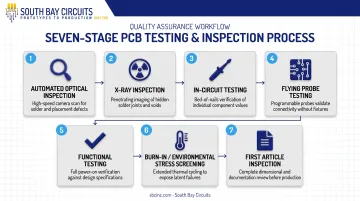
AS9100-driven programs typically require temperature cycling, vibration, humidity, and EMI/EMC screening so a board proves out under flight-like conditions, not only on a bench. Most compliant shops combine that environmental work with these seven methods:
- Automated Optical Inspection (AOI) - catches visible defects like misaligned components or soldering issues
- X-ray inspection - verifies hidden connections on BGAs and inner layers that AOI can't see
- In-Circuit Testing (ICT) - checks for opens, shorts, and incorrect component values using fixtured probes
- Flying Probe testing - performs the same electrical checks as ICT without a custom fixture, ideal for prototypes
- Functional testing - confirms the assembly performs correctly under simulated real-world operating conditions
- Burn-in/environmental stress screening - runs hardware under elevated conditions to flush out early workmanship failures
- First Article Inspection - documents that the production process reliably meets design specifications
SBC performs AOI, X-ray, ICT, and flying probe testing in-house, with 100% AOI coverage on inner layers. Final electrical verification uses equipment such as a Teradyne Z1860VP ICT system and an ATG A5CF Flying Probe system.
Documentation carries equal weight. AS9100 requires auditable records of every test and process step, creating full lifecycle traceability from raw material to finished, tested board.
Choosing the Right AS9100-Certified PCB Manufacturing Partner
Not every certified shop offers the same depth of capability. Before signing off on a supplier, run through this checklist:
- Current AS9100 certification status - verify it hasn't lapsed
- ITAR registration - required for most defense-related programs
- Documented traceability systems - ask how material and process history gets tracked, not just whether it exists
- Technical capability for complex multilayer or HDI boards - including microvias and controlled impedance
- On-time delivery track record and any independent quality awards
The Single-Source Advantage
Multi-vendor aerospace builds create handoff points, and every handoff is a place where documentation can get lost or misaligned. SBC combines AS9100 aerospace compliance with ISO 9001:2015 certification and ITAR registration under one roof at its 60,000-square-foot Chandler, Arizona facility, covering design through assembly.
That single-source model pays off in practice:
- Eliminates the "blame game" when a defect can't be traced to one vendor in a fragmented supply chain
- Puts one accountable party in charge of design, fabrication, assembly, and testing
- Keeps prototype-to-volume work under the same quality system and documentation trail
SBC's supported board technologies include multilayer designs up to 22+ layers, HDI interconnects, blind and buried vias, and fine-pitch assembly down to 0.4mm. Those capabilities matter once a program moves from prototype to volume production.
What Does AS9100 Compliance Cost? Audits, Design Services, and PCB Pricing
There's no universal price tag for AS9100 compliance, and any manufacturer claiming otherwise is oversimplifying.
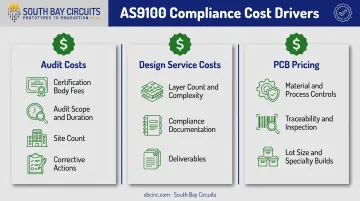
Audit costs depend on several variables:
- Certification body fees, which vary by accredited provider
- Audit scope and duration, driven by headcount and quality-system complexity
- Number of sites and how complex each operation is
- Corrective action work after any initial nonconformity
As DQS notes, there's no fixed lump-sum price for AS9100 certification. Pricing is set case by case from organization size and risk profile.
Initial certification uses a two-stage audit, then annual surveillance audits, with full recertification every three years.
Design service costs for aerospace-grade PCBs scale with:
- Layer count and design complexity, including RF/microwave or high-speed digital requirements
- Compliance documentation, such as ITAR handling and AS9102 reporting
- Required deliverables like IPC netlists, fabrication drawings, and pick-and-place data
SBC quotes design services based on these same factors, along with production volume and turnaround time.
PCB pricing for AS9100 work usually tracks:
- Material and process controls required for aerospace-grade boards
- Traceability, inspection, and AS9102 first-article documentation
- Lot size, layer count, and specialty builds (RF, HDI, controlled impedance)
Compliance costs more up front. Rework, warranty claims, and field failures in flight-critical hardware cost more still—in cash and in program credibility. Documentation and test rigor now almost always beat a failure later.
Frequently Asked Questions
How much do PCB design services cost?
Costs vary widely based on layer count, design complexity (RF, high-speed digital, HDI), and aerospace documentation requirements like ITAR compliance and AS9102 reporting. Get a project-specific quote rather than relying on a general estimate.
How much does an AS9100 audit cost?
There is no fixed price. Cost depends on the certification body's fees, your company's size and quality system complexity, and whether it's an initial certification audit or an annual surveillance audit.
What are the 7 types of PCB testing methods?
The seven common methods are AOI, X-ray inspection, In-Circuit Testing, Flying Probe testing, functional testing, burn-in/environmental stress screening, and First Article Inspection. Each targets a different type of defect or performance risk.
Is AS9100 certification mandatory for all aerospace PCB suppliers?
It's not legally required, but most aerospace OEMs and prime contractors make it a contractual condition of doing business. In practice, it's a near-universal requirement for flight-critical work.
What's the difference between AS9100 and ISO 9001 for PCB manufacturers?
AS9100 includes every ISO 9001 requirement plus aerospace-specific additions like configuration management, counterfeit parts prevention, and enhanced traceability. Think of ISO 9001 as the foundation and AS9100 as the aerospace-grade build on top of it.
How long does it typically take to become AS9100 certified?
A quality management system generally needs at least three months of operating history, including a completed internal audit cycle, before the initial two-stage certification audit can begin. Total timelines vary based on how quickly nonconformities get resolved.