None of these can rely on a bare board and good intentions.
The market reflects that pressure. The global conformal-coatings segment alone was valued at $930.89 million in 2021 and is projected to reach $1.49 billion by 2030, growing at a 5.9% CAGR, according to Grand View Research. That growth is being driven by automotive, medical, and aerospace programs that simply can't afford field failures.
Encapsulation often gets lumped in as "just a protective coating." In practice, its value shows up somewhere else entirely: in reliability data, in compliance audits, and in the total cost of keeping a product running for years instead of months. This article breaks down why that's the case, not just what encapsulation theoretically blocks.
Key Takeaways
- Full encapsulation in epoxy, silicone, or polyurethane blocks moisture, vibration, and contamination.
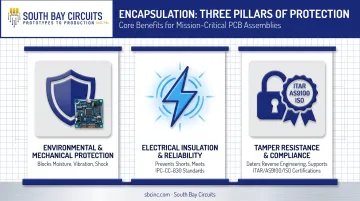
- Core payoffs are physical protection, reliable electrical insulation, and tamper/compliance support.
- Choose method and material by operating environment, not the lowest quote.
- Process consistency and certification matter more than the coating for long-term reliability.
What Is Electronic Encapsulation
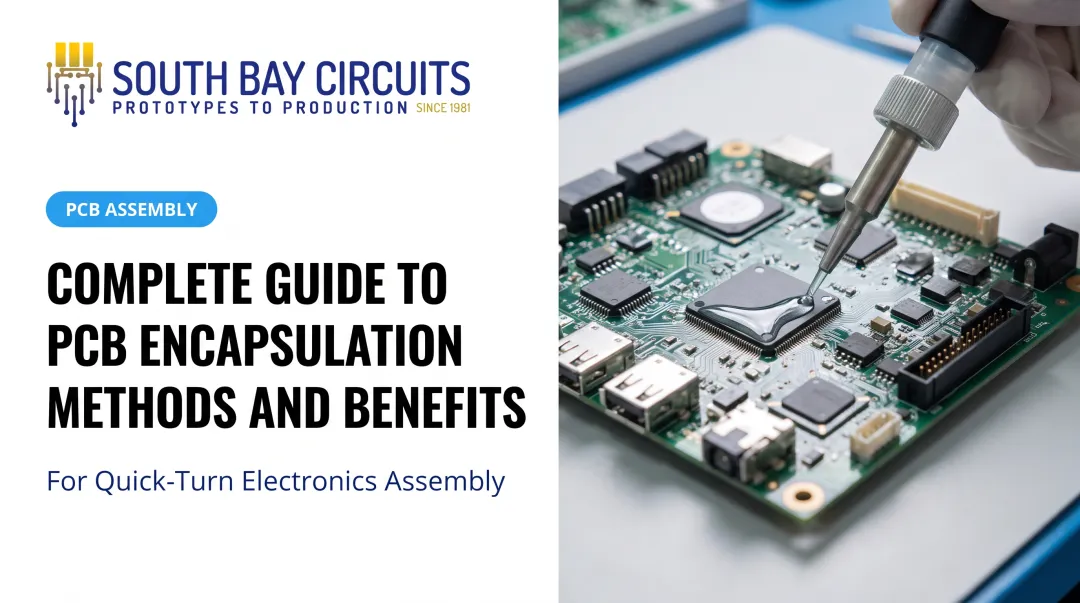
Encapsulation covers or embeds a sensitive component in a protective material so it can survive moisture, dust, vibration, and physical shock. That's the simple version.
The more useful way to think about it: encapsulation isn't a manufacturing step you check off. It's how a product earns reliability, safety, and compliance outcomes in the field, long after it leaves the factory floor.
Common Methods of Encapsulation
Three approaches dominate the industry, and each trades off protection against cost and speed:
- Conformal coating — A thin dielectric film, typically 25 to 100 microns thick, applied directly over the board. Inexpensive and easy to rework, but limited against sustained moisture or heavy mechanical stress.
- Epoxy potting — Resin fills a hard shell or housing around the assembly. Delivers strong shock, vibration, and chemical resistance, but adds weight and can need up to 24 hours to cure.
- Overmolding — Thermoplastic or epoxy molding compound is injected around the component. Some low-pressure cycles finish in 30 seconds, which suits high-volume runs, though tooling costs more upfront.
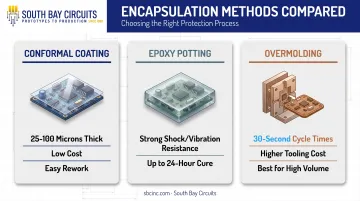
Choosing between them depends on production volume, how harsh the environment is, available space, and the cost target for the finished product. There's no universal "best" method here.
Materials Commonly Used
The material matters as much as the method:
- Epoxy resins — High strength and chemical resistance. Common in high-voltage and rigid-mounting applications where flexibility isn't needed.
- Silicones — Stay flexible under vibration and UV, with some formulations stable from -40°C to 200°C continuous service.
- Polyurethanes — Flexible and moisture-resistant, often chosen for delicate or thermally sensitive components where a rigid epoxy shell would create stress.
South Bay Circuits in Chandler, Arizona puts these options on the production floor through conformal coating (silicone, acrylic, and urethane) and potting.
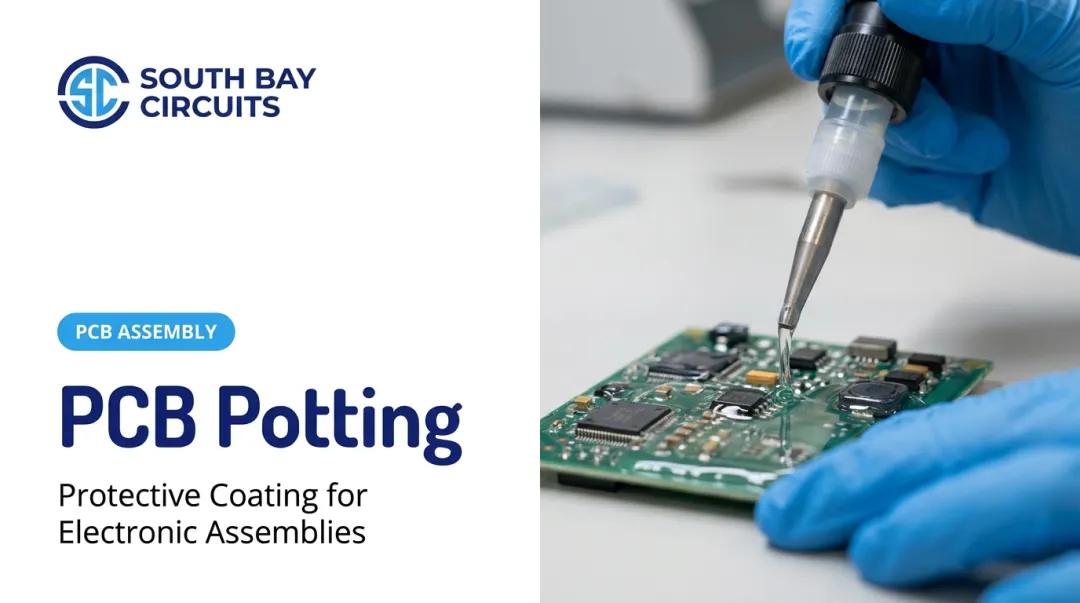
Potting fully fills a completed assembly with thermosetting plastics or silicone rubber gels to resist shock, vibration, and corrosive agents.
Key Advantages of Electronic Encapsulation
The advantages below aren't abstract technical claims. They're outcomes that manufacturers and program managers actually track: field failure rates, defect counts, audit results. And every one of them gets more important as products get more complex, environments get harsher, and regulators pay closer attention.
Environmental and Mechanical Protection That Extends Product Life
A full-coverage barrier behaves differently than a partial coating. It blocks moisture, dust, chemicals, vibration, and physical shock across the entire assembly, not just the exposed top layer.
This matters most in specific settings:
- Automotive underhood electronics exposed to heat cycling and road vibration
- Aerospace assemblies subject to pressure and temperature swings
- Outdoor sensors sitting in rain, dust, and direct sun for years
The physics behind this is well documented. A NASA Goddard study found that raising PCB moisture content from 0% to just 0.98% increased the dielectric constant by roughly 5.13% and the dissipation factor by about 74.5%, degrading electrical performance well before a visible failure occurs (NASA, 2018).
The same research found ionic contamination above 50 micrograms per square inch can trigger rapid electrochemical migration and shorts.
Full encapsulation interrupts that failure path before it starts. Fewer field failures translate directly into lower warranty claim volume and better mean time between failures (MTBF). Those metrics matter more to a program manager than any coating spec sheet ever will.
When it matters most: outdoor, high-vibration, or safety-critical deployments — automotive, aerospace, and industrial equipment top the list.
Electrical Insulation and Performance Reliability
Encapsulation materials are electrically insulating by design. They fill the gaps around solder joints and leads, which reduces the mechanical stress those connections face during thermal cycling or vibration.
That gap-filling does two things at once:
- Prevents short circuits and current leakage that partial coatings can miss
- Reduces defect rates and improves first-pass yield on the production line
Industry test standards like IPC-CC-830 set the bar here. Coated samples are expected to withstand voltages around 1,500 VDC for one minute without breakdown, and moisture-insulation testing requires a minimum insulation resistance of 5 x 10⁹ ohms under humid conditions. Uncoated boards simply don't hold up to that kind of stress test.
For high-voltage circuits, dense assemblies, and safety-critical electronics (think EV power electronics or implantable medical devices), that insulation reliability is the difference between predictable performance and a costly field return.
Highest impact in: high-voltage circuits, dense assemblies, and safety-critical electronics such as medical devices and EV power electronics.
Tamper Resistance, IP Protection, and Regulatory Compliance
Embedding a component in resin makes it genuinely difficult to reverse-engineer or physically tamper with, compared to a bare or lightly coated board. That's not a minor point for defense contractors and companies protecting proprietary designs.
Counterfeit electronics are a documented problem in regulated supply chains. A 2016 GAO report found the Government-Industry Data Exchange Program logged 526 suspect counterfeit-part reports between FY2011 and FY2015, with more than 90% submitted by contractors themselves (GAO, 2016).
The Department of Defense managed over 4.7 million parts across communications and weapon systems that year, at a cost exceeding $96 billion. At that scale, even small counterfeit exposure carries real risk.
Encapsulation doesn't eliminate that risk on its own, but it raises the bar for anyone trying to access, copy, or tamper with a design. Pairing that with the right certifications closes the loop.
Manufacturers with ITAR registration, AS 9100, and ISO 13485 (South Bay Circuits holds all three, alongside ISO 9001:2015 and ISO/TS 16949) build compliance and process discipline directly into production for aerospace, defense, and medical customers, rather than treating it as a bolt-on requirement.
Priority use cases: defense and military contracts, medical device manufacturing, and any application with proprietary or export-controlled designs.
What Happens When Encapsulation Is Missing or Ignored
Skip encapsulation, or apply it inconsistently, and the consequences show up in predictable places:
- Inconsistent field performance and premature failures in humid, dusty, or high-vibration environments
- Rising warranty and rework costs tied to moisture ingress, short circuits, and corrosion
- Greater exposure to IP theft, reverse engineering, and failed compliance audits in regulated industries
- Blocked path into high-reliability or high-volume contracts without a documented, repeatable protection process
None of these show up on day one. They show up six months into deployment, when a customer's field team reports the same failure pattern across multiple units. By then, the fix costs far more than the encapsulation would have.
How to Get the Most Value from Encapsulation
Getting real value out of encapsulation comes down to three habits:
- Match the method to actual operating conditions. Temperature range, voltage, chemical exposure, and production volume should drive the decision — not whichever option looks cheapest on a quote.
- Work with a certified single-source manufacturer. Integrating encapsulation into the PCB assembly workflow reduces handoffs and inconsistency. South Bay Circuits, for example, handles it under ISO 9001:2015, AS9100, ISO 13485, and ISO/TS 16949 at its Chandler, Arizona facility—keeping aerospace, medical, automotive, and defense assemblies with one vendor.
- Treat encapsulation as an ongoing quality practice, not a one-time decision. Test cured assemblies under real-world stress and review failure data regularly to refine material and process choices over time.
Skip any one of these, and encapsulation becomes a checkbox instead of a reliability strategy.
Conclusion
The real value of encapsulation is the control and consistency it brings to protecting sensitive electronics over years of field use.
Durability, insulation reliability, and compliance support compound when encapsulation is applied correctly and reviewed on a regular basis. Treat it as a one-time decision and those gains fade.
Approached as an ongoing manufacturing discipline, encapsulation stops being a line item. It becomes a process best executed with a production partner who has the certifications and process control to back it up.
Frequently Asked Questions
What is encapsulation in technology?
Encapsulation is the process of covering or embedding electronic components in a protective material to shield them from moisture, contamination, and mechanical stress. It protects the assembly for its full service life, not just during shipping.
What are the three types of encapsulation?
The three common types are conformal coating (thin, low-cost, limited durability), epoxy potting (hard resin fill, strong protection), and overmolding (injection molding compound, fast cycles, high durability).
What materials are used for encapsulation?
Epoxy resins, silicones, and polyurethanes are the most common. Each is chosen based on temperature range, flexibility needs, and the specific environmental exposure the product will face.
What is the encapsulation process?
The component is placed in a mold or shell, the protective compound is injected or applied, the material is cured, and the finished part is removed and inspected before final integration.
What is the difference between potting and encapsulation?
Potting leaves the shell as a permanent part of the finished assembly. Encapsulation typically uses a reusable mold, and the hardened material fully covers the component once it's removed.
How do I choose the right encapsulation material for my application?
The choice depends on operating temperature, flexibility needs, voltage requirements, and environmental exposure. Consulting a manufacturing partner for application-specific guidance is the fastest way to avoid an expensive mismatch.