Circuit boards keep getting denser. Product cycles keep getting shorter. Meanwhile, global supply chains remain unpredictable, and skilled labor is harder to find than ever. Many OEMs and engineers now face a real challenge: picking a manufacturing partner who can keep pace with these shifts without sacrificing quality or turnaround time.
This article breaks down the top automation trends reshaping PCB assembly in 2026, what's fueling them, how they're changing the industry from the factory floor to the boardroom, and what signals to watch heading into 2027 and beyond.
Key Takeaways
- AI inspection, cobots, digital twins, reshoring, and micro-component placement define 2026's automation landscape
- Design complexity, labor shortages, and tariff pressure are accelerating adoption industry-wide
- Automation's reach now extends beyond the shop floor, shaping capital budgets and workforce planning
- Early adopters see faster cycle times, fewer defects, and lower total cost of ownership
Top Automated PCB Assembly Trends to Watch in 2026
Investment and innovation are concentrated in five areas right now. Manufacturers modernizing their lines this year are putting real money behind these specific capabilities.
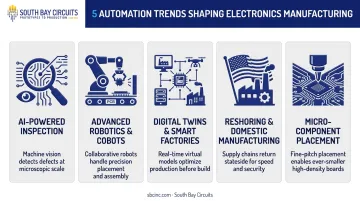
AI-Powered Inspection and Predictive Quality Control
AOI and AXI systems have inspected boards for years. What's changed is the layer of machine learning sitting on top of them, flagging solder joint anomalies and predicting yield issues before a board ever leaves the line.
Mycronic's DeepReview system, for example, is designed to cut false calls by 50% to 100% for eligible components and reduce the time operators spend reviewing those false calls by up to 90%, according to the company's 2024 product release.
That's a vendor projection, not an independently audited factory result, but it points to where the technology is headed.
Why it matters:
- Fewer false calls mean less operator fatigue and faster line throughput
- Predictive flagging catches issues before rework becomes necessary
- AI-assisted programming is also cutting inspection setup time by automating much of the manual coding these systems used to require
Advanced Robotics and Collaborative Automation (Cobots)
Traditional pick-and-place handles bulk SMT well. It struggles with high-mix, low-volume builds that require flexibility. Cobots are filling that gap.
At Marelli's Kechnec facility, four Universal Robots cobots now insert connectors and odd-form through-hole components directly from supplier packaging. The result: 25% higher line speed, eliminated quality issues, and payback within a single year, according to Assembly Magazine's 2024 coverage.
Cobots and multi-axis arms are also taking on:
- Selective soldering on mixed-technology boards
- Fine-pitch component placement once reserved for skilled hand assembly
- Repetitive tasks across multiple shifts without fatigue-driven errors
As build complexity climbs and experienced technicians retire faster than they're replaced, this flexibility is becoming less optional.
Digital Twins and Connected Smart Factories
Digital twins let manufacturers simulate a production line before touching a single physical component. Fuji's SMT digital twin, for instance, models cycle-time data, staffing, AGV movement, and line allocation to visualize bottlenecks before they happen on the actual floor.
On the changeover side, ASMPT reports that customers using its Automatic Program Change feature see setup-time reductions of up to 35% across setups, based on the company's 2025 press release.
Real-time connectivity is quickly becoming table stakes rather than a competitive edge. Manufacturers without IIoT-connected equipment are increasingly the exception, not the rule.
Reshoring and Automated Domestic Manufacturing
Tariff volatility, geopolitical risk, and IP protection concerns are pushing more OEMs toward domestic assembly. North American EMS shipments rose 6.7% year over year in June 2026, with a book-to-bill ratio of 1.33, according to IPC's industry data.
That's a demand signal, not a formal reshoring percentage, but it tracks with what manufacturers are reporting anecdotally.
South Bay Circuits' 60,000-square-foot Chandler, Arizona facility reflects this shift directly. As a domestic, ITAR-registered, single-source provider, it offers same-day assembly turnaround as an alternative to the queue times and IP exposure that come with offshore production.
Automation for Extreme Miniaturization and Fine-Pitch Components
Boards keep shrinking while performance demands keep climbing. Automated placement systems now routinely handle 01005 packages, micro-BGAs, and QFNs at tolerances no human hand can match.
Fuji announced stable placement technology for 016008 mm components using nano-level position compensation in a 2026 product release. Wearable and medical device assembly, in particular, depends on this kind of sub-millimeter accuracy, where micro-BGAs get mounted directly to flex circuitry in space-constrained enclosures.
This trend will only accelerate as consumer and medical electronics keep shrinking while packing in more functionality per square millimeter.
What's Driving These Automated PCB Assembly Trends
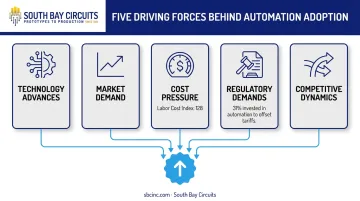
Automation adoption is accelerating faster than at any point in the past decade, driven by technology maturity, market demand, cost pressure, regulatory requirements, and competitive dynamics.
- Technology advances: AI, robotics, and IIoT tools have matured to the point where mid-size assembly lines can afford to integrate them, alongside the largest contract manufacturers
- Market demand: Shorter product lifecycles and rising complexity in aerospace, medical, and automotive electronics leave little room for slow, manual processes
- Cost pressure: IPC's Labor Cost Index reached 128 in April 2025, and 31% of manufacturers say they've invested in automation to offset tariff exposure, according to IPC's April 2025 market report
- Regulatory demands: ITAR, AS9100, and ISO 13485 all push manufacturers toward traceable, repeatable processes, which automated documentation and inspection systems support well
- Competitive dynamics: Turnaround speed has become a genuine differentiator among contract manufacturers, not just a nice-to-have
For many shops, these combined pressures leave little choice: automate now, or risk losing contracts to competitors who already have.
How These Trends Are Impacting the PCB Assembly Industry
Automation's ripple effects go well beyond the factory floor. They're reshaping strategy, staffing, and how manufacturers structure their entire operations.
Operational Impact
Workflows are shifting toward continuous, data-logged production with far fewer manual handoffs between stations. Every step gets recorded, which shortens cycle times and creates an audit trail.
Automated inspection also catches defects earlier in the process. Fuji's case study with Alps Alpine shows an automation rate jump from roughly 12% to 56%, enabling 5 to 6 hours of unmanned production per shift.
Business Impact
Capital investment is moving toward flexible automation and domestic capacity as companies work to de-risk their supply chains. Single-vendor delays used to be an accepted cost of doing business; now they're a liability.
Single-source providers who handle design through assembly under one roof, like South Bay Circuits' Chandler, Arizona operation, are gaining ground over fragmented, multi-vendor supply chains. Fewer handoffs mean fewer places for problems to hide.
Workforce Impact
The job on the floor looks different than it did five years ago. Roles are shifting from manual assembly toward machine programming, data analysis, and automation maintenance.
- Technicians need training in robotics operation, not just hand assembly
- AOI and AXI system operation now requires interpreting software output, not just visual inspection
- Upskilling budgets are becoming a standard line item rather than an afterthought
Future Signals for Automated PCB Assembly Beyond 2026
These are early indicators worth tracking as the industry keeps evolving past this year.
- "Lights-out" assembly cells: High-volume lines are inching closer to near-autonomous operation, building on current unmanned production windows of 5 to 6 hours per shift
- Generative AI for process optimization: This remains early-stage for PCB assembly specifically, but AI-driven predictive supply chain management is already gaining real traction across manufacturing broadly
- Continued reshoring momentum: Expect domestic capacity investment to keep climbing as tariff and IP concerns persist, favoring in-house manufacturers like SBC's Chandler, AZ facility
- Sustainability integration: Lead-free processes and energy-efficient equipment are moving from compliance checkboxes to competitive selling points
- Hyper-customized small-batch automation: Flexible cells built for high-mix, low-volume runs will keep expanding beyond their current niche
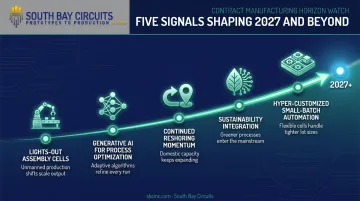
None of these are guaranteed outcomes yet. They're directional signals based on where investment and R&D are currently pointed.
Conclusion
AI-driven inspection, advanced robotics, digital twins, domestic automation, and micro-component placement are defining automated PCB assembly heading into 2026 and beyond. Manufacturers who adapt early gain measurable ground in speed, quality, and cost control while competitors play catch-up.
Navigating this shift on your own is difficult. Partnering with a certified single-source provider like South Bay Circuits gives OEMs a domestic, ITAR-registered path through design, fabrication, and assembly. With over 40 years of experience and ISO 9001:2015 certification, SBC eliminates the offshore queue times and multi-vendor headaches that slow competitors down.
Frequently Asked Questions
What is automated PCB assembly?
It's the use of machine-driven pick-and-place, soldering, and inspection systems to populate and verify circuit boards with minimal manual handling. This includes everything from SMT placement to AOI-based quality checks.
How does automation improve PCB assembly quality?
Automation reduces human error and delivers consistent repeatability across every board. AI-enhanced AOI and AXI systems catch defects like solder joint anomalies earlier and more reliably than manual inspection alone.
Is automated PCB assembly cost-effective for low-volume production?
Yes, in most cases. Flexible automation and cobots have made automated assembly viable even for prototype and low-volume runs. Highly unusual or one-off builds may still call for manual assembly.
Which industries benefit most from automated PCB assembly?
Aerospace, medical, automotive, and industrial electronics benefit most, since these fields demand precision and traceability that manual processes struggle to guarantee at scale.
How is AI changing PCB assembly automation?
AI is improving predictive maintenance and defect detection while shortening inspection programming time. Engineers spend less time on setup and more time running production.
What should businesses look for in a PCB assembly partner in 2026?
Look for certifications such as ISO 9001, AS9100, and ITAR registration. Domestic manufacturing capacity and single-source capability from design through assembly matter just as much, especially when turnaround speed is critical.