Cost depends on a mix of technical factors (layer count, component types, assembly technology) and business factors (order volume, lead time, supplier choice). Change any one of these, and your quote changes with it.
This guide breaks down typical pricing by production tier, the individual cost components hiding inside every quote, the biggest price drivers, and how to budget accurately for your next assembly run.
Key Takeaways
- Per-board cost is highest at prototype quantities and drops sharply as volume reaches the hundreds and thousands
- Complexity, low volume, and rush turnaround push prices up; standard parts and higher volume pull them down
- Setup fees, testing, and shipping change your real total — the quoted unit price is never the full story
How Much Does PCB Assembly Cost? (Pricing Overview)
PCB assembly doesn't work like retail pricing. There's no catalog rate. Every quote is calculated per project based on board size, component count, assembly technology, and quantity.
Misunderstanding this leads to real budgeting problems:
- Underbudgeting: counting only bare-board fabrication and skipping assembly, testing, and setup fees
- Mismatched technology: choosing SMT, THT, or hybrid assembly without matching the process to real production volume
- Surprise fees: NRE, stencil, or rush charges that appear after the order is placed
Most contract manufacturers build per-unit cost dynamically instead of publishing a flat rate. Live component pricing and labor go into every quote. That is standard practice across the industry.
Quoted assembly prices usually include machine placement, basic inspection, and standard components. They typically exclude premium testing, expedited shipping, and hard-to-source parts, which are added separately.
Directional cost follows volume and complexity: simple high-volume boards can land in the low single-digit dollars per unit for assembly labor, while complex prototype builds often run far higher on a per-board basis once setup and scarce parts are included.
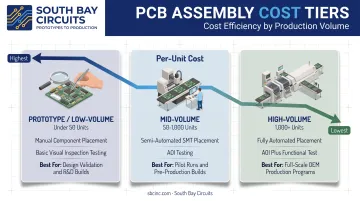
Prototype / Low-Volume Assembly (Under 50 Units)
Low-volume runs usually include manual or semi-automated placement, basic visual or AOI inspection, and standard lead times. Per-unit costs run highest here because setup work isn't spread across many boards.
Best for: design validation, first-article builds, and iterative testing before committing to full production.
Mid-Volume / Standard Assembly (50–1,000 Units)
This tier typically runs on automated SMT lines with standard component sourcing, AOI, and functional testing built in. Unit costs drop noticeably compared to prototype runs.
Best for: companies moving from prototype to early production with a design that's already stabilized.
High-Volume Assembly (1,000+ Units)
High-volume production uses fully automated SMT lines, bulk component pricing, and setup/tooling costs amortized across thousands of units.
Best for: established products where economies of scale meaningfully cut per-unit cost.
Key Factors That Affect the Cost of PCB Assembly
Final pricing isn't just about board size. It's shaped by design decisions, component choices, and operational requirements stacked together.
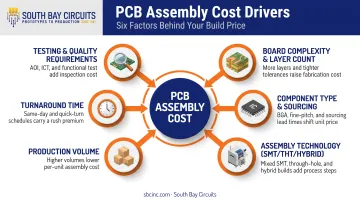
Board Complexity and Layer Count
More layers, denser component placement, and tighter tolerances all increase material use and processing precision. A multilayer board demands more from fabrication and assembly than a basic two-layer design: tighter alignment, longer inspection cycles, and less room for process error.
Component Type and Sourcing
Standard SMDs are inexpensive and widely available. Advanced packages like BGA or CSP need specialized placement equipment. Because their solder joints sit hidden under the package, they also require X-ray inspection to verify quality instead of standard optical checks.
Sourcing strategy matters too:
- Turnkey: Assembler sources all parts and takes on procurement risk
- Consigned: You supply the parts and keep control, but own availability risk
- Combo: Sourcing responsibility is split between both parties
Assembly Technology (SMT vs. THT vs. Hybrid)
SMT is the most automatable option, which makes it the cost-efficient choice for high-density, high-volume work. THT is more labor-intensive because components are inserted and soldered by hand, so it fits specialty parts or low-volume builds better.
EMS Inc. notes that hybrid assembly (combining both) often still costs less than forcing an entire board into one method when the layout doesn't support it.
Production Volume
Setup, stencil creation, and programming are fixed, one-time costs. Bittele points out that these costs matter far more on small runs because they can't be spread across many units. Order 5,000 boards instead of 50, and that same setup fee barely registers per unit.
Turnaround Time
Rush orders typically carry a premium over standard lead times. Overtime labor and expedited logistics both cost more, and that gets passed along in the quote. If your timeline has any flexibility, standard turnaround is almost always the cheaper path.
Testing and Quality Requirements
Basic visual or AOI checks are low-cost. Advanced testing (ICT, X-ray, functional test) costs more upfront but reduces expensive rework later. This matters most in regulated industries like medical, automotive, and aerospace, where a single defective board can mean a compliance failure, not just a warranty claim.
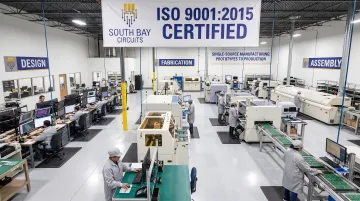
It's also where working with one manufacturer for both fabrication and assembly pays off. South Bay Circuits, for example, runs AOI, BGA X-ray, ICT (2,048 test points), functional testing, and burn-in testing in-house at its Chandler, Arizona facility.
Because fabrication and assembly happen under one roof, boards don't ship back and forth between vendors while a defect is traced. That handoff delay is a cost of its own.
Cost Breakdown of PCB Assembly
The quoted "assembly price" is only one line item. Real project cost includes several charges, some one-time and some recurring on every order.
| Cost Component | Type | What It Covers |
|---|---|---|
| Setup and NRE | One-time | Stencil creation, pick-and-place programming, engineering setup |
| Component costs | Recurring | Parts pricing based on availability, market conditions, and sourcing model |
| Labor and machine assembly | Recurring | Automated (SMT) vs. manual (THT/rework) placement, plus regional labor rates |
| Testing and inspection | Recurring | Ranges from basic AOI to ICT or X-ray depending on reliability needs |
| Packaging and shipping | Recurring | ESD-safe packaging, moisture barriers, and for overseas orders, duties and import fees |
A few dynamics matter more than the line items alone:
- Setup and NRE hit hardest on small runs because they can't be spread across many units
- Component costs are often the largest share of total spend and swing with turnkey vs. consigned sourcing
- Shipping is the line item most teams underestimate, especially international duties that surface after the order is placed
Low-Cost vs High-Cost PCB Assembly — What's the Difference?
The real difference is a trade-off between upfront savings and long-term reliability.
| Factor | Lower-Cost Assembly | Higher-Cost Assembly |
|---|---|---|
| Precision & defect rates | Less precise placement equipment, more misalignment or solder defects | High-precision pick-and-place, tighter process controls, fewer defects |
| Testing rigor | Limited to basic visual checks, subtle faults can slip through | AOI, ICT, or X-ray catches defects before they reach the field |
| Long-term value | Lower sticker price, higher risk of field failures and rework | Higher upfront cost, fewer warranty claims, stronger compliance for regulated industries |
For a simple prototype or early proof-of-concept, the lower-cost path can make sense. For boards going into medical devices, aerospace systems, or other regulated products, the math changes fast. One field failure can cost far more than the testing that would have caught it.
How to Estimate the Right Budget for PCB Assembly
The "right" budget matches your product's actual performance and compliance needs, not just the lowest number on a quote sheet.
Before requesting quotes, work through:
- Order quantity, and whether this is a prototype, pilot run, or full production build
- Component sourcing strategy (consigned vs. turnkey) and current part availability
- Required testing level based on your end-use industry (medical, automotive, aerospace, industrial)
- Acceptable lead time versus what a rush order will actually cost you
Common budgeting mistakes to avoid:
- Focusing only on the quoted unit price and ignoring setup/NRE and shipping
- Over-specifying tolerances or testing beyond what the application genuinely needs
- Choosing the lowest bid without checking a supplier's defect rate or certifications
To simplify budgeting, work with a manufacturer that handles design, fabrication, and assembly under one roof. South Bay Circuits is an ISO 9001:2015-certified contract manufacturer with over 40 years in the industry; one quote covers boards, parts, and assembly instead of separate vendors.
That single-source setup cuts queue time, file transfers, and shipping delays that pile up when a fix is needed and no one supplier owns the full outcome.
Frequently Asked Questions
PCB assembly cost varies widely by volume, complexity, and technology choice. Breaking out each cost component produces more accurate budgets than relying on a single headline number.
How much do PCBs cost?
Bare PCB cost depends on size, layer count, and material, ranging from a few dollars for simple boards to much more for complex multilayer designs. This is separate from assembly cost, which gets added on top.
How much does PCB assembly cost per board?
Per-board assembly cost runs highest for small prototype runs and drops significantly at high volume, depending on complexity and testing requirements. There's no fixed rate; every quote is project-specific.
Is SMT or through-hole assembly cheaper?
SMT is generally cheaper thanks to automation and its fit for high-volume runs. Through-hole costs more due to manual labor but remains necessary for certain mechanical or high-power components.
Why is my PCB assembly quote higher than expected?
Common culprits include low order quantity, hard-to-source components, rush lead times, or added testing such as ICT or X-ray. Flag these drivers early when you request quotes so apples-to-apples comparisons stay realistic.
Does order quantity really change PCB assembly cost that much?
Yes. Unit cost drops substantially from small to large batches because fixed setup and NRE costs get spread across far more boards.
What's included in a typical PCB assembly price quote?
A full quote should cover setup/NRE, components, labor and machine time, testing, and packaging/shipping. Compare line items side by side so a lower bid isn't missing testing or freight.