The decision isn't academic. It affects unit cost, assembly defect rates, product lifespan, and how fast you get from prototype to shipping hardware — especially in regulated fields like aerospace, medical devices, and automotive, where a failed solder joint isn't just an inconvenience.
This guide breaks down what each technology actually is, where each one earns its keep, and how to decide with confidence instead of guesswork.
Key Takeaways
- Rigid PCBs use a single FR-4 substrate, delivering the lowest cost for high-volume, fixed-shape designs.
- Rigid-flex PCBs combine rigid sections with flexible interconnects, eliminating cables in compact assemblies.
- Cost, vibration resistance, and design complexity separate these two technologies most sharply.
- Rigid boards dominate consumer and industrial electronics; rigid-flex leads in aerospace and medical devices.
- The right choice depends on your budget, environment, and reliability targets — not universal superiority.
Rigid vs. Rigid-Flex PCB: Quick Comparison
Before diving into definitions, here's how the two technologies stack up side by side:
| Factor | Rigid PCB | Rigid-Flex PCB |
|---|---|---|
| Cost | Lower material and tooling cost; mature, high-volume processes | Higher fabrication cost per square inch due to specialized materials and lamination steps |
| Composition | FR-4/fiberglass substrate with copper layers, solder mask, silkscreen | Rigid FR-4 sections bonded to flexible polyimide layers into one structure |
| Durability & Vibration | More connectors and solder joints mean more potential failure points | Fewer joints and connectors reduce failure points and improve shock/vibration resistance |
| Design & Lead Time | Simpler design, wider manufacturer availability, shorter lead times | Requires 3D mechanical planning and specialized fabrication, often extending lead times |
| Space & Weight | Fixed flat form factor; multi-board assemblies need cables and connectors | Reduces footprint and weight by eliminating interconnecting cables |
Cost deserves a caveat here. An EDN cost-modeling analysis found that once you factor in connectors, cable assembly, testing, and inspection labor, one rigid-flex design became cheaper than its multi-board rigid equivalent at roughly 100 units.
That's a single modeled scenario, not a universal break-even point — but it illustrates why "rigid-flex costs more" isn't the whole story.
What Is a Rigid PCB?
A rigid PCB is a non-flexible board built from bonded layers of dielectric laminate and copper foil , typically FR-4 fiberglass. Once fabricated, it holds its shape permanently. That dimensional stability is exactly why it's the default choice for most electronics manufactured today.
Why Rigid Still Dominates
Rigid boards remain the backbone of the industry for practical reasons:
- Cost efficiency at scale: mature processes and widespread fabrication capacity keep per-unit pricing low
- Mechanical stability for mounting components without flex-related stress on solder joints
- Predictable impedance control, critical for high-speed digital and RF designs
- High manufacturing yield, since fewer process variables mean fewer defects
In fact, rigid boards still held 38.36% of the global PCB market's product-type segment in 2025, according to Fortune Business Insights. That's proof that despite all the buzz around flexible and rigid-flex construction, rigid remains the workhorse of the industry.
Common Subtypes
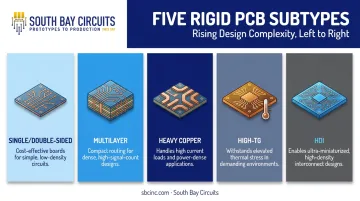
Not all rigid boards are the same. Depending on performance and budget needs, projects typically fall into one of these categories:
- Single- and double-sided boards for simple, low-density circuits
- Multilayer boards for higher component density and complex routing
- Heavy copper boards for high-current power applications
- High-Tg boards for thermal stability in demanding environments
- HDI (High-Density Interconnect) boards for miniaturized, high-pin-count designs
Selecting the right subtype comes down to matching circuit complexity, current draw, and thermal load to the application. A simple two-layer board handles basic control circuits, while heavy copper or HDI designs manage power-dense or high-pin-count assemblies in tighter spaces.
Where Rigid PCBs Fit
Rigid boards show up everywhere in production: standard product assemblies, early prototyping runs, and high-volume manufacturing where the board's shape never changes. Industries relying heavily on rigid construction include:
- Industrial controllers and automation systems
- Medical diagnostic equipment
- Automotive electronic control units (ECUs)
- Aerospace instrumentation panels
SBC's own certification footprint reflects this reality. Its ISO 13485, ISO TS 16949, and AS 9100 compliance all center on rigid-board manufacturing for medical, automotive, and aerospace customers who need predictable, repeatable board performance run after run.
What Is a Rigid-Flex PCB?
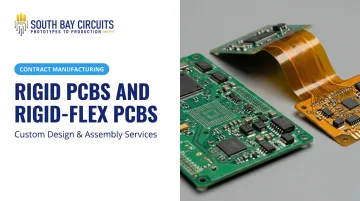
A rigid-flex PCB is a hybrid structure: flexible circuit layers laminated directly to rigid sections, forming one continuous board. Instead of connecting separate boards with cables, the flex layer folds and bends to route signals between rigid zones, replacing connectors entirely in many designs.
Core Benefits
Rigid-flex offers several concrete advantages over traditional board-and-cable assemblies:
- Space and weight reduction through 3D packaging that eliminates bulky interconnects
- Fewer failure points since connectors and cable terminations are designed out of the assembly
- Enhanced signal integrity from shorter, more direct routing paths
- Design flexibility for enclosures that would otherwise require awkward cable routing
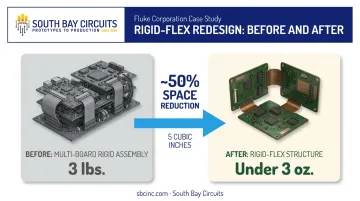
One often-cited data point comes from a PCD&F guide to rigid-flex design covering a Fluke Corporation military infrared-imaging redesign. Switching from multiple interconnected rigid boards to a single rigid-flex structure dropped the assembly's weight from 3 pounds to under 3 ounces. The redesign also cut the payload to 5 cubic inches, roughly a 50% space reduction.
Rigid-flex isn't a one-size-fits-all category, though. Designs vary based on:
- Number of flex layers built into the stackup
- Placement of rigid sections relative to bend zones
- Overall layer-stackup configuration, which shifts depending on application requirements
Where Rigid-Flex Fits
Rigid-flex earns its cost premium in assemblies that fold or bend during installation, or where minimizing interconnects is the priority. Common applications include:
- Avionics and satellite systems
- Implantable and wearable medical devices
- Automotive ADAS modules
- Military communication equipment
NASA's Jet Propulsion Laboratory has even used an origami-inspired rigid-flex approach in its PUFFER exploration robot, combining rigid panels, flexible circuitry, and fabric hinges. It's a good example of how far the "fold it into place" concept can go in harsh, weight-sensitive environments.
Rigid vs. Rigid-Flex: Which Is Better for Your Project?
There's no universal winner here. The right answer depends on five factors you should weigh together, not in isolation:
- Budget: can your program absorb higher upfront fabrication cost for lower total system cost later?
- Mechanical environment: repeated vibration, shock, or thermal cycling changes which construction holds up.
- Space and weight constraints: does the enclosure demand a 3D form factor?
- Production volume: are you building 50 units or 50,000?
- Regulatory and reliability requirements: does your industry demand Class 3 performance under IPC standards?
Choose rigid PCBs when cost-efficiency and high-volume, stable-shape production are the priority. Choose rigid-flex when space savings, weight reduction, and reliability in dynamic or harsh environments matter more than upfront board cost.
There's also a middle ground worth knowing about: multi-board rigid designs connected by flex jumpers. This approach adds partial flexibility for connector-constrained layouts without committing to a full rigid-flex build. It's useful when budget doesn't support a complete rigid-flex investment but a straight cable run won't fit the enclosure either.
Why the Decision Shouldn't Happen in a Vacuum
This is where working with a single-source manufacturer changes the equation. When design, fabrication, and assembly all happen under one roof, engineering teams can flag mechanical risk early, before a rigid design gets locked in and later needs an expensive redesign.
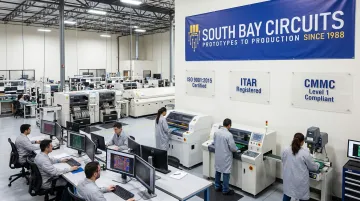
SBC's model, spanning design through final assembly from its 60,000-square-foot Chandler, Arizona facility, is built around exactly this kind of continuity. ISO 9001:2015 certification, ITAR registration, and CMMC Level 1 compliance mean the same accountable team designs your board and builds it. That continuity reduces the handoff errors that creep in when design, fab, and assembly are split across separate vendors.
The takeaway: whether your next board stays rigid or moves to rigid-flex, get your mechanical and reliability requirements in front of an engineering team before finalizing the layout. Talk to SBC's team about evaluating your design's requirements before you commit to a stackup.
Conclusion
Rigid PCBs remain the right call for cost-sensitive, high-volume products with a fixed shape. Rigid-flex earns its premium when space and weight limits, or the need for reliability in harsh, dynamic environments, outweigh the higher fabrication cost.
Either path affects your bottom line: cost control, product durability, time to market, and long-term reliability. South Bay Circuits supports both paths with ISO 9001:2015-certified design, fabrication, and assembly in-house in Chandler, Arizona, from initial design review through final production.
Frequently Asked Questions
What are rigid PCBs?
Rigid PCBs are non-bendable circuit boards built on a hard substrate like FR-4. They're the standard platform used in most electronic devices manufactured today.
What is an example of a rigid PCB?
Common examples include smartphone motherboards, laptop and desktop computer boards, and industrial controller boards — anywhere a fixed, flat form factor works.
What is the difference between rigid and flexible PCBs?
Rigid PCBs use a solid, non-bendable substrate for stability, while flexible PCBs use a bendable polyimide substrate. The choice depends on whether the application needs a fixed shape or dynamic movement.
What is the difference between rigid-flex and flexible PCBs?
Flexible PCBs are entirely bendable throughout. Rigid-flex PCBs combine flexible sections with rigid areas, giving you bend capability plus a stable zone for mounting components.
How do I decide between rigid and rigid-flex PCBs for my project?
The decision comes down to budget, vibration and space constraints, and reliability needs. Review the decision framework above, then confirm your choice with South Bay Circuits' PCB design team before finalizing your design.
Are rigid-flex PCBs more expensive than rigid PCBs?
Yes, rigid-flex typically costs more upfront due to specialized materials and manufacturing steps. However, it can lower total system cost by eliminating connectors and reducing failure points over the product's lifespan.