Many engineering teams still treat it as "just a smaller prototype run." In practice, its real value shows up in how it de-risks decisions, protects working capital, and catches quality problems before they scale into expensive ones.
This article breaks down the practical, day-to-day benefits of low volume PCB assembly — not the textbook definition, but what it actually changes on your production floor and your budget.
TL;DR
- Low volume PCB assembly bridges prototyping and full-scale production, giving teams a controlled proving ground
- Faster design validation, lower financial risk, tighter quality control, and smoother scaling
- Most valuable for OEMs, regulated industries, and products still undergoing design changes
- A partner with in-house fabrication and assembly determines how much of that value you capture
What Is Low Volume PCB Assembly
Low volume PCB assembly is the process of populating a small batch of bare boards with components, using the same core processes as a high-volume production line, just at a smaller scale. Batch sizes vary by manufacturer and board complexity, ranging anywhere from a handful of units to a few thousand.
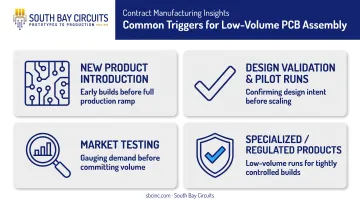
It typically shows up in a few specific scenarios:
- New product introduction (NPI) runs where a design is being validated for the first time
- Design validation and pilot runs ahead of a production commitment
- Market testing before investing in large-scale inventory
- Specialized or regulated products built in limited quantities by design, not by necessity
The goal is to validate design, functionality, and manufacturability before you commit full production capital.
That's also where the choice of manufacturer starts to matter. Single-source manufacturers that handle PCB design, fabrication, and assembly under one roof (South Bay Circuits in Chandler, Arizona, is one example) let a design move from a low-volume run into full production without re-qualifying a new vendor partway through.
The same team, process knowledge, and test data carry forward instead of getting lost in a handoff.
Key Advantages of Low Volume PCB Assembly
The advantages below focus on measurable outcomes: cost, speed, quality, and risk. Each one maps to a KPI your team is probably already tracking, whether that's NPI cycle time, cost per unit, defect rate, or scrap.
Faster Design Validation and Lower Financial Risk
A hand-built prototype tells you a design can work. A low volume run tells you it will work under real manufacturing conditions.
Small batches surface issues that a single prototype simply can't reveal:
- Pad geometry and clearance problems that only appear at scale
- Thermal performance under actual assembly conditions
- Firmware and mechanical fit issues across multiple units, not just one
Catching these problems early carries a clear financial upside. NASA's research on systems-error correction found that the cost of fixing an error escalates sharply the later it's caught.
Normalized correction factors climb from roughly 1X at the requirements stage to 7X–16X once you're building hardware, and 21X–78X during integration and test, according to NASA's error cost escalation study. That research comes from aerospace and defense systems, but the underlying principle holds for PCB programs of any kind: problems get exponentially more expensive the further downstream they travel.
KPIs impacted: NPI cycle time, design revision count, scrap/rework rate, capital committed before validation.
New products, complex multi-component boards, and first-time designs entering an unfamiliar process benefit most. If you've never built this exact board before, a low volume run is where you find out what you don't know, while it's still cheap to fix.
Meaningful Cost Control and Capital Efficiency
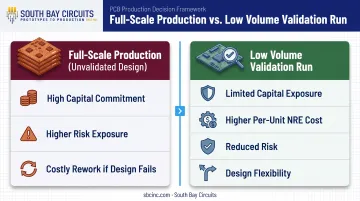
Committing to a full production run on an unvalidated design means locking up capital in components, tooling, and labor before you know the board actually works. Low volume assembly lets you limit that spend until the design earns it.
Many manufacturers structure their NRE fees (stencils, programming, setup) so those costs aren't recharged when a design moves from a low volume run into full production. SBC, for instance, structures tooling, stencil, and test charges so customers typically pay for them once as a program scales rather than repeatedly across each production phase.
Per-unit NRE cost is higher on a low volume run because setup costs get spread across fewer boards. Businesses accept that premium in exchange for flexibility and reduced exposure. It's a deliberate trade, not a hidden cost.
High-mix, low-volume operations also carry real cost drivers of their own. ASSEMBLY Magazine's analysis of HMLV manufacturing notes that greater product variety and faster response times increase material-handling, setup, and test costs — which is exactly why disciplined scheduling and process control matter even at small batch sizes.
KPIs impacted: Cost per unit, total NRE exposure, inventory carrying cost, budget variance.
Unproven demand, limited funding, or a design that may still change make this trade especially useful. You spend where risk is highest (validation) instead of where volume is highest.
Tighter Quality Control and Faster Time-to-Market
Small batches allow a level of scrutiny that simply isn't practical across a 50,000-unit run. AOI, X-ray inspection, ICT, and functional testing can be applied board-by-board rather than through statistical sampling.
That level of inspection matters because when something's wrong, it's wrong on a handful of boards, not thousands. On low volume builds, SBC applies:
- AOI to verify component placement and solder-joint quality
- X-ray inspection for BGA installation and hidden solder joints
- ICT to check shorts, opens, resistance, and capacitance
- Functional testing, partial or 100%, on the finished assembly
Catching defects at this stage protects more than the immediate build. It protects brand reputation and avoids expensive field failures, a concern that's especially acute in regulated sectors. The FDA's design validation guidance, for example, requires manufacturers to validate under actual or simulated use conditions using initial production units before a device design is considered proven, according to FDA design controls guidance.
Speed compounds this advantage. A single-source provider that controls design, fabrication, and assembly under one roof can move from completed layout to assembled boards in as little as 48 hours. Multi-vendor workflows rarely match that pace once queue times and shipping delays stack up.
KPIs impacted: Defect/failure rate, time-to-market, first-pass yield, compliance pass rate.
Safety-critical and regulated applications feel this most, where a post-launch failure can mean recalls, compliance findings, or worse.
What Happens When Low Volume PCB Assembly Is Missing or Ignored
Skip straight from a single hand-built prototype to mass production, and the gaps show up fast, usually on the production floor, where fixes cost the most.
Typical fallout looks like this:
- Inconsistent results when high-speed lines run a design never validated at scale
- Higher defect and rework rates, discovered only after a large capital commitment
- Reactive firefighting on the floor instead of planned validation earlier in the process
- Rising per-unit costs from scrap, redesign, and expedited fixes
- Difficulty scaling confidently, because no one has data to back the next decision
These outcomes show up after capital is already committed—when scrap, redesign, and expedites hit hardest.
How to Get the Most Value from Low Volume PCB Assembly
Low volume assembly pays off when you treat it as a deliberate validation stage rather than a rushed formality on the way to mass production.
A few practices make the difference:
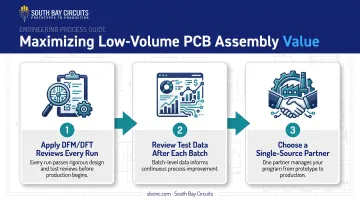
- Apply DFM/DFT reviews on every run, not just the first prototype. Designs change between batches; the review should keep pace.
- Review test data after each batch. AOI, X-ray, and functional results should inform real decisions before you scale, not sit in a report nobody reads.
- Choose a single-source partner. Fabrication, assembly, and testing under one roof cuts handoff delays and version mismatches that appear when a project jumps vendors as it scales.
That last point is where programs often lose the most value. Every vendor handoff means re-explaining requirements, re-validating files, and re-building trust from scratch. A partner that carries a design from prototype through production — like SBC's model in Chandler — keeps that knowledge intact.
Conclusion
The real value of low volume PCB assembly is the control and risk reduction it gives you before you commit to scale.
Cost and quality gains compound when you apply it consistently across every new design, not as a one-off checkbox before "real" production starts.
Partnering with an experienced, certified single-source manufacturer helps carry a validated design smoothly from prototype through full production, without losing the process knowledge that made the design work in the first place.
Frequently Asked Questions
What is the 3W rule in PCB layout?
The 3W rule calls for spacing adjacent signal traces at least three times the trace width apart to reduce crosstalk and maintain signal integrity. It's a design rule of thumb, not a universal requirement. Simulation sometimes shows narrower spacing works fine.
What is the minimum thickness of a PCB?
There's no single universal minimum. Common nominal thickness is 1.6mm, though boards can run thinner or thicker depending on the fabricator's capabilities and the application's mechanical and electrical needs.
How many boards typically qualify as a "low volume" PCB assembly run?
It generally ranges from a handful of units up to a few thousand, depending on the manufacturer and how complex the board is. There's no formal industry-wide cutoff. Your manufacturing partner and project scope usually define the range.
Is low volume PCB assembly more expensive per unit than high volume production?
Yes, per-unit costs are typically higher because NRE and setup costs get spread across fewer boards. That premium buys reduced risk and design flexibility, which usually outweighs the added cost during validation.
Can low volume PCB assembly use the same manufacturer as full-scale production?
Yes, and it's usually the better approach. Using the same single-source manufacturer for both stages keeps processes consistent and removes the delays that come with qualifying a new vendor mid-program.
What industries benefit most from low volume PCB assembly?
Startups, medical device makers, aerospace and defense programs, and automotive suppliers benefit most. These are industries where design validation and regulatory compliance carry real weight before scaling to production.