Introduction
As electronic systems grow more complex, engineers need a reliable way to interconnect dozens of boards and modules without a tangle of cables. That's the job of a backplane PCB. It acts as the electrical spine of a chassis, letting cards plug in and exchange power and signals across the enclosure.
Choose the wrong architecture, or hand the project to a manufacturer without real backplane experience, and problems surface fast: signal integrity issues, costly redesigns, or field failures in systems that cannot afford downtime.
This guide breaks down what backplane PCBs are, how they function, where they show up across industries, and what actually matters in the design process. It draws on more than 40 years of PCB manufacturing experience at South Bay Circuits (SBC), including decades specializing in backplane production since the 1990s.
Key Takeaways
- A backplane PCB interconnects multiple daughter cards through connectors, serving as a system's electrical backbone
- Backplanes come in active (signal-buffering) and passive (routing-only) configurations, suited to different reliability needs
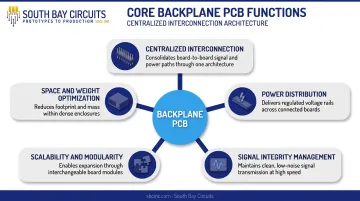
- Centralized interconnection, power distribution, signal integrity, and scalability are the core backplane functions
- Telecom, servers, industrial automation, and aerospace, defense, and medical systems all rely on backplane architectures
- Material selection, stack-up design, and connector choice determine long-term signal integrity and reliability
What is a Backplane PCB? Understanding Its Structure, Types, and Connectors
A backplane PCB is a specialized circuit board fitted with an array of connectors or slots that links multiple plug-in boards, such as CPUs, I/O cards, and memory modules, into a single functioning system. Unlike a standard PCB built to perform one job, a backplane's role is structural: it's the centralized backbone everything else plugs into.
Per PICMG's MicroTCA specification, a backplane supplies the physical and electrical connections among system modules, carrying both high-speed data and power between them (PICMG). That definition holds whether you're looking at a carrier-grade telecom chassis or an industrial PLC rack.
Physically, backplanes are multilayer boards. Copper traces, vias, and dense connector arrays are engineered to move power and high-speed signals cleanly between modules, often using dedicated signal layers alongside separate power and ground planes to keep noise down and current capacity up.
Backplane connectors are the physical interfaces—often DIN 41612-style or similar—where daughter cards mate with the backplane. They're rated for a set number of mating cycles, which matters in equipment that gets reconfigured or serviced often. See the FAQ below for more on connector selection.
Active vs. Passive Backplanes
Backplanes generally fall into two categories:
- Passive backplanes carry no onboard driving or arbitration circuitry. All the logic lives on the plugged-in boards, keeping the backplane simple and reducing the number of parts that can fail.
- Active backplanes include buffering or driving chips that manage signal loads across more slots, supporting higher-complexity systems at the cost of added power and thermal design work.
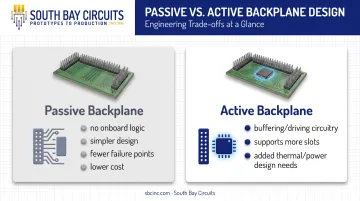
Choose passive when slot count and signal demand stay modest. Choose active when you need signal conditioning, redundant power distribution, or hot-swap monitoring across a larger card set.
Backplane vs. Midplane Configurations
A midplane is essentially a backplane with connectors on both sides. Blade servers and telecom chassis use this arrangement to separate processing cards on one face from I/O or power modules on the other, letting technicians service one side without disturbing the other. It's a small structural change with a real impact on serviceability.
Key Functions of Backplane PCBs in Electronic Systems
A backplane earns its place in a design by doing several jobs at once.
Centralized Interconnection Instead of running dozens of point-to-point cables between boards, a backplane consolidates that wiring into a single, connector-based structure. Fewer cable runs mean fewer solder joints and fewer places for vibration or thermal cycling to trigger a failure.
NASA's connector-pin failure analysis identified fatigue cracking from vibration as the primary failure mechanism in a tested batch. Every physical connection point is a potential weak spot worth eliminating.
Power Distribution Backplanes distribute power to every board in the chassis while keeping voltage drop in check. That control matters in dense equipment where multiple cards draw current at once. Standards like VITA 62 even set limits on inrush current, because an unmanaged startup surge can pull output rails below what a module needs to boot cleanly.
Signal Integrity Management High-speed buses running across a backplane need controlled impedance and shielding to avoid crosstalk and EMI. The Optical Internetworking Forum tested 25.78125 Gb/s lanes across a 90-ohm differential reference backplane, measuring insertion loss and crosstalk to validate design margins at that speed (OIF).
Scalability and Modularity Need to add another I/O card or processing module later? A backplane with open slots makes that possible without redesigning the whole system. It's why blade servers and industrial control racks can grow in capacity over time just by adding cards to existing slots.
Space and Weight Optimization Consolidating dozens of interconnections onto a single board cuts bulk and weight considerably. That's a real advantage in aerospace and telecom equipment, where every cubic inch and every gram counts against a tight design budget.
Applications of Backplane PCBs Across Industries
Telecom and Networking
Backplanes form the backbone of routers, switches, and network chassis handling heavy data traffic. Base and fabric interfaces on carrier-grade backplanes support Ethernet and other high-speed protocols in star or mesh topologies, letting network equipment scale without a full chassis redesign.
Servers and Data Storage
Blade servers and hot-swappable disk arrays use backplanes to connect drives and blades directly, without cabling. IBM's BladeCenter architecture, for example, uses a midplane to support hot-swapping across 14 blade bays, so a technician can pull and replace a blade without powering down the rack.
Industrial Automation and PLCs
In programmable logic controllers, the backplane assembly is the rack-mounted board connecting the CPU module to I/O and communication modules.
Rockwell Automation's ControlLogix chassis documentation notes that its backplane provides the high-speed path between modules and that any module can sit in any slot (Rockwell Automation). That slot flexibility lets plant engineers swap or add modules without rewiring the rack.
Aerospace, Defense, and Medical Systems
These sectors demand the highest reliability of any application. A backplane failure in a flight control system or a medical imaging device creates a direct safety risk.
Manufacturing credentials matter as much as the design itself. SBC's AS 9100 aerospace and ISO 13485 medical compliance reflect the quality systems needed to build backplanes for these regulated environments, backed by decades of hands-on backplane assembly work.
Critical Design Considerations for Reliable Backplane PCBs
Reliable backplanes hinge on three design choices that drive signal integrity and service life: materials, stack-up, and connectors.
Material Selection
High-speed backplane signals need laminates with stable dielectric properties across frequency and temperature swings. SBC selects laminates for the frequency range, thermal cycling, and dielectric stability each application requires, including:
- High-temperature FR4
- Rogers 3000 and 4000 series
- Nelco N4000 series
Layer Stack-Up and Impedance Control
Multi-Gbps data lanes are common on modern backplanes, and impedance control is not optional at those speeds. Define the exact laminate, prepreg, and copper weight at every point in the stack-up so the fabricator can calculate impedance accurately. Loose tolerances here translate directly into signal integrity problems later.
SBC supports controlled-impedance builds on boards up to 22 layers, including:
- Edge-coupled stripline and coplanar waveguide structures
- Single-ended and differential configurations
Connector Selection and Placement
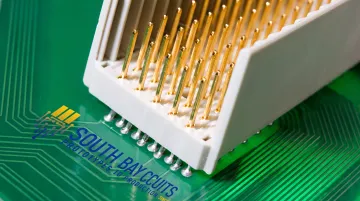
Connector durability, measured in mating cycles, and precise placement both affect how long a backplane holds up in frequently serviced equipment. Press-fit connectors, SBC's specialty for more than 25 years, offer a reliable, solder-free mechanical and electrical connection built to withstand repeated card insertions and removals.
Partnering with SBC for Backplane PCB Design and Manufacturing
South Bay Circuits added back panels to its product line in the 1990s, well before backplane technology became mainstream in commercial electronics. More than 25 years later, that specialization still shapes every backplane project. The team brings deep, hands-on press-fit and soldered-assembly experience built over decades of dedicated backplane work.
What sets SBC apart on backplane work specifically:
- Single-source production: Design, fabrication, and assembly under one roof at SBC's 60,000+ sq. ft. Chandler, Arizona facility, cutting queue time and handoff delays
- Press-fit tooling and tight-tolerance control: Dedicated press-fit tools plus in-house bare-board fabrication and assembly for consistent quality across both processes
- Regulated-industry certifications: ISO 9001:2015, AS9100 for aerospace, ISO 13485 for medical devices, and ITAR registration for defense programs
For teams building backplanes for aerospace, defense, or medical equipment, that certification stack is what gets a supplier through an audit. Combined with decades of backplane-specific manufacturing experience, SBC works as an engineering partner on projects that demand zero-defect reliability.
Frequently Asked Questions
What is a backplane assembly and what is its purpose?
A backplane assembly is a populated backplane PCB, complete with connectors and components, ready to interconnect multiple plug-in boards. Its purpose is to centrally connect and power those boards without individual point-to-point cabling.
How does a backplane assembly differ from a motherboard?
A motherboard has onboard processing and memory components built into the board itself. A backplane has none of that; it relies entirely on plug-in cards for functionality and simply provides the interconnection path.
What is a backplane assembly in a PLC?
In a programmable logic controller, the backplane assembly is the rack-mounted board that connects the CPU module to I/O and communication modules. It's the high-speed communication path that lets modules in different slots talk to each other.
What is a backplane connector in a backplane assembly?
A backplane connector is the durable, high-mating-cycle interface, often DIN-style or press-fit, that physically and electrically links a daughter card to the backplane. Its durability rating matters most in equipment that gets serviced or reconfigured frequently.
What's the difference between a backplane and a midplane?
A midplane accepts connectors on both sides, so front-facing processing cards and rear I/O or power modules mate through the same center board. A standard backplane, by contrast, connects boards on one side only.
How do I choose the right manufacturer for a backplane PCB project?
Look for demonstrated backplane manufacturing experience, in-house capability spanning fabrication through assembly, and certifications relevant to your industry, such as AS9100 or ISO 13485. These factors reduce risk far more than price alone.