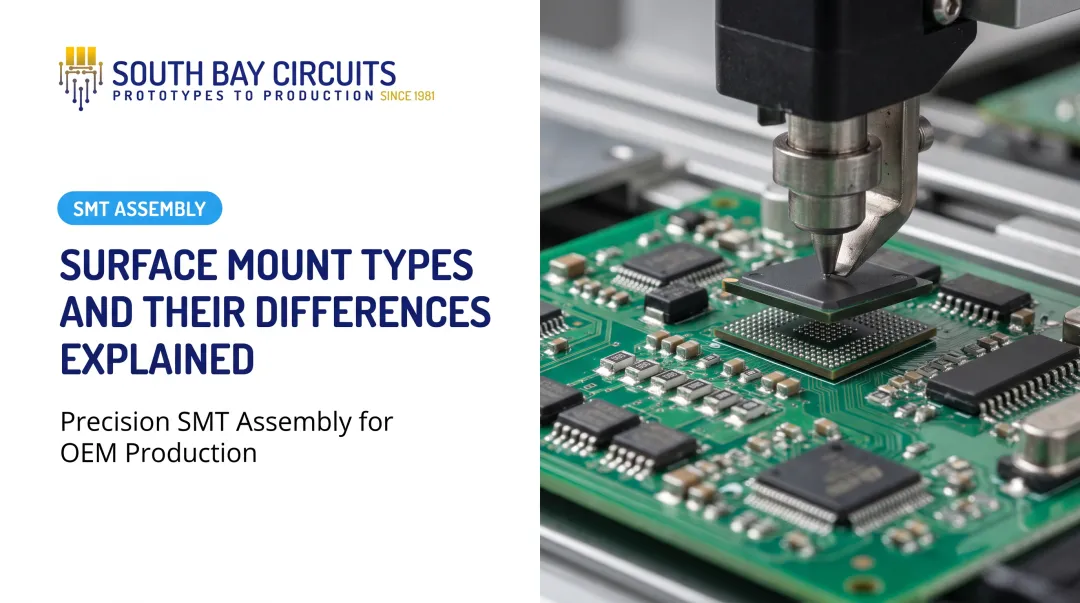
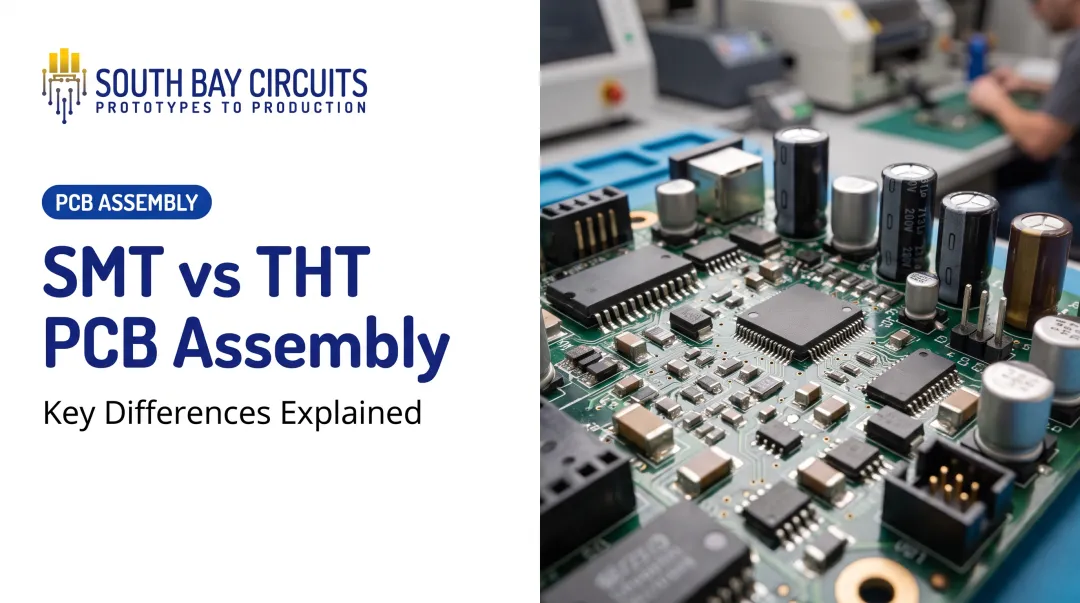
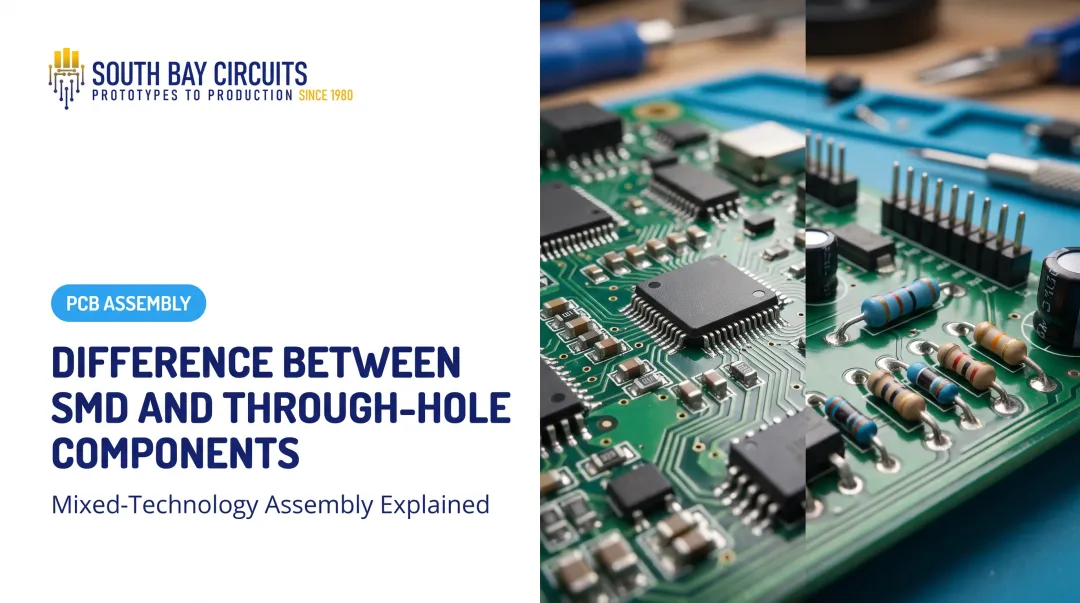
That confusion isn't just semantic. For engineers finalizing a design, or procurement teams vetting a PCB assembly partner, mixing up SMT and SMD can lead to unclear specs and mismatched sourcing conversations.
This guide breaks down what each term actually means, how they relate, and why the real question isn't "SMT vs SMD." It's how well your manufacturing partner handles both.
Key Takeaways
- SMD is the component; SMT is the process that mounts and solders it on a PCB
- SMT replaced through-hole technology (THT) for faster builds and smaller board designs
- SMD and SMT work as one ecosystem, not as competing options
- A certified assembly partner matters more than debating the labels
SMT vs SMD: Quick Comparison
SMT is the assembly process; SMD is the component. Use the table below to separate method from part before you weigh design or production tradeoffs.
| Category | SMT | SMD |
|---|---|---|
| Definition | Automated manufacturing process for mounting components onto a PCB surface | Physical component built for surface mounting (no drilled leads) |
| Role in PCB Assembly | The method: solder paste, placement, reflow, inspection | The material: resistors, capacitors, ICs placed during that method |
| Examples/Forms | Pick-and-place machines, reflow ovens, AOI systems | 0402 resistors, QFN packages, BGA chips, SOT diodes |
| Cost & Efficiency Driver | Reduces labor time and increases throughput via automation | Reduces board space and weight (per-unit cost can run higher) |
What is SMT (Surface Mount Technology)?
SMT is the manufacturing process used to mount electronic components directly onto the surface of a PCB. It replaced the older method of inserting leaded components through drilled holes, a slower, more manual approach that limited how densely a board could be populated.
The shift to SMT made automation practical at production scale. Manufacturers could run faster cycle times, cut labor costs, pack more components into less space, and improve signal performance at higher frequencies. Shorter lead lengths on surface-mount parts reduce parasitic inductance, which is critical for high-speed digital and RF designs.
The Core SMT Process
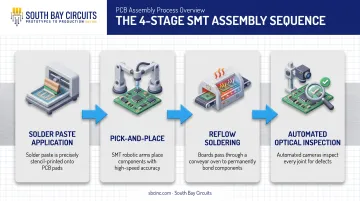
Every SMT line follows roughly the same sequence, regardless of scale:
- Solder paste application – Paste is screen-printed onto the board's pads
- Pick-and-place – Automated machines position each SMD onto its designated pad
- Reflow soldering – The board passes through a reflow oven, melting the paste to form permanent joints
- Automated Optical Inspection (AOI) – Cameras scan for placement errors, solder bridges, or missing components
Setups vary by production stage. Prototype and low-volume runs sometimes use simpler, semi-manual placement, while high-volume production relies on fully automated lines running continuously with minimal operator intervention.
Use Cases of SMT
SMT sits at the assembly stage of the PCB lifecycle. It happens after bare board fabrication and before final testing. It's the step where a blank board becomes a functioning circuit.
Industries that rely heavily on SMT include:
- Consumer electronics – smartphones, tablets, wearables
- Medical devices – diagnostic and monitoring equipment requiring compact, reliable boards
- Automotive – control units and sensor modules
- Aerospace and defense – high-density assemblies where every cubic inch counts
According to Grand View Research's 2026 report on the PCBA market, SMT represented more than 72.7% of the printed circuit board assembly market in 2025, underscoring how fully the industry has standardized on surface-mount assembly.
What is SMD (Surface Mount Device)?
If SMT is the process, SMDs are the components that process places. Surface Mount Devices are parts (resistors, capacitors, ICs, diodes, transistors) engineered with small leads or flat pads instead of long wire leads that require drilled holes.
That design choice pays off in three ways:
- Space savings on the board layout
- Lighter finished products, since there's no need for bulky leads or hardware
- Better thermal and high-frequency performance, thanks to shorter electrical paths
Common SMD Subtypes
SMDs generally fall into three buckets:
- Passive components – resistors, capacitors, inductors
- Discrete components – diodes, transistors, LEDs
- Complex packages – ICs, QFN, BGA chips with dozens or hundreds of connection points
Package Sizing and Density
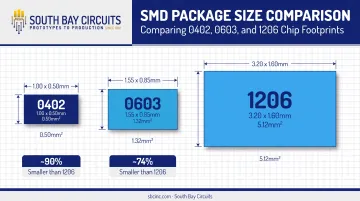
SMD package sizes follow standardized codes like 0402, 0603, and 1206 (dimensions in hundredths of an inch). The smaller the code, the tighter the footprint, and the more parts you can fit on a board.
Typical body sizes look like this:
| Package | Body Dimensions (L x W) | Body Area |
|---|---|---|
| 0402 | 1.00 x 0.50 mm | 0.50 mm² |
| 0603 | 1.55 x 0.85 mm | 1.32 mm² |
| 1206 | 3.20 x 1.60 mm | 5.12 mm² |
Compared to a 1206 package, a 0402 resistor takes up roughly 90% less body area, while a 0603 saves about 74%. Those numbers explain why dense, compact designs favor smaller package codes. Routing, spacing, and thermal needs still set the practical limit.
Use Cases of SMD
SMDs are the building blocks placed during the SMT assembly stage. You'll find them densely packed inside:
- Smartphones and wearables
- Medical instrumentation
- Automotive control units
- Industrial sensors and controllers
Miniaturization trends push this further every few years. An IPC APEX paper on microchip mounting found that switching from a 0402M microchip to the smaller 03015M device cut PCB area by about 50% and weight by 58%.
That comparison is SMD-to-smaller-SMD, not against through-hole parts. It still shows how much room manufacturers have to shrink board footprints within surface-mount technology itself.
SMT and SMD: How They Work Together (Not Against Each Other)
Here's where the terminology confusion actually causes problems. SMT and SMD aren't two options you choose between. One is the method; the other is the components used within that method. Asking "should we use SMT or SMD?" is a bit like asking whether to use a printer or paper. You need both, and they only work because of each other.
When someone asks whether SMT and SMD are the same thing, the honest answer is: related, but distinct. SMD components can't get onto a board without an SMT process. And an SMT line has nothing to place without SMD components. They're inseparable in modern assembly.
Where Through-Hole Still Fits
Mixed-technology boards are common, and for good reason. SMT and SMD handle compact, high-volume designs well, but through-hole technology (THT) still earns its place for:
- Large transformers
- Heat-sinked power semiconductors
- Connectors needing extra mechanical strength
South Bay Circuits, for instance, routinely combines SMT/SMD placement with through-hole soldering on the same board when a design calls for both dense circuitry and mechanically robust components.
Process Control Makes the Difference
This is the part buyers often overlook: the quality of the SMT process directly determines how well SMD components perform once soldered. A 2007 IPC technical paper on Flextronics' inspection data makes this concrete. After the manufacturer optimized AOI and AXI inspection coverage and corrected a reflow-profile issue, one assembly's defect rate dropped from 38 defective joints on 1,581 boards to just 1 defective joint on 651 boards.
Test times across five assemblies also fell to roughly 55% of previous levels.
That's the payoff of tight process control. It is not a guarantee for every factory, but a clear demonstration of what disciplined inspection and feedback loops can do.
South Bay Circuits' Chandler, Arizona facility runs on this same principle. Its two in-house Fuji SMT lines (added in 2004 and 2007) support SMT placement down to 0201 components and fine-pitch work down to 0.4mm, with AOI, X-ray, and functional testing built into the workflow.
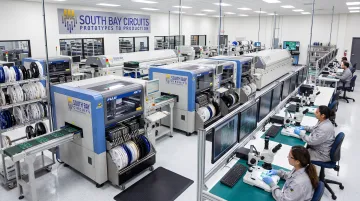
Because design, fabrication, and assembly happen under one roof, customers typically see NPI time drop by 43%, or about 10 days, compared to working across separate vendors.
The real decision for buyers isn't "SMT or SMD." It's whether your manufacturing partner controls both the process and the components well enough to deliver consistent results. If you're evaluating assembly partners for an upcoming build, request a quote from South Bay Circuits to see how single-source design-to-assembly can tighten your timeline.
Conclusion
SMT and SMD are complementary parts of the same manufacturing system, not competing ideas. Understanding the difference helps you ask sharper questions when evaluating a manufacturing partner: not just "do you use SMD parts?" but "how tightly do you control the SMT process that places them?"
That distinction shows up in production speed, board reliability, and cost efficiency down the line. Partnering with a contract manufacturer that holds certifications like ISO 9001:2015, runs in-house Fuji SMT lines, and has decades of hands-on experience means both the process and the components get handled correctly, from first prototype to full production.
Frequently Asked Questions
Are SMT and SMD the same?
No. SMT is the automated assembly process; SMD is the physical component placed during that process. They're closely related but describe different things.
What is the purpose of SMD?
SMDs enable compact, high-density PCB designs by eliminating drilled leads. They support automated placement, reduce board size, and improve thermal and high-frequency performance.
Can SMT and THT be combined on the same PCB?
Yes, mixed-technology assembly is common. Boards often use SMT/SMD for compact circuitry while keeping through-hole connectors or transformers for mechanical strength.
Is SMD assembly more expensive than through-hole assembly?
Not universally. Individual SMD components can cost more than through-hole equivalents, but SMT automation typically lowers labor and assembly time, cutting overall production costs.
Which came first, SMT/SMD or through-hole technology?
Through-hole technology came first, patented in 1961. SMT gained momentum in Japan during the 1980s and became widely adopted worldwide by the mid-1990s.
What industries rely most on SMT and SMD technology?
Consumer electronics, automotive, medical, aerospace/defense, and industrial sectors are the heaviest users, driven by demand for compact, reliable, high-density circuit boards.