Here's the challenge: there's no single "standard" price for PCB assembly. Cost depends on board complexity, order volume, how components are sourced, and how fast you need the finished product.
Many engineering and procurement teams struggle with this uncertainty. Quotes come back wildly different from vendor to vendor, and it's hard to know which number reflects reality. This guide breaks down pricing ranges, the cost components hiding inside every quote, the factors that push prices up or down, and how to budget a project without getting blindsided.
Key Takeaways
- High-volume SMT boards cost a few dollars per unit; low-volume prototypes cost hundreds.
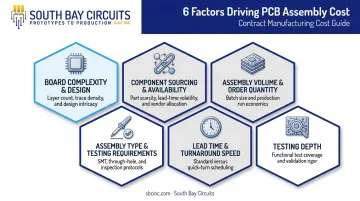
- Six factors drive assembly cost: complexity, sourcing, volume, assembly type, testing depth, and lead time.
- Rush and low-volume runs cost more per unit; high-volume, standard-lead-time runs cost less.
- A single-source manufacturer cuts hidden costs from vendor handoffs and delays.
How Much Does PCB Assembly Cost? (Pricing Overview)
PCB assembly quotes are built from scratch for each project. The bill of materials, board specifications, order quantity, and testing requirements all factor into the final number. There's no catalog price to point to.
At South Bay Circuits, every quote starts the same way: we review your BOM, board specs, and volume before pricing a single board.
Common budgeting mistakes worth avoiding:
- Underbudgeting for prototype and NRE (Non-Recurring Engineering) costs, then getting surprised by the first invoice
- Choosing offshore sourcing purely on unit price without factoring in lead time or quality risk
- Overlooking testing and setup fees until they show up as line items at the end
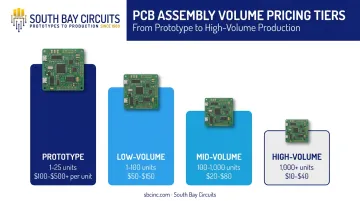
Based on 2025 manufacturer benchmarks, here's what assembly-only pricing typically looks like (excluding bare-board fabrication and component costs):
| Volume Tier | Quantity | Typical Per-Unit Cost |
|---|---|---|
| Prototype | 1-25 units | $100-$500+ |
| Low-volume | 10-100 units | $50-$150 |
| Mid-volume | 100-1,000 units | $20-$80 |
| High-volume | 1,000+ units | $10-$40 |
These figures come from a 2025 assembly cost benchmark report and generally include component placement and standard testing. They exclude PCB fabrication, premium or hard-to-source components, and custom tooling, which get added separately.
Prototype / Low-Volume Assembly
This tier typically includes setup and stencil fees, engineering review of the design, small-batch component placement, and first-article inspection. It's the right fit for new product development, design validation, and pre-production testing runs where you need to catch problems before committing to full production.
Mid-Volume / Standard Production
Once a design clears validation, costs shift. Programming gets optimized, standard AOI and functional testing become routine, and per-unit pricing drops as setup costs spread across more boards. This tier suits designs moving into steady, repeatable production.
High-Volume Production
At scale, manufacturers dedicate line time to your product, buy components in bulk, and hit the lowest achievable per-unit cost. This is where mature, stable-demand products belong. Cost efficiency becomes the priority once the design is locked and demand is predictable.
Key Factors That Affect the Cost of PCB Assembly
Pricing depends on technical design choices, sourcing strategy, and production scale — not just how big the board is.
Board Complexity & Design
Layer count, board dimensions, and high pin-count components like BGAs, QFNs, and fine-pitch parts down to 0.4mm all increase placement time, tooling needs, and inspection requirements. Mixed-technology boards combining SMT and through-hole components need additional processes and equipment changeovers, which raises labor cost further.
Component Sourcing & Availability
Turnkey sourcing, where the manufacturer procures all components, versus consignment, where the customer supplies parts, changes both total cost and lead time. Turnkey usually moves faster because procurement and fabrication happen in parallel, while consignment shifts sourcing risk to the customer.
Supply chain disruption still matters here. IPC's December 2025 survey found that 56% of electronics manufacturers reported rising material costs, with 46% reporting rising labor costs too. That's a strong argument for building sourcing contingency into any quote rather than treating it as fixed.
Assembly Volume & Order Quantity
Low-volume, high-mix runs carry higher per-unit costs because setup and programming expenses get spread across fewer boards. Economies of scale kick in fast at higher volumes. Doubling your order rarely doubles your total cost.
Assembly Type & Testing Requirements
SMT-only assembly costs less than mixed-technology work, which costs less than specialized processes like BGA rework, conformal coating, or full box build. Testing depth matters just as much:
- AOI (Automated Optical Inspection): Catches visible placement and solder defects
- ICT (In-Circuit Testing): Verifies electrical assembly faults, usually requiring a dedicated fixture
- Functional testing: Confirms the board actually performs as designed, adding roughly $10-$50 per board
Regulated industries like medical, aerospace, and automotive typically need deeper testing coverage. Match your testing requirements to the actual end-use risk rather than defaulting to the maximum every time.
Lead Time & Turnaround Speed
Rush or quick-turn orders require premium scheduling and expedited component sourcing, which often drives costs well above standard lead times. Manufacturers with fast in-house capabilities can soften that premium considerably.
SBC, for example, runs 24-hour PCB fabrication and same-day assembly under one roof in its Chandler, Arizona facility. That single-source setup eliminates the queue time and shipping delays that typically stack up between separate design, fabrication, and assembly vendors.
Cost Breakdown of PCB Assembly
Total project cost covers more than just populating a bare board. It includes one-time setup expenses and ongoing recurring costs that show up on every run.
| Cost Category | One-Time or Recurring | What It Covers |
|---|---|---|
| NRE / Setup costs | One-time | Stencils, programming, engineering review, first-article inspection |
| Per-unit assembly & component costs | Recurring | Labor, materials, and placement cost per board, scaling with complexity and volume |
| Testing, inspection & packaging | Recurring/Periodic | AOI, ICT, or functional test fees, conformal coating, box build, shipping prep |
Amortize NRE over your expected production volume — don't treat it as part of the per-unit price. Request quotes that separate these three categories; bundled numbers make it hard to compare vendors apples-to-apples.
Low-Cost vs High-Cost PCB Assembly — What's the Difference?
Low-Cost vs High-Cost PCB Assembly : What's the Difference?
Budget offshore assembly and premium domestic, single-source assembly solve different problems. Here's how they typically compare:
| Factor | Lower-Cost Assembly | Higher-Cost Assembly |
|---|---|---|
| Quality & Reliability | Higher risk of inconsistent QC, limited traceability | Tighter quality control backed by certifications like ISO 9001, AS9100, and ISO 13485 |
| Turnaround & Communication | Longer lead times, time-zone and communication gaps | Faster iteration, direct engineering oversight with a domestic single-source partner |
| Long-Term Value | Hidden costs from rework, rejects, or missed deadlines | Higher upfront cost offset by fewer defects and single-source accountability |
Geography alone doesn't guarantee quality, but domestic single-source manufacturers like SBC do build in structural advantages. With PCB design, layout, fabrication, and assembly happening under one roof at SBC's Chandler facility, there's no handoff between separate organizations and no shipping delay between process steps.
That matters most when something goes wrong. In a fragmented offshore arrangement, the design house blames the fabricator, the fabricator blames the assembler, and you're left mediating disputes across time zones. A single-source model puts one team on the hook for the entire process.
How to Estimate the Right Budget for PCB Assembly
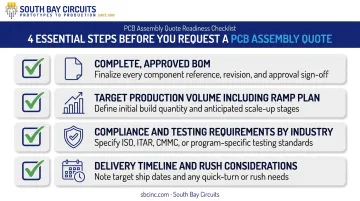
Fit-for-purpose sourcing beats chasing the lowest quote every time. Before requesting quotes, define:
- A complete, approved BOM — incomplete bills of materials are the number one cause of quote revisions
- Target production volume, including expected ramp from prototype to full production
- Compliance and testing requirements specific to your industry: medical, aerospace, and automotive each carry different documentation needs
- Delivery timeline, including whether any portion of the run needs rush turnaround
Budgeting mistakes to avoid:
- Underestimating NRE and prototype costs relative to production pricing
- Ignoring rush-order premiums until they hit the final invoice
- Over-specifying testing beyond what the application actually requires
- Selecting the lowest bidder without verifying certifications or quality history
Request an itemized quote that separates NRE, per-unit assembly, and testing costs clearly. A certified single-source manufacturer, such as SBC with its ISO 9001:2015, ITAR, and AS9100 credentials, can offer transparent, all-in pricing covering fabrication through assembly rather than piecing together quotes from multiple vendors.
Conclusion
PCB assembly cost swings widely based on complexity, volume, sourcing method, and turnaround speed. Understanding each cost component, from NRE to per-unit pricing to testing fees, leads to more accurate budgets and fewer surprise expenses down the line.
The "right" cost rarely matches the lowest quote on the table. It's the number that balances quality, reliability, and total program value. Working with a single-source partner that controls design through assembly, like SBC, simplifies that balance by keeping accountability in one place instead of scattered across vendors.
Frequently Asked Questions
What are assembly costs?
Assembly costs cover the labor, equipment, materials, and testing required to populate and finish a bare PCB into a functional board. They scale with board complexity, component count, and volume.
How much does PC assembly cost?
This usually refers to PCB assembly, and per-unit costs range from a few dollars for high-volume, simple boards to hundreds of dollars for complex, low-volume, or prototype builds. Volume and complexity are the biggest drivers.
What is included in a PCB assembly quote?
A typical quote covers components, labor, setup/NRE fees, and testing charges. Exact inclusions vary by manufacturer, so confirm what's bundled versus billed separately.
What's the difference between PCB fabrication cost and PCB assembly cost?
Fabrication cost covers manufacturing the bare, unpopulated board. Assembly cost covers placing and soldering components onto that board. They're separate line items unless you're working with a turnkey quote that combines both.
How can I reduce my PCB assembly costs without sacrificing quality?
Standardize components where possible and right-size your testing to match actual risk instead of defaulting to maximum coverage. Working with a single-source manufacturer also avoids vendor handoff costs and delays.
What is NRE (Non-Recurring Engineering) cost in PCB assembly?
NRE covers one-time setup costs like stencils, programming, and engineering review incurred before production begins. It's amortized over your expected production volume rather than charged per unit indefinitely.