This single choice affects your cash flow, your quality control, your lead times, and your final production cost. Yet many buyers sign contracts without fully weighing the trade-offs of consigned versus turnkey sourcing.
This guide breaks down the real advantages and disadvantages of the consigned parts model. We'll compare it against turnkey and hybrid approaches, and help you figure out which one actually fits your business.
Key Takeaways
- Consigned parts give direct control over sourcing and pricing, but shift procurement risk to you
- Cash flow gets locked in components before they generate any revenue
- Counterfeit and quality liability stays with the customer, not the assembler
- Regulated industries often need traceability that turnkey or hybrid models handle better
- A hybrid model combining consigned and turnkey sourcing is often the most practical choice
What Does "Consigned" Mean in Assembly?
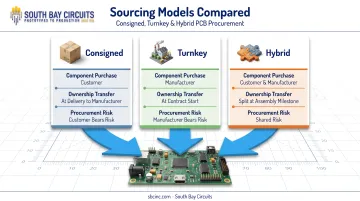
In a consigned parts arrangement, the customer purchases and owns the components. Those parts get shipped to the assembly partner for use in production, but ownership stays with the customer until the part is actually installed on the board.
This differs sharply from the other two common models:
- Turnkey: The manufacturer procures and owns every component until it's invoiced to the customer as part of a finished assembly
- Hybrid: The customer consigns select parts (usually critical or long-lead items) while the manufacturer sources everything else
A Real-World Example
Picture an OEM with an established distributor relationship. That company purchases a batch of specialized ICs and connectors directly, then ships them to its contract manufacturer along with a bill of materials and work order.
Ownership doesn't transfer until those exact parts get consumed on the assembly line.
At South Bay Circuits, that BOM usually arrives in Excel and should include:
- Unique component designators
- Manufacturer part numbers
- Quantities per assembly
- Special designations such as Do Not Install (DNI), consigned parts, or Approved Vendor List (AVL) requirements
That file feeds an MRP system that tracks inventory, work orders, and traceability for both turnkey and consigned builds.
Advantages of Consigned Parts in Assembly
For the right company, consigning your own components is a strategic advantage.
Direct Sourcing Control
You specify exact manufacturers, lot codes, or component grades. This matters most in aerospace, defense, and medical applications, where regulatory or qualification requirements demand precise traceability that a generic BOM sourcing process might not guarantee.
Cost Transparency and Purchasing Power
Companies with established distributor relationships often negotiate pricing and credit terms that beat what a contract manufacturer would charge. Beyond savings, consigned sourcing gives you itemized component pricing instead of a bundled per-board price.
That transparency matters when you need to:
- Justify spend internally to finance or leadership
- Audit exactly where budget went on a given program
- Negotiate better terms on future contracts using real cost data
Inventory Utilization and Ownership Retention
- Use leftover components from a prior build in a new run instead of leaving them as dead inventory
- Keep legal ownership of ITAR-controlled, proprietary, or chain-of-custody-sensitive parts rather than transferring title to the assembler
Disadvantages of Consigned Parts in Assembly
The trade-offs are real, and they're often underestimated until a program is already underway.
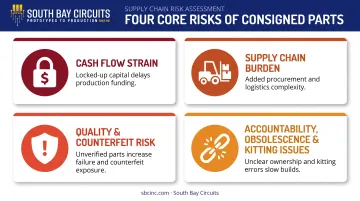
Cash Flow Strain
Capital gets locked into components weeks or months before they become finished, sellable products. Inventory pressure across the supply chain isn't slowing down either.
According to IPC's June 2025 industry sentiment survey, the Customer Inventory Index sat at 106, with supplier inventory levels rising at half of surveyed APAC manufacturers. That's capital sitting on shelves instead of moving through your business.
Supply Chain Burden Shifts to You
When you consign, you inherit the procurement headache:
- Tracking lead times and MOQs across multiple suppliers
- Managing delivery schedules to avoid missed production windows
- Absorbing the internal staff time most lean teams haven't budgeted
Quality and Counterfeit Risk
Unless every component comes from an authorized distributor, you're exposed to counterfeit or out-of-spec parts. And that liability lands on you, not the assembler.
This isn't a hypothetical concern. ERAI's 2024 annual report recorded 1,055 suspect counterfeit and nonconforming parts reported that year, the highest total since 2015. Analog ICs, microprocessors, and memory ICs topped the list of flagged component types.
Accountability, Obsolescence, and Kitting Risks
A few additional risks compound the picture:
- Accountability gaps: when a board fails, pinning the cause on a defective consigned part versus an assembly process issue can spark warranty disputes
- Excess and obsolete inventory: buffer stock purchased for yield can turn into dead stock if a design changes or demand doesn't materialize
- Kitting delays: missing, mismatched, or late-arriving consigned parts can stall the assembler's entire production schedule
Consigned vs. Turnkey vs. Hybrid: Choosing the Right Model
The right model depends on your team, your industry, and your market conditions.
Company Size and Internal Capability
Startups and lean teams without dedicated procurement staff typically do better with turnkey sourcing. Larger OEMs with established purchasing departments can manage the added complexity of consigned inventory effectively.
Regulated Industries
Medical devices, aerospace, and automotive programs often require strict traceability. Turnkey manufacturers typically handle this by default through their certifications and authorized-distributor networks.
In defense work specifically, DFARS 252.246-7008 requires covered contractors to source electronic parts from original manufacturers, authorized aftermarket manufacturers, or their authorized suppliers. When that chain can't be established, the contractor still carries the burden of risk-based traceability.
Volume, Complexity, and Market Conditions
A few more factors that tip the scale:
- High BOM complexity drives coordination overhead up fast under consignment when you have dozens of unique part numbers
- Component shortages favor a contract manufacturer's broader supplier network over a single company competing for limited allocation
- Long-lead or IP-sensitive parts remain strong consignment candidates even inside an otherwise turnkey program
The Hybrid Middle Ground
Many companies consign only the critical, long-lead, or IP-sensitive components while letting the assembler source standard passives and connectors. This combines control where it matters most with the convenience of turnkey sourcing everywhere else.
Before deciding, ask:
- What's the true internal cost of procurement, including staff time and storage?
- How does the partner handle obsolescence and excess inventory?
- What quality and traceability standards actually apply to your industry?
- How much inventory risk can your company tolerate?
Best Practices When Using Consigned Components
If you're going the consigned route, a few practices reduce the risk considerably.
- Draft a clear consignment agreement upfront. Cover ownership terms, loss or damage responsibility, replenishment timelines, and unused inventory handling. Verbal deals create disputes later.
- Keep inventory visibility current. Send BOM revisions to your assembly partner immediately. A late part substitution can cause a line-down delay that costs more than the component itself.
- Follow packaging and handling protocols. Handle moisture-sensitive devices per J-STD-033 and ESD-sensitive parts per ANSI/ESD S20.20, with grounding and protective packaging in transit. Skipping these steps often fails receiving inspection.
How SBC Supports Both Consigned and Turnkey Assembly Needs
South Bay Circuits offers flexible sourcing arrangements that match your BOM and internal capabilities:
- Full turnkey procurement through authorized distributors with complete component traceability
- Consigned inventory management, with controls designed to track customer-owned components through an integrated MRP system
- Hybrid models that let you consign critical parts while SBC sources the rest
Every BOM line submitted to SBC gets its own internal part number tied to the manufacturer, manufacturer part number, package size, and stock quantity, whether the part is consigned or SBC-sourced. That structure keeps consigned and turnkey materials visible in the same system rather than scattered across disconnected spreadsheets.
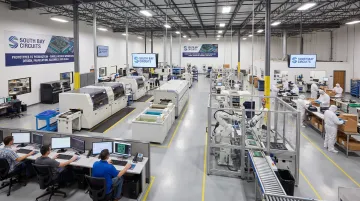
SBC's single-source, in-house model strengthens both approaches. Design, fabrication, assembly, and box build all happen under one roof in Chandler, Arizona. That eliminates the inter-vendor handoffs and shipping delays that typically create the accountability gaps buyers worry about with consigned parts. There's no separate vendor to point to when something goes wrong.
SBC's certifications, including ISO 9001:2015, AS9100 for aerospace, ISO 13485 for medical, and ISO/TS 16949 for automotive, support the rigorous quality control regulated programs need, regardless of which sourcing model you choose.
Frequently Asked Questions
What does "consigned" mean?
Consigned components are parts owned by the customer and supplied to the assembler for production. Ownership only transfers to the assembler once the part is actually used in the build.
Can you give me an example of consignment inventory?
A customer purchases specialized ICs directly from a distributor, then ships them to its contract manufacturer with a BOM and work order. The customer retains ownership until those parts are placed on the board.
What's the difference between consigned and turnkey PCB assembly?
Consigned means the customer sources and owns the parts before shipping them to the assembler. Turnkey means the manufacturer procures every component based on the customer's BOM.
Who is responsible for component quality in a consigned parts arrangement?
The assembler inspects and handles the parts provided, but ultimate responsibility for component authenticity and quality rests with the customer who sourced and consigned the parts.
Is consigned or turnkey better for a startup?
Turnkey is generally the better fit for startups. Limited working capital and a lack of in-house procurement expertise make managing multiple suppliers directly a real strain.
Can I use a hybrid model combining consigned and turnkey sourcing?
Yes, hybrid models are common. Customers consign critical or long-lead-time parts while letting the manufacturer source standard passives, connectors, and other readily available components.