Introduction
Getting a PCB assembled is one thing. Turning that board into a shippable, deployable product is another challenge entirely.
For OEMs and product developers, the gap between a completed PCBA and a finished unit is where schedules slip and quality risks multiply. Multiple vendors, disconnected handoffs, mismatched documentation, and timeline pressure all converge at this stage — and a single coordination failure can set a program back by weeks.
PCB box build assembly services solve this by integrating PCBAs, enclosures, wiring, power supplies, firmware, and testing into a single managed process. Rather than coordinating four or five suppliers through the final production stage, you work with one partner who owns the outcome.
This guide covers what box build assembly is, how it differs from standard PCB assembly, what the process involves, and how to choose the right partner — written for engineers, procurement managers, and OEMs in aerospace, defense, medical, automotive, and industrial electronics.
Key Takeaways
- Box build assembly integrates PCBAs, enclosures, wiring, and firmware into a complete, shippable product
- IPC-A-630A governs box build assembly — setting the inspection and test benchmarks your end-customers and auditors will hold you to
- Single-source partners eliminate inter-vendor handoffs that cause schedule delays and quality gaps
- ISO 9001:2015, ISO 13485, AS9100, and ITAR registration are required qualifications for defense, medical, and aerospace program access — not optional extras
- Vertically integrated partners — handling fabrication, assembly, and box build in one facility — can cut weeks off a program schedule compared to multi-vendor chains
What Is PCB Box Build Assembly?
Box build assembly — also called systems integration or electromechanical assembly — is the process of integrating a fully tested PCBA with mechanical enclosures, cables, power supplies, hardware, and firmware to produce a finished, deployable product. The output isn't a bare board or a component destined for further production. It's a complete unit ready for installation, sale, or shipment.
This is the final stage of product manufacturing, where all subsystems converge.
Complexity Varies Widely
Not all box builds are equal. The spectrum runs from straightforward configurations to highly complex multi-subsystem programs:
- Simple builds: A single PCBA mounted inside an enclosure with a few cable connections and basic functional testing
- Mid-complexity builds: Multiple boards, wire harnesses, display interfaces, and customer-defined acceptance testing
- High-complexity builds: Multi-board architectures, thermal management systems, firmware loading, environmental stress screening, and multi-stage testing for Class 2 or Class 3 applications under IPC-A-630A
Why Structure Matters
Box build is distinct from ad hoc assembly. A documented, repeatable build process supports prototype-to-production scaling, provides the traceability required in regulated industries, and ensures consistency across production runs — whether you're building 5 units or 500.
Working with a single-source partner who handles PCB fabrication, PCBA, and box build integration eliminates inter-vendor queue times and maintains quality continuity across every stage. Key advantages include:
- Removes handoffs between disconnected suppliers
- Preserves traceability from bare board through finished unit
- Accelerates time-to-ship without sacrificing process control
South Bay Circuits (SBC) manages PCB design, fabrication, assembly, and box build integration under one roof in Chandler, Arizona, so a customer's project reaches a shippable state without passing through fragmented supplier chains.
Box Build Assembly vs. PCB Assembly: Key Differences
PCB assembly (PCBA) ends with a populated, tested circuit board — a component ready for the next production stage. Box build assembly takes that PCBA and integrates it into a complete, deployable system inside an enclosure, with all wiring, power, mechanical hardware, and firmware in place.
The table below maps the key differences:
| Category | PCB Assembly | Box Build Assembly |
|---|---|---|
| Scope of Work | Component placement, soldering, board-level inspection and test | Enclosure integration, PCBA mounting, wiring, firmware loading, system test |
| Output | Populated circuit board (a component) | Finished, deployable product |
| Mechanical Content | None | Enclosures, standoffs, brackets, gaskets, sub-panels |
| Testing Level | Board-level functional and in-circuit test | System-level functional test, burn-in, environmental screening |
| Governing Standards | IPC-A-610, J-STD-001 | IPC-A-630A, plus IPC-A-610, IPC/WHMA-A-620, IPC-1782 |
| Readiness State | Requires further integration | Ready for installation, sale, or shipment |
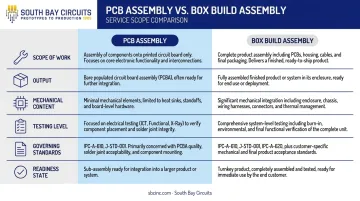
As the table shows, box builds span three disciplines simultaneously — electrical, mechanical, and software. That added complexity also raises the cost of failure: a defect caught at the bare board stage is cheap to fix; a defect in a finished, integrated unit carries significantly higher rework cost and schedule risk.
Key Components of a Box Build Assembly
PCBAs
One or more fully assembled and tested circuit boards serve as the functional core, managing signal processing, control, and communication. Mounting orientation, connector access points, and thermal footprint within the enclosure all require design-phase decisions — before the enclosure is ordered, not after.
Enclosures and Mechanical Hardware
The housing — whether sheet metal, plastic, or custom fabricated — protects internal electronics, provides mounting points, and ensures environmental sealing where required. Supporting hardware includes:
- Standoffs and mounting brackets for PCBA positioning
- Screws, clips, and fasteners for component retention
- Gaskets and seals for environmental protection
- Sub-panels for internal partitioning and dimensional alignment
Cable Assemblies and Wire Harnesses
Internal wiring distributes power and signals between the PCBA, power supply, displays, sensors, and external I/O. Routing paths, strain relief, and connector integrity directly affect long-term reliability. IPC/WHMA-A-620 governs wire harness acceptance, specifying inspection criteria for cable assemblies from termination through final installation.
Power Supplies and Thermal Management
The power supply converts and stabilizes input voltage for the system. Thermal management elements — heat sinks, fans, thermal interface materials, and ventilation design — prevent component damage under sustained operation. Thermal requirements are defined during design review, with component selection and airflow paths validated before assembly begins.
User Interface, Firmware, and Labeling
The final layer of a box build includes:
- Displays, switches, LEDs, and I/O ports for user interaction
- Firmware loaded to the embedded controller at a specified, documented revision
- Compliance markings, identification labels, and serialization records — including UDI requirements under 21 CFR Part 830 for medical devices
The Box Build Assembly Process, Step by Step
Step 1: Design Review and Planning
Before a single component is staged, the engineering team reviews the BOM, mechanical drawings, assembly documentation, wiring diagrams, and firmware requirements. This review confirms:
- Component compatibility and enclosure fit
- Cable routing paths and connector accessibility
- DFM considerations that could affect yield or repeatability
- Long lead-time component availability
Problems caught here cost far less to resolve than those found after assembly. Engaging the build partner during the design phase — not at production kickoff — compresses cycle time in ways that downstream coordination simply cannot match.
Step 2: Component Sourcing and Incoming Inspection
PCBAs, enclosure parts, cables, mechanical hardware, and firmware files are procured and verified against the BOM before staging. Incoming inspection confirms that components match the specified revision and meet quality criteria before they enter the build.
A single-source provider with in-house PCB fabrication and assembly can order components concurrently with bare board manufacturing: when boards come off the fabrication line, everything else is already staged and ready.
Step 3: Mechanical Integration and Subassembly
Technicians mount PCBAs into the enclosure, secure mechanical hardware, install sub-panels, and position thermal management components according to build documentation. Precise alignment at this stage prevents:
- Connector misalignment under mating force
- Vibration-related fastener loosening in the field
- Dimensional fit issues that cascade across production units
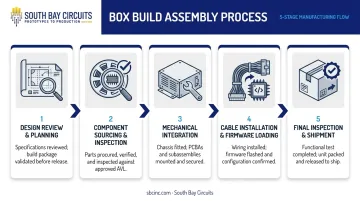
Step 4: Cable Installation, Firmware Loading, and Power-On Testing
With the mechanical structure in place, technicians complete the following in sequence:
- Route and secure wire harnesses per documented routing paths
- Connect all internal interfaces
- Load firmware to the specified revision
- Run initial power-on and functional tests to confirm the system operates as designed
The unit moves to final inspection only after passing these checks.
Step 5: Final Inspection, System Testing, and Shipment Preparation
The final stage covers:
- QC inspection — mechanical fit, workmanship, and electrical integrity per acceptance criteria
- System-level testing — functional validation, and for demanding applications, burn-in or environmental stress screening
- Label application — compliance markings, serialization, and identification per program requirements
- Documentation handover — traceability records maintained per IPC-1782, which defines four risk-based traceability levels covering assemblies, components, process data, and test results
- Packaging and shipment preparation — protecting the finished unit for transport and deployment
Benefits of Outsourcing Box Build Assembly Services
Single-Source Accountability and Faster Time-to-Market
Consolidating PCB fabrication, assembly, and box build with one partner eliminates the handoff delays that occur when boards, enclosures, and cables travel between separate vendors before final assembly. There's one contact, one quality record, and one party responsible for the finished product.
SBC's parallel processing model orders components concurrently with bare board fabrication rather than sequentially — eliminating a scheduling gap that can add weeks to a production cycle before a single unit ships.
Improved Quality and Scalability
Assembling and testing the complete system under one roof enables early defect detection, before a problem becomes a field return. Key quality outcomes include:
- Consistent workmanship across production runs governed by the same quality management system
- Adherence to IPC-A-630A for electronic box manufacture and IPC-A-610 for assembly acceptance
- Smoother prototype-to-production transitions without retooling supplier relationships or re-qualifying a new integrator mid-program
SBC holds ISO 9001:2015 certification (Certificate #10000903 QM15, valid through August 2027), which applies across its PCB fabrication, assembly, and box build operations.
Reduced Supply Chain and Documentation Risk
A managed box build service handles component sourcing, BOM validation, and revision-controlled build documentation in a single system. This reduces the risk of:
- Part mismatches caused by outdated drawings at one vendor while another has the current revision
- Compliance gaps when documentation travels across multiple organizations
- Undetected counterfeit components — a risk that IPC-1782 traceability controls and supplier verification programs directly address
How to Choose the Right Box Build Assembly Partner
Technical Capabilities and Certifications
Look for demonstrated experience in electromechanical integration, cable harness assembly, and system-level integration — not just surface-mount PCB assembly. Relevant certifications to require:
- ISO 9001:2015 — foundational quality management system
- ISO 13485:2016 — medical device QMS; note that FDA's Quality Management System Regulation (QMSR) incorporates ISO 13485 by reference, effective February 2, 2026
- AS9100:2016 — aerospace and defense QMS, verified through the IAQG OASIS database
- ITAR registration — required for U.S. manufacturers of defense articles; registration does not authorize export but confirms the partner operates within the regulatory framework
SBC holds ISO 9001:2015 certification and ITAR registration, and operates with CMMC Level 1 compliance for defense-related programs — with AS9100 and ISO 13485 alignment for aerospace and medical work.
Testing Depth and Traceability
The partner should offer system-level functional testing, in-process inspection, and full traceability from component receipt through final shipment. Ask specifically about:
- Acceptance criteria documentation and test records
- Traceability level applied (per IPC-1782 Levels 1–4)
- Whether burn-in, environmental stress screening, or customer-defined test protocols are supported
For regulated industries, documented test records and serialized traceability aren't preferences — gaps here mean failed audits, rejected shipments, and no defensible quality record when something goes wrong.
Single-Source Advantage and Turnaround Capability
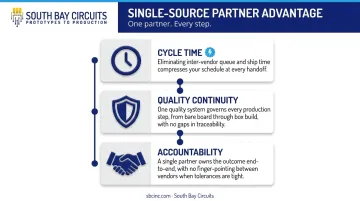
The strongest box build partners are those who can take a project from PCB design through fabrication, assembly, and box build integration without external handoffs. This matters for three reasons:
- Cycle time: No inter-vendor queue or ship time between stages compresses the schedule.
- Quality continuity: One quality system governs every step, so defects don't fall between the cracks at handoff points.
- Accountability: One partner owns the outcome — not a chain of subcontractors pointing at each other when something fails.
SBC handles design through box build production in-house in Chandler, Arizona. With PCB fabrication completed in 24 hours and 3-Day Turn or Less assembly, the total cycle from design to shippable product runs in days rather than the weeks typical of multi-vendor supply chains.
Frequently Asked Questions
What is a box build?
A box build assembly is the process of integrating a completed PCBA with an enclosure, wiring, power supply, and other subsystems to produce a finished, deployable product. It's the final manufacturing step that turns a circuit board into a usable device ready for installation or shipment.
What is the box build process?
The core stages, in order, are:
- Design review and documentation confirmation
- Component sourcing and incoming inspection
- Mechanical integration and subassembly
- Cable and harness installation with firmware loading
- Power-on testing
- Final system inspection, labeling, and shipment preparation
How is a box build different from PCB assembly?
PCB assembly produces a populated circuit board — a component. Box build assembly integrates that board into a complete system inside an enclosure with wiring, power, and firmware. The output of a box build is a finished, shippable product rather than a standalone board awaiting further integration.
What is an example of a box build assembly?
A medical diagnostic device is a common example. A tested PCBA is mounted inside a sealed enclosure, connected to a display, power supply, and cable harness, loaded with firmware at a specified revision, and tested as a complete functional unit. UDI labeling is applied per 21 CFR Part 830 before shipment.
What documentation is needed for a box build?
At minimum, you'll need:
- Complete and accurate BOM with current revision levels
- Mechanical and assembly drawings (or STEP files)
- Wiring diagrams and firmware revision details
- Test specifications and acceptance criteria
- Labeling and serialization requirements
What industries use box build assembly services?
Box build assembly is standard across industries that require finished product reliability, regulatory compliance, and component-level traceability:
- Aerospace and defense
- Medical devices
- Industrial automation
- Automotive electronics
- Military applications