Introduction
Ask three people in electronics sourcing to define "PCB" and "CCA," and you might get three different answers. In practice, the terms get used interchangeably in RFQs and vendor calls — but they describe two distinct stages of the manufacturing pipeline.
That mix-up isn't just semantic. Ordering the wrong stage can throw off your quote, stretch your lead time, or send you to a vendor that can't actually deliver what your project needs.
This guide breaks down what separates a bare PCB from a fully populated CCA, where each sits in the production path, and when it makes sense to keep both stages with one manufacturer. South Bay Circuits (SBC) is one example of a single-source partner that handles fabrication and assembly under one roof.
Key Takeaways
- A PCB is the bare board; a CCA is that board with components soldered on and functioning
- PCB fabrication and CCA assembly are sequential steps in one pipeline, not competing choices
- Cost, lead time, and testing scope differ sharply between a bare board and a finished assembly
- Consolidating both stages with one manufacturer cuts total cycle time versus separate vendors
CCA vs PCB: Quick Comparison
These aren't either/or alternatives — a CCA can't exist without a PCB first. Here's how the two stages stack up side by side.
| Factor | PCB (Bare Board) | CCA (Assembled Board) |
|---|---|---|
| Definition | Unpopulated substrate with etched copper traces, no components installed | PCB fully populated with resistors, ICs, connectors, and other parts via soldering |
| Manufacturing Stage | First stage — fabrication, plating, and bare-board testing | Final stage — component placement, soldering, and inspection after fabrication |
| Cost Structure | Driven by board size, layer count, material, and drill count | Adds component sourcing, placement labor, automation, and test fixtures on top of board cost |
| Complexity & Testing | Electrical net-list testing and visual inspection of the unpopulated board (per IPC-9252) | Acceptance testing under IPC-A-610, plus AOI, X-ray, ICT, or functional test as specified |
| Typical Lead Time | Varies by complexity; quick-turn shops can run 24 hours to 7 days | Depends heavily on component availability and test requirements on top of fab time |
What is a PCB?
A PCB is the non-conductive substrate with etched copper traces and no components attached. It's the physical and electrical skeleton every electronic device is built on. According to IPC's own checklist for producing rigid printed board assemblies, a "Printed Circuit Board" is explicitly the bare board, distinct from the assembled version called a PCBA.
Bare-board quality sets the ceiling for assembly yield and field reliability. Trace routing, layer count, and material selection directly determine:
- How well components can be placed and soldered later
- Whether the board survives thermal cycling in the field
- The long-term reliability of the finished product
Board Types That Affect Downstream Assembly
Not every PCB is built the same way. Common variations include:
- Rigid boards (FR-4): The standard workhorse for most consumer and industrial applications
- Flexible boards: Polyimide-based substrates for space-constrained or bending applications
- Rigid-flex: Combines rigid sections with flexible connections in one board
- Multilayer/HDI: Double-sided to 20+ layers, often with blind and buried vias for dense routing
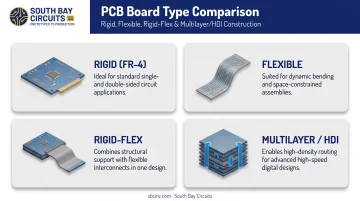
Each type fits different design requirements, and choosing wrong at this stage creates headaches once assembly begins.
Where Bare-Board Specs Are Non-Negotiable
Manufacturing has to be completed and quality-checked before a single component ever touches the board. Once bare boards fail inspection, no amount of careful assembly downstream fixes that problem.
Industries that depend on tight bare-board specs include:
- Aerospace avionics, where IPC-6012FS governs space and military applications
- Medical instrumentation, addressed under the IPC-6012EM addendum for high-reliability boards
- Automotive control units, which follow the IPC-6012FA addendum for vibration and thermal survival
Demand for this stage remains strong. IPC's own data showed a 1.12 North American PCB book-to-bill ratio in its early 2026 release, a sign that orders are outpacing shipments.
Quick-turn fabrication windows vary by shop and complexity, commonly spanning about 24 hours to 7 days. That range is a useful benchmark, not a universal standard.
What is a Circuit Card Assembly (CCA)?
A CCA is a PCB fully populated with electronic components — resistors, ICs, connectors — attached through soldering. Once that happens, the bare board becomes a functional, testable module instead of just a piece of copper-clad substrate.
Assembly quality is where reliability really gets decided. Placement accuracy, soldering consistency, and inspection rigor drive whether a device fails in the field or performs for years. IPC-A-610 sets the acceptance requirements for these assemblies. Passing IPC-A-610 does not automatically mean full functional or environmental testing happened—those requirements need to be spelled out separately in the contract.
Common CCA Production Methods
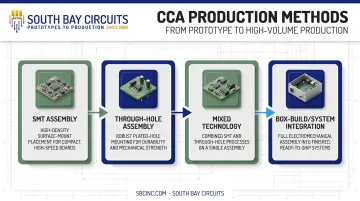
- SMT assembly: Component terminations mount directly to board lands on the surface
- Through-hole assembly: Leads pass through plated holes before soldering — still common for parts needing extra mechanical strength
- Mixed technology: Combines both methods on a single board
- Box-build/system integration: Integrates the finished CCA into a full enclosure or higher-level system
Use Cases of CCA Production
CCA is the last production stage before the board is integrated into its end device or enclosure, so the assembly is expected to function when it leaves this step.
Sectors that require finished, tested CCAs under strict compliance include:
- Aerospace and defense, where AS9100D quality-management requirements often get flowed down contractually
- Medical devices, governed by ISO 13485 quality systems
- Automotive electronics, following IATF 16949 requirements
For regulated programs, keeping assembly close to the rest of the build reduces handoffs and queue time. At its 60,000-square-foot Chandler, Arizona facility, South Bay Circuits (SBC) runs automated SMT, through-hole soldering, and BGA placement down to 0.4mm, verified with AOI and X-ray inspection.
Same-day assembly options and single-source accountability shorten NPI timelines compared with shipping boards to a separate assembly house and waiting in another queue.
CCA vs PCB: Which One Do You Need?
The right choice depends less on preference and more on where your project sits.
Decision Factors to Weigh
- Project stage — Are you validating a design, or moving into production?
- In-house capability — Can your team handle component procurement, placement, and testing internally?
- Order volume — Prototype quantities versus full production runs change cost, lead time, and vendor strategy.
- Budget and timeline — Assembly adds cost and complexity, but also removes work from your plate
General guidance:
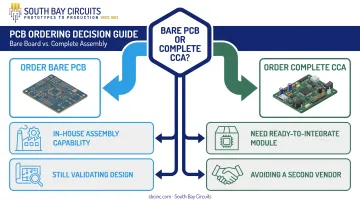
- Order bare PCBs if you have in-house assembly capability or you're still validating a design
- Order a complete CCA if you need a ready-to-integrate, tested module without managing a second vendor
- For high-reliability work in aerospace or medical devices, a single-source CCA provider reduces the handoff errors that crop up between separate fab and assembly vendors
A Common Sourcing Scenario
Many OEMs fabricate bare boards at one shop, then ship them to a separate assembly house. Each handoff adds shipping time, a new queue to wait in, and a fresh set of quality standards to reconcile if something doesn't match spec.
When something goes wrong, such as a plating issue traced to fab or a soldering defect blamed on the board, the two vendors can point fingers at each other while the OEM's schedule slips.
Single-source models exist to remove that friction. SBC keeps design, fabrication, and assembly under one accountable process, with fabrication in as little as 24 hours and same-day assembly when materials are on hand.
There is no file transfer between companies, no second shipping leg, and no ambiguity about who owns a quality issue.
Consolidating PCB and CCA sourcing removes the vendor blame game and shortens time-to-market. If you are deciding whether to split fab and assembly across two suppliers, request a quote from SBC for combined PCB fabrication and CCA assembly first.
Conclusion
PCB and CCA are sequential stages of the same build, not competing options. Which one you order depends on where your product sits in its development lifecycle: still validating a design, or ready for a functional, tested module.
Partnering with an experienced, single-source manufacturer for both stages pays off in three ways:
- Steadier quality control across fabrication and assembly
- Shorter lead times without handoffs between vendors
- Clearer accountability during troubleshooting
For OEMs across aerospace, medical, automotive, and industrial sectors, that combination matters more than shaving a few dollars off a per-unit quote.
Frequently Asked Questions
What is the difference between PCB and CCA?
A PCB is the bare, unpopulated board: just copper traces on a substrate. A CCA is that same board after components have been soldered on, making it a functional, ready-to-use module.
Is a CCA the same thing as PCBA?
Yes, in practical terms, both describe an assembled, populated board. CCA tends to be the more formal or military-influenced term, while PCBA is the common industry shorthand for the identical deliverable.
Can I order a CCA without fabricating the PCB separately?
Yes. Single-source manufacturers fabricate the bare board and assemble components in one continuous process, so you never have to coordinate a separate handoff between two vendors.
How long does it typically take to go from a bare PCB to a finished CCA?
Timelines vary based on component availability and board complexity. Consolidated providers that fabricate and assemble in-house can shorten the cycle significantly. SBC, for example, offers same-day assembly after 24-hour fabrication.
What certifications should a circuit card assembly manufacturer hold?
Look for ISO 9001:2015 for general quality management, AS 9100 for aerospace work, ISO 13485 for medical devices, and ITAR registration for defense-related manufacturing. Each addresses a different compliance requirement.
Which industries rely most heavily on fully assembled CCAs versus bare PCBs?
Aerospace, defense, medical, and automotive sectors typically need fully tested, populated CCAs ready for direct system integration. Bare PCBs are more common for teams handling their own in-house assembly or early-stage design validation.