Engineers and product teams often mix up two closely related terms — SMD and SMT — and many still wonder whether their design should use surface mount, through-hole, or both. Getting that decision wrong can mean cost overruns, reliability issues, or a board that simply doesn't fit its enclosure.
This guide breaks down what SMT actually is, walks through the assembly process step by step, compares it against through-hole mounting, and covers the components, packages, and industries that depend on it every day.
Key Takeaways
- SMT mounts components directly onto PCB surface pads, no drilled holes required
- SMD is the component itself; SMT is the process that places and solders it
- Automated SMT lines place thousands of components per hour versus slower manual through-hole work
- High-stress or high-power parts often still need through-hole mounting
- Medical, automotive, and defense SMT work typically requires documented process controls and certifications
What Is Surface Mount Technology (SMT)?
Surface mount technology is a manufacturing method for attaching electrical components directly onto flat metal pads on a printed circuit board (PCB) rather than inserting wire leads through drilled holes. The component sits flush against the board's surface, gets held in place with solder paste, and is permanently bonded during a heating process.
SMT traces back to the 1960s, when engineers began experimenting with what was then called "planar mounting," a term still found in older engineering literature.
IBM's early mainframe work relied on compact circuit packaging that laid the groundwork for surface-mount concepts. The method became the industry default only after automation matured through the 1980s and 1990s.
SMT vs. SMD: What's the Difference?
One of the most common points of confusion in electronics manufacturing is the difference between the part and the process:
- SMD (surface-mount device) is the physical component — a resistor, capacitor, diode, or integrated circuit designed with flat metal terminals instead of wire leads
- SMT (surface mount technology) is the process and equipment used to place and solder those components onto a board
Think of a smartphone's main board. The dozens of tiny resistors, capacitors, and processor chips soldered to it are all SMDs. The automated pick-and-place machines and reflow ovens that put them there and bonded them permanently? That's SMT. One is the part. The other is the method.
What Does "Surface-Mount" Actually Mean?
The name describes exactly what happens: components are soldered onto the surface of the board using flat pads, rather than having leads pushed through drilled holes as with older through-hole designs. There's no hole to drill, no lead to bend or trim, and no need to access the back of the board during assembly.
That single design difference is why SMT dominates modern electronics. According to Mordor Intelligence, the SMT market is projected to grow from $7.11 billion in 2026 to $10.19 billion by 2031, a 7.49% CAGR. That figure covers the equipment, materials, and process solutions built around SMT manufacturing.
How the SMT Assembly Process Works
SMT assembly follows a repeatable, automated sequence. Each stage builds on the last, and skipping steps or rushing them is where most quality problems originate.
From Solder Paste to Placement
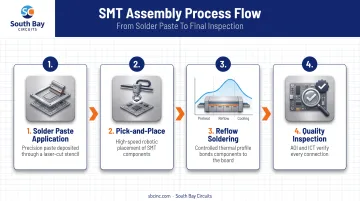
The process starts with solder paste application. A thin metal stencil sits over the bare PCB, and a mix of flux and microscopic solder particles is screen-printed onto the exposed pads. Precision matters here: too much or too little paste on a pad can cause defects later in reflow.
Pick-and-place machines come next. These robotic systems lift each component from a reel or tray and set it on the pasted pads at high speed and tight tolerance. Modern platforms are extremely fast: Yamaha's YRM20 surface mounter is rated at 115,000 components per hour under optimal conditions, with placement accuracy around ±25 micrometers.
That figure is a manufacturer's peak rating, not a guaranteed sustained line speed, but it shows how far automation has pushed placement capability.
Reflow Soldering and Quality Checks
Once every component sits on its pad, the board travels through a reflow oven. This oven has distinct zones:
- Preheat: gradually raises board temperature to avoid thermal shock
- Reflow: melts the solder paste, permanently bonding leads to pads
- Cooling: solidifies the joints as the board exits the oven
After reflow, boards go through quality verification. Automated optical inspection (AOI) scans the assembly for misaligned parts, solder bridges, or missing components. Many manufacturers pair AOI with in-circuit testing (ICT) and functional testing to confirm electrical performance before a board ever ships.
South Bay Circuits runs this entire sequence in-house on two automated Fuji SMT lines at its Chandler, Arizona facility. That equipment first came online in 2004 and expanded in 2007.
Because design, fabrication, and assembly happen under one roof, boards can move from prototype to loaded assembly the same day. That removes the shipping and queue delays that come with juggling separate vendors.
SMT vs. Through-Hole Technology: Key Differences
Choosing between SMT and through-hole isn't always obvious, and the right answer often depends on what the board needs to survive, not just how small it needs to be.
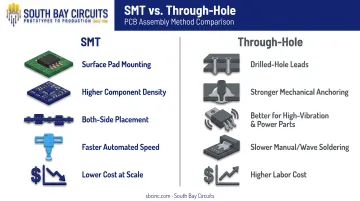
Mounting method is the core distinction. SMT components sit on surface pads; through-hole components have leads that pass through drilled holes and get soldered on the opposite side. That difference directly affects board density. SMT allows components on both sides of a board and much tighter spacing.
Speed and cost favor SMT decisively. Automated placement rates dwarf manual insertion or wave-soldering speeds used in through-hole production, which translates into lower labor costs and shorter production cycles at any real volume.
That said, through-hole hasn't disappeared. It still matters for:
- Connectors subject to repeated plugging and unplugging
- Transformers and other heavy components needing mechanical anchoring
- High-vibration environments like aerospace and military platforms
- Power components that generate significant heat and need robust joints
Many boards today use a hybrid approach: dense SMT circuitry for the bulk of components, with through-hole reserved for parts that need extra mechanical strength.
SMT's dominance is well documented. Grand View Research reports SMT holding more than 72.7% of the PCB assembly market in 2025, while other researchers put the figure closer to 63%. Either way, SMT is the default choice for most new designs.
South Bay Circuits builds mixed-technology boards regularly, placing SMT components down to 0201 packages on the same board as axial and radial through-hole devices. Wave or hand soldering handles those through-hole parts—the hybrid layout many OEM designs require.
Advantages and Disadvantages of SMT
No manufacturing method fits every situation, and SMT is no exception.
Advantages of SMT
- Higher component density — parts on both sides of the board, tighter spacing
- Faster automated production — pick-and-place speeds that manual assembly can't match
- Better electrical performance — shorter lead paths mean lower parasitic inductance and capacitance
- Lower per-unit costs at scale — automation drives down labor cost as volume increases
Disadvantages of SMT
- Difficult manual rework — fine-pitch components are hard to repair or replace by hand, especially in the field
- Not ideal for high mechanical stress — repeated flexing or vibration can fatigue small solder joints over time
- Specialized equipment required — stencils, reflow ovens, and precision placement tools raise the barrier for small-batch or one-off builds
The right method depends on the component, the environment, and how the finished product will actually be used.
Common SMT Components, Packages & Industries That Rely on It
SMDs fall into three broad categories:
- Passive components: resistors, capacitors, inductors
- Active components: diodes, transistors, integrated circuits
- Electromechanical components: switches, connectors, relays
Package formats have evolved to support miniaturization:
| Package | Description |
|---|---|
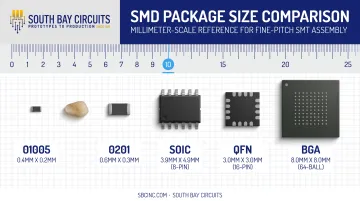
| SOIC | Small-Outline Integrated Circuit, a compact leaded IC format |
| QFN | Quad Flat No-Lead, contacts on all four sides with an exposed thermal pad |
| BGA | Ball Grid Array, solder balls on the underside instead of leads |
Passive components have shrunk dramatically too. The 01005 case size measures just 0.4mm by 0.2mm, smaller than a grain of sand. South Bay Circuits places standard SMDs down to 0201 packages, with fine-pitch placement to 0.3mm available following engineering review.
Industries relying on SMT span consumer electronics, automotive, industrial equipment, and heavily regulated sectors like aerospace, defense, and medical devices. Those regulated fields demand more than assembly capability; they require documented quality credentials.
South Bay Circuits holds the certifications most mission-critical programs need:
- ISO 9001:2015
- AS9100 aerospace compliance
- ISO 13485 for medical device production
- ISO TS 16949 automotive compliance
- ITAR registration
- CMMC Level 1 compliance
Frequently Asked Questions
What does surface-mount mean?
Surface-mount means a component is soldered directly onto flat pads on a PCB's surface, rather than having leads inserted through drilled holes. That on-surface attachment is what sets SMT apart from through-hole assembly.
What is the difference between SMD and SMT?
SMD refers to the physical component itself, such as a resistor, capacitor, or chip built for surface mounting. SMT is the manufacturing process and equipment used to place and solder those components onto the board.
What is the difference between recessed and surface-mount?
Recessed mounting sets a component into a cutout or cavity so it sits flush with or below the board surface. Surface-mount components rest entirely on top of the board and solder only to surface pads.
Is SMT better than through-hole technology?
SMT is generally faster, cheaper, and allows higher component density, making it the default for most modern boards. Through-hole still wins for parts needing extra mechanical strength or high-power handling.
What industries commonly use SMT?
Consumer electronics, automotive, industrial equipment, aerospace and defense, and medical devices all rely heavily on SMT. Regulated industries specifically require manufacturing partners with certifications like AS9100 or ISO 13485.
Can SMT and through-hole mounting be combined on the same PCB?
Yes, hybrid boards combining both technologies are common. This lets designers use dense SMT circuitry where space matters and through-hole components where mechanical durability is the priority.