This explanation is written for OEMs, product developers, and engineers working in electronics, aerospace, medical, automotive, and defense industries. In these fields, a missed tolerance or an undocumented process step isn't just inconvenient. It can affect safety and performance downstream.
You'll also see "contract manufacturing," "contract assembly," and "sub-assembly" used as if they mean the same thing. They don't. This article breaks down how the process actually works, what affects the outcome, and when it makes sense to use it.
TL;DR
- Contract manufacturing assembly hands part or all of product assembly to a specialized partner
- Cuts labor and equipment costs, adds specialized expertise, and shortens time to market
- The process runs through five steps: design review, sourcing, assembly/integration, testing, and delivery
- Success hinges on material quality, equipment capability, certifications, and production volume
- Highly proprietary prototypes and extremely low-volume builds often gain little from outsourcing
What Is Contract Manufacturing Assembly?
Contract manufacturing assembly is the outsourced process of combining components, parts, or sub-assemblies into a finished or semi-finished product according to a customer's exact specifications. The goal is a tested, quality-verified assembly that's ready for integration, final production, or shipment, without the OEM having to invest in its own labor, floor space, or equipment.
Three related terms are easy to confuse:
- Contract manufacturing — the broader relationship, which can include fabrication, raw material sourcing, engineering, and even fulfillment
- Contract manufacturing assembly — specifically the assembly step: turning already-fabricated or sourced parts into a functional unit
- Sub-assembly — a partial build of components that feeds into a larger final assembly later in the process
There's also a common mix-up between contract manufacturers, OEMs, and ODMs. An OEM owns the design and brand; a contract manufacturer builds to that design. An ODM designs the product as well and supplies it under the customer's brand. We cover these distinctions in more depth in the FAQ section below.
A Concrete Example: PCB Assembly
PCB assembly is one of the clearest ways to see this process in action. A bare board and a bag of components aren't a product yet. Getting there involves:
- SMT (surface-mount technology): automated placement of components like resistors, capacitors, and BGAs directly onto the board surface
- Through-hole assembly: inserting leaded components through drilled holes, then wave or hand soldering them in place
- Box build: integrating the finished board into an enclosure with wiring, connectors, and mechanical hardware to produce a ready-to-use unit
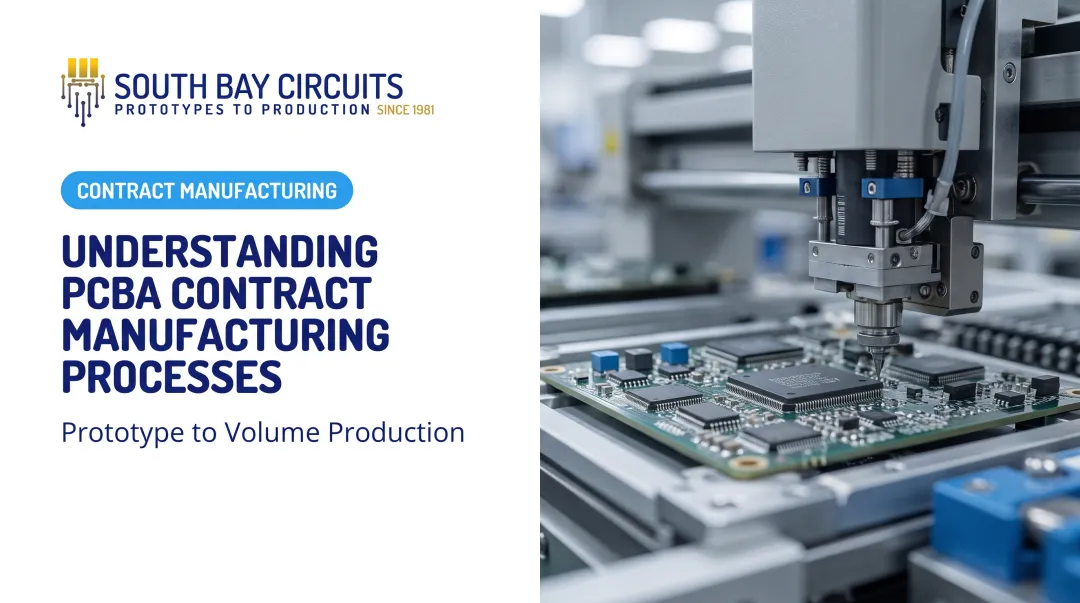
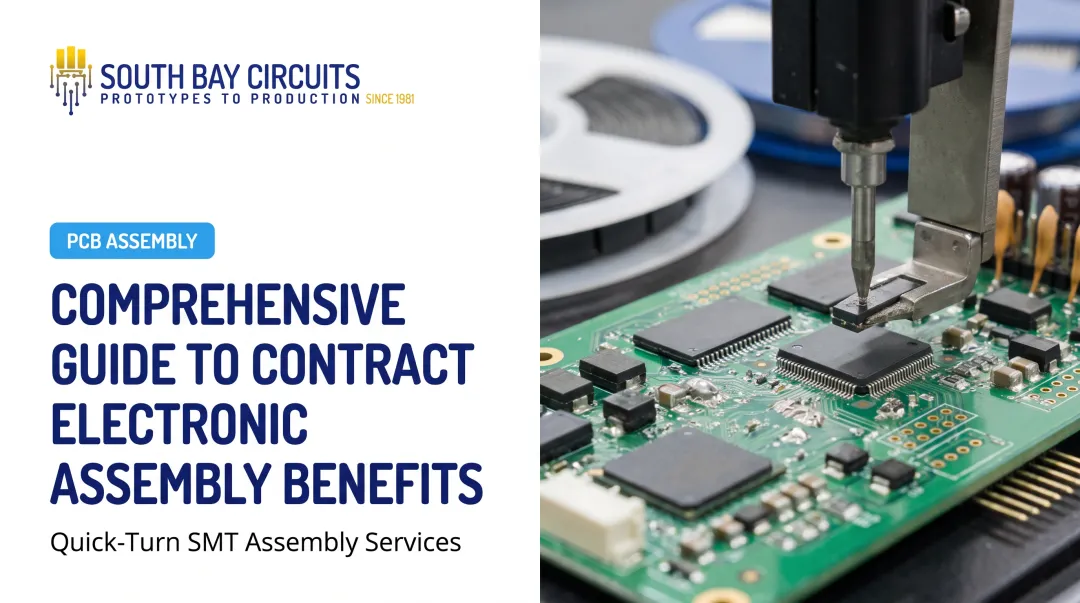
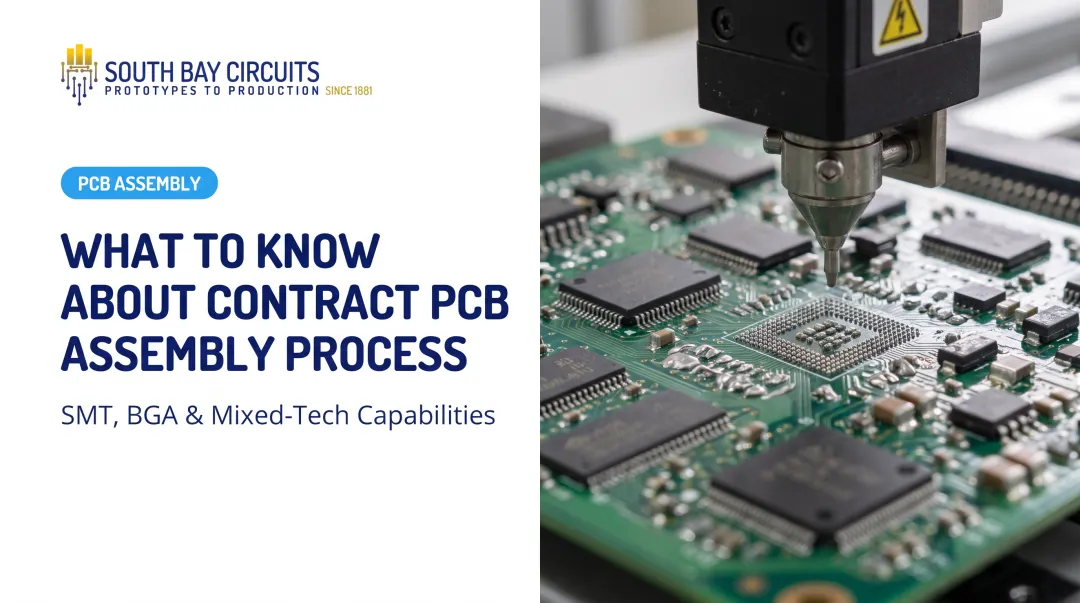
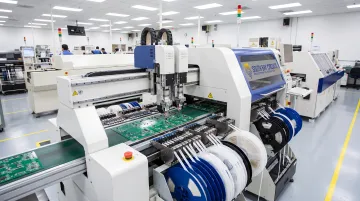
South Bay Circuits, for instance, runs SMT placement down to 0201 packages and fine-pitch work down to 0.4 mm on automated Fuji lines. The same lines support through-hole and mixed-technology assembly for parts like transformers or heatsinked power components that aren't suited to surface mounting.
That mix is what turns discrete parts into a functional, testable assembly ready for the next production step.
Why Contract Manufacturing Assembly Is Used in Electronics and Regulated Industries
Companies outsource assembly for a few specific, practical reasons:
- Lower fixed costs by avoiding capital investment in SMT lines, test rigs, and skilled labor
- Access specialized tooling and expertise most OEMs can't justify building in-house
- Reach market faster with a partner ready to start production without a lengthy equipment ramp
- Scale volume up or down as demand shifts
This isn't a niche practice, either. The global electronic contract manufacturing and design services market is projected to reach $1,361.54 billion by 2033, reflecting how central outsourced production has become to electronics supply chains.
What Regulated Industries Demand
Aerospace, medical, and automotive customers need more than a working assembly. They need:
- Consistent, repeatable processes across production runs
- Full traceability from raw material to finished unit
- Tight tolerances held under audit-level scrutiny
- Certified quality systems, not informal quality control
Without a qualified partner, the failure modes are predictable: inconsistent quality between batches, missed deadlines, rising per-unit costs, and compliance failures that surface during a customer or regulatory audit. Outsourcing to certified partners isn't just a best practice in these industries. It's often a baseline expectation before a program even gets approved.
South Bay Circuits runs PCB fabrication and assembly under one roof, backed by ISO 9001:2015 certification, AS9100 aerospace compliance, and ISO 13485 compliance for medical device work.
Keeping both processes in-house removes vendor hand-offs, shortens cycle time, and eliminates the finger-pointing that surfaces when something goes wrong across a multi-vendor supply chain.
How Contract Manufacturing Assembly Works (Conceptual Flow)
Contract manufacturing assembly runs through five stages: design and spec intake, material procurement, assembly and integration, testing and inspection, and delivery. On the shop floor, those stages typically group into three operational phases.
What feeds into the process:
- CAD drawings and fabrication/assembly data
- Bills of materials (BOM)
- Written work instructions
- Sourced or customer-supplied components
During the core transformation, assemblers combine discrete parts and sub-assemblies through mechanical, electrical, or SMT/through-hole processes into a functional unit. A quality management system such as ISO 9001 governs the work, with inspection checkpoints and documented traceability at each stage. The end result: raw components become a tested, verified assembly, ready to ship or integrate into a larger product.
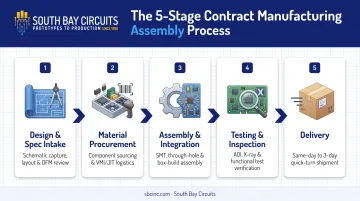
Step 1: Design Review & Material Procurement
Before anything gets built, the assembler reviews drawings and specs for manufacturability. This typically includes checking that the BOM has complete part numbers and sourcing information, confirming footprint and stack-up details, and verifying Gerber and drill data.
Components then get sourced from vetted, authorized suppliers, with particular attention paid to long-lead-time or critical-path parts. Programs like Vendor Managed Inventory (VMI), Just-in-Time (JIT) delivery, and Kanban help manage lead times so materials are ready when production starts, not scrambled for at the last minute.
Step 2: Assembly & Sub-Assembly Integration
This is where individual parts and sub-assemblies (populated boards, wiring harnesses, and housings) are built and combined into the final configuration. SMT lines handle automated component placement, wave or hand soldering secures through-hole parts, and mechanical assembly brings everything together into the customer's specified enclosure.
Specialized equipment matters here. Fuji chipshooters, for example, are built for rapid placement of small components, while flexible placers handle a broader mix, including tray-fed parts. The right equipment for the job affects both speed and consistency.
Step 3: Testing, Inspection & Delivery
Before anything ships, the assembly goes through a series of checkpoints:
- Automated Optical Inspection (AOI) — checks placement accuracy and solder quality
- Visual inspection — often 100% inspection to IPC-A-610 Class II or Class III standards
- X-ray inspection — verifies hidden solder joints on BGAs and other concealed connections
- Electrical testing — in-circuit or flying-probe testing catches shorts, opens, and out-of-spec values
- Functional testing — confirms the finished assembly performs as intended under real operating conditions
Documentation and traceability run alongside these checks, tying each build back to specific components, lot numbers, and work orders before packaging and shipment.
Where It's Applied and What Affects the Outcome
Where Contract Manufacturing Assembly Is Applied
Contract manufacturing assembly covers a wide range of builds:
- PCB assemblies (SMT, through-hole, mixed-technology)
- Electromechanical builds and backplane assemblies
- Wiring harnesses
- Full box builds combining boards, enclosures, and mechanical hardware
Teams use it at several points in a product's life: new product introduction (NPI) and prototyping, production ramp-up, and long-term support once a design stabilizes.
Common triggers include capacity constraints, a new product launch, a cost-reduction push, or certified production an OEM can't support in-house.
Key Factors That Affect the Process
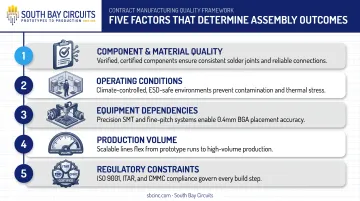
A few variables decide how smoothly and cost-effectively an assembly project runs:
- Component and material quality — BOM accuracy and supplier reliability directly affect build quality and rework rates
- Operating conditions — ESD control, and in some cases cleanroom or environmental requirements, protect sensitive components
- Equipment dependencies — SMT lines, test rigs, and automated tools determine what's actually achievable
- Production volume — high-mix/low-volume work needs fast changeovers and higher setup costs; high-volume runs favor long automated production
- Regulatory constraints — ITAR, AS9100, or ISO 13485 requirements shape documentation and process controls specific to the industry
ANSI/ESD S20.20 covers grounding, personnel controls, and ESD-protected work areas. Those controls are standard wherever sensitive electronic components are assembled.
Common Issues, When It May Not Be the Right Fit, and Key Takeaway
A few misconceptions cause real problems down the line. Clearing them up now saves headaches later.
"Assembly" and "full manufacturing" aren't the same thing. Assembly-only partners typically don't handle fabrication or full material sourcing; they build from parts someone else supplied. Know which service you're actually buying.
Sub-assembly and kitting aren't interchangeable either. Kitting organizes parts, fittings, and tools into a set for a task. Sub-assembly actually joins those parts into a partial build. One prepares inputs; the other transforms them.
Contract manufacturing assembly isn't always the right move. It tends to be a poor fit when:
- Low-volume, highly proprietary early-stage prototypes that should stay in-house to protect IP
- Frequent engineering changes that an outside partner cannot keep pace with
- The product is simple enough that outsourcing overhead outweighs any savings
Watch for signs you're outsourcing by default, not by need: picking a partner without checking certifications, verifying capacity, or testing communication before you commit.
Key takeaway: Know the process before you outsource it. That distinction keeps assembly efficient instead of expensive.
Partners with decades of experience and the right certifications, such as South Bay Circuits, help teams apply assembly correctly from prototype through full production rather than treating it as a commodity buy.
Frequently Asked Questions
What is the difference between an ODM and a contract manufacturer?
An ODM designs and manufactures a product using its own intellectual property, which is then branded and sold by another company. A contract manufacturer builds to a design the client already owns.
Is a contract manufacturer the same as an OEM?
No. An OEM owns the product design and brand. A contract manufacturer is the outsourced partner that builds the product on the OEM's behalf.
What is an assembly in manufacturing?
An assembly is two or more parts or sub-assemblies joined together to form a functional component or a finished product.
What is the difference between contract manufacturing and contract assembly?
Contract manufacturing can include the full production process, including sourcing and fabrication. Contract assembly focuses specifically on putting pre-made components together.
How much does contract manufacturing assembly typically cost?
Cost depends on materials, labor complexity, equipment needs, production volume, and compliance requirements. Ask partners for a detailed quote on your specific build for accurate pricing.
What industries rely most on contract manufacturing assembly?
Aerospace, defense, medical devices, automotive, and industrial electronics rely most on certified assembly partners where quality systems, traceability, and regulated performance are non-negotiable.