Introduction
Manufacturers aren't outsourcing electronic assembly because it sounds efficient on paper. They're doing it because cost pressure, compressed launch windows, and stricter compliance demands leave little room for error.
According to IPC's mid-2025 survey of electronics manufacturing executives, 63% reported rising material costs and 48% reported rising labor costs, with nearly a third seeing profit margins shrink as a result.
Add tightening quality expectations in medical, aerospace, and automotive production, and the math on running an in-house assembly line gets harder every year.
Contract electronic assembly (CEA) often gets discussed as an abstract outsourcing strategy. In practice, its value shows up in daily production numbers: fewer defects, shorter cycle times, and costs that don't creep upward every quarter.
This guide breaks down what CEA is, where it delivers measurable advantages, and what goes wrong when it's mismanaged. It also covers how to get the most out of a manufacturing partner.
Key Takeaways
- Outsourcing PCB and electronic assembly avoids the capital cost of building in-house capacity
- Faster launches, lower per-unit costs, and certified quality control are the primary gains
- Choosing the wrong partner drives inconsistent builds, higher defect rates, and rising costs over time
- Early design collaboration and ongoing KPI tracking separate average CEA results from exceptional ones
What Is Contract Electronic Assembly (Brief Context)
Contract electronic assembly means handing off the physical build of your product (PCBs, cable and wire harnesses, box builds) to a specialized third-party manufacturer instead of running your own SMT line.
It shows up across nearly every hardware-driven industry:
- Consumer electronics — fast refresh cycles, tight margins
- Industrial controls — mixed-technology builds, long product lifecycles
- Medical devices — regulatory scrutiny under FDA quality system requirements
- Aerospace and defense — AS9100-driven process control, ITAR compliance
- Automotive — high-volume production with IATF/ISO TS 16949 expectations
CEA isn't the end goal. It's a means to faster launches, lower risk, and predictable quality. That outcome is strongest under a single-source model, where design, fabrication, and assembly run under one roof instead of bouncing between separate vendors.
Grand View Research's analysis of the electronic contract manufacturing market shows OEMs increasingly outsource circuit assembly to focus on core competencies while cutting capital investment and time-to-market.
Key Advantages of Contract Electronic Assembly
The advantages below aren't abstract selling points. Each one maps to a metric that production and finance teams already track: cycle time, unit cost, defect rate, and time-to-market.
Faster Time-to-Market & Reduced Cycle Time
An OEM building an in-house line starts from zero: sourcing SMT equipment, hiring and training operators, and validating processes before a single board ships. CEA partners already have the lines, the trained staff, and the established workflows running.
The bigger gain often comes from consolidation. When design, fabrication, and assembly sit under separate vendors, every handoff adds queue time and shipping time between steps. Those delays frequently outlast the actual processing time itself.
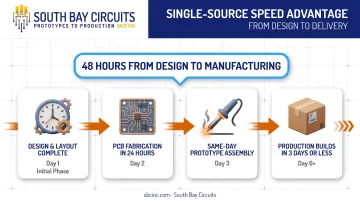
South Bay Circuits illustrates how tight this can get when everything sits under one roof: 24-hour PCB fabrication, same-day prototype assembly, and production builds in three days or less.
After design and layout, manufacturing and assembly can move forward in as little as 48 hours, with no shipping a board to a second facility or waiting in someone else's queue.
KPIs impacted:
- Lead time and order-to-ship time
- NPI/NPD cycle time
- Overall time-to-market
This advantage matters most in fast-moving product categories, tight launch windows, or projects still cycling through multiple design revisions before hitting full production.
Cost Efficiency & Reduced Capital Investment
Building assembly capacity in-house means buying SMT placement equipment, test infrastructure, and skilled labor, then carrying that overhead whether you're running at capacity or not.
Contract manufacturers spread those fixed costs across many clients. That's how they pass through competitive per-unit pricing that a single OEM would struggle to match. Grand View Research notes that outsourcing circuit assembly reduces both production cost and capital investment while improving operational flexibility.
The real shift is in how capital gets allocated:
- Fixed equipment costs become variable per-unit costs
- Freed capital can go toward R&D, marketing, or scaling new lines
- Startups skip the multi-year equipment payback period entirely
South Bay Circuits' Managed Cost Reduction Program works alongside VMI, JIT, and Kanban inventory models to keep costs predictable as volume shifts, without customers ever owning the equipment behind it.
KPIs impacted:
- Unit cost
- Capital expenditure
- Overhead as a percentage of production cost
- ROI on new product lines
Startups and SMEs without equipment capital feel this first. Established OEMs feel it when they scale into new volumes without locking into fixed infrastructure.
Enhanced Quality, Reliability & Single-Source Accountability
Reputable CEA providers operate under formal quality systems: ISO 9001 for general quality management, IPC-A-610 for assembly acceptance, and industry-specific frameworks like AS9100 for aerospace or ISO 13485 for medical devices.
Single-source providers control the entire flow from design through test. That matters because fragmented supply chains create a "blame game" the moment a defect appears: was it the board house, the assembler, or the test lab? When one company owns the whole process, that ambiguity disappears.
South Bay Circuits is ISO 9001:2015 certified (Certificate #10000903 QM15, through UL-DQS) and builds to standards that support AS9100 aerospace requirements, ISO 13485 medical-device quality expectations, and ISO/TS 16949 automotive compliance. That layered coverage is what makes a partner audit-ready across sectors like medical, aerospace, and automotive rather than qualified for just one.
Even with a certified single-source partner, accountability does not fully transfer. FDA guidance on contract manufacturing treats contract assembly as an extension of the finished-device manufacturer's own process.
Serious deficiencies at a contractor can still trigger regulatory action against the OEM. Certification reduces risk; it does not eliminate the OEM's duty to verify it.
KPIs impacted:
- Defect rate/DPPM
- First-pass yield
- Warranty and RMA cost
- Compliance audit outcomes
What Happens When Contract Electronic Assembly Is Mismanaged or Ignored
Skipping CEA, or choosing an unqualified partner, rarely fails loudly. It fails slowly, through a string of compounding problems:
- Inconsistent build quality across production runs, without standardized process control to catch drift
- Higher defect rates from limited in-house test infrastructure (no AOI, X-ray, or in-circuit testing)
- Reactive firefighting when late-stage design changes collide with missed launch windows
- Rising per-unit costs as underutilized or aging in-house equipment loses its cost advantage
- Scaling bottlenecks that force headcount or capital additions just to grow volume
Real-world recall records show how small assembly defects escalate. A 2023 NHTSA safety recall involving a vehicle cabin coolant-heater module traced back to a missing solder joint connecting a low-voltage connector to a PCB assembly, a defect that could reduce windshield defrost performance.
A separate 2024 recall cited incomplete conformal coating on PCB inter-layer passages, creating a risk of liquid ingress and short circuits.
Neither case proves the assembler lacked certification. But both show exactly the kind of failure that rigorous inspection (AOI, X-ray, and conformal coating verification) is designed to catch before a board ships.
How to Get the Most Value from Contract Electronic Assembly
CEA delivers its full value when it's treated as a partnership, not a late-stage handoff.
- Bring manufacturing into design early. DFM/DFA reviews conducted during schematic capture and layout, rather than after the board is finalized, catch manufacturability issues before they become costly rework.
- Track shared KPIs consistently. Yield, on-time delivery, and defect rate should be reviewed on a regular cadence with your manufacturing partner — not only when something goes wrong.
- Act on inspection data. AOI, X-ray, and functional test results should feed back into design and process improvements instead of sitting unused after each run.
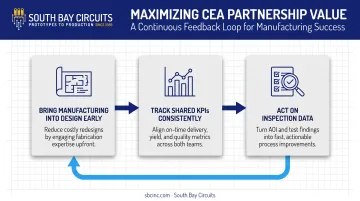
South Bay Circuits' approach reflects this: its engineering teams get involved from product conception through manufacture, reviewing designs concurrently with fabrication and assembly planning rather than waiting for a finished layout to land on the shop floor. That early involvement is often the difference between a smooth production ramp and a scramble to fix problems after tooling is already cut.
Conclusion
The real value of contract electronic assembly is the control and consistency it brings to production, not the act of outsourcing alone. Speed and cost advantages don't peak on day one. They compound as the relationship matures and processes get refined together.
Treat CEA as an ongoing practice, not a one-time vendor decision. Evaluate potential partners on certifications, turnaround capability, and single-source accountability rather than price alone. A cheaper quote with fragmented quality control usually costs more once warranty claims and missed launches enter the picture.
Frequently Asked Questions
What is contract electronic assembly?
Contract electronic assembly is the outsourcing of PCB and electronic product assembly to a specialized third-party manufacturer instead of building in-house production capacity. It covers SMT and through-hole assembly, testing, and box builds.
What is electronics assembly?
Electronics assembly is the process of combining individual components — PCBs, wiring, enclosures — into a finished, functioning electronic product. It includes soldering, placement, and final integration steps.
What is the difference between EMS and OEM?
An OEM designs and sells a product under its own brand. An EMS, or contract manufacturer, builds that product on the OEM's behalf without selling it under its own name.
What industries benefit most from contract electronic assembly?
Medical, aerospace, automotive, and industrial instrumentation benefit most, since they require certified, reliable production at scale under strict regulatory oversight.
How do I choose the right contract electronic assembly partner?
Look at certifications (ISO 9001, AS9100, ISO 13485), turnaround capability, single-source process control, and a documented quality track record. Price alone shouldn't drive the decision.
What certifications should a contract electronic assembly provider have?
At minimum, look for ISO 9001 and IPC-A-610 compliance. Regulated industries should also confirm AS9100 for aerospace or ISO 13485 for medical-device production.