Introduction
Ask ten people in electronics manufacturing to explain the difference between PCB and PCBA, and you'll get ten slightly different answers. These two terms get used interchangeably more often than they should, even though they represent completely different stages of the same board.
Get this distinction wrong, and the consequences show up fast. Timelines slip, budgets blow, and shipments start arriving without the one thing you actually need: a working board.
This guide breaks down what separates a PCB from a PCBA, including how their costs and lead times differ. You'll also see where each one fits in your product lifecycle, and how to decide which service to order at each stage.
Key Takeaways
- A PCB is a bare, unpopulated board with copper traces; a PCBA is that same board fully assembled and soldered
- PCBA always costs more and takes longer than PCB fabrication, since components, labor, and testing add both time and money
- Your choice depends on project stage (prototyping vs. production) and whether you have in-house assembly capability
- One single-source manufacturer for both fabrication and assembly cuts vendor handoffs, queue time, and finger-pointing when defects appear
PCB vs PCBA: Quick Comparison
Before we define each term, here's the side-by-side breakdown most engineers actually search for.
| Factor | PCB | PCBA |
|---|---|---|
| Cost | Lower; driven by layer count, material, and board size | Higher; PCB cost plus BOM, labor/machine setup, and testing |
| Composition | Substrate, copper traces, solder mask, silkscreen, vias, but no parts | PCB plus all soldered components (resistors, capacitors, ICs, connectors) |
| Manufacturing Process | Imaging/etching, drilling, plating, lamination, surface finish | Solder paste printing, SMT/THT placement, reflow/wave soldering, AOI/X-ray inspection |
| Lead Time | Faster; single fabrication process | Longer; depends on component sourcing and assembly steps |
| Functionality | Non-functional on its own | Fully functional, ready for test or integration |
Why Lead Time Varies So Much
Lead time is where most confusion starts. There's no single "standard" turnaround for either service — it depends entirely on complexity.
For bare PCBs, AdvancedPCB reports 3-5 business days for standard 2-4-layer boards, 24-72 hours for quick-turn prototypes, and 5-15 business days for multilayer builds.
PCBA timelines swing wider because component availability is the wildcard: a board with a hard-to-source IC can sit in procurement for weeks, regardless of how fast the assembly line itself runs.
What is a PCB?
A PCB (printed circuit board) is the bare board itself: an insulating substrate, commonly FR-4, with etched copper pathways that will eventually carry electrical signals and mechanically support components. On its own, it does nothing: no components, no function, just structure and pathways waiting to be used.
That said, the PCB stage determines a lot before a single part ever gets placed. Signal integrity, thermal performance, and form factor are all locked in during fabrication. Get the stackup wrong, and no amount of careful assembly downstream will fix it.
Board Types and What They Cost You
Not all PCBs are built the same way, and the type you choose affects both price and complexity:
- Single-layer — copper on one side only; cheapest and simplest
- Double-layer — copper on both sides, connected by plated through-holes
- Multilayer — multiple copper layers laminated together for dense designs
- Flex/rigid-flex — polyimide-based circuits that bend, or hybrid boards combining rigid and flexible sections
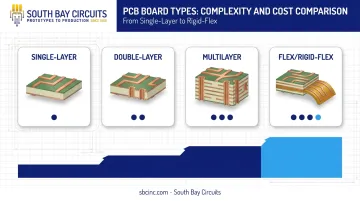
More layers and tighter tolerances mean higher fabrication cost and longer lead times. Ask your manufacturing partner whether fabrication happens in-house or gets outsourced. That single detail can add days to your schedule before assembly even starts.
Use Cases of PCB
Bare PCBs make sense in specific situations:
- Prototyping and R&D, where you need to validate a design before committing to full assembly
- In-house or certified assembly lines, common in aerospace and medical companies that require component soldering under their own security or compliance controls
- Hobbyist and student projects, where hand-soldering is part of the learning process
Early prototype boards let you catch electrical or manufacturability problems before you've spent money on components and labor. Fast-turn prototyping lets a team iterate a design, adjusting trace routing or antenna tuning across several revisions, before locking in production.
The value isn't a guaranteed dollar figure. It's the ability to fail cheap and fix fast, before assembly costs enter the picture.
What is a PCBA?
A PCBA (printed circuit board assembly) is a PCB that's been fully populated with electronic components (resistors, capacitors, ICs, connectors) through soldering. Add the parts, and the board goes from structural to functional. This is the stage that actually determines whether your product works.
Two assembly methods dominate:
- SMT (Surface Mount Technology): components sit directly on pads, placed and reflow-soldered
- THT (Through-Hole Technology): leads pass through drilled holes for stronger mechanical retention
Most modern PCBAs use a mix of both, depending on which components need the durability of through-hole mounting versus the density of surface mount.
Inspection Is Non-Negotiable
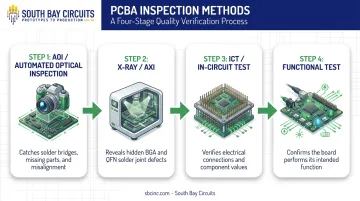
Unlike bare PCBs, PCBAs require testing to confirm they actually function. Four methods typically apply, each catching different problems:
- AOI (Automated Optical Inspection): camera-based check for missing or misaligned parts
- X-ray/AXI: reveals hidden solder joints, especially under BGAs
- ICT (In-Circuit Test): fixture-based electrical testing for opens, shorts, wrong values
- Functional test: powers the board and verifies real-world behavior
Use Cases of PCBA
PCBA fits wherever a working board is the actual deliverable:
- EVT/DVT/PVT development gates: MacroFab notes that EVT validates fit and function, DVT confirms performance in small batches, and PVT proves the process scales to full production
- Small-batch and full-scale production via turnkey assembly services
- Regulated industries: automotive ECUs, medical device boards, aerospace avionics, and industrial motor drives all depend on PCBA, not bare boards, to function
A related sourcing question comes up often: does turnkey assembly reduce defects compared to self-assembly? There's no universally cited comparison; that specific claim doesn't hold up under scrutiny.
What does hold up: turnkey providers manage sourcing, placement, and testing under one quality system, which reduces the number of places something can go wrong across a supply chain with multiple hand-offs.
PCB vs PCBA: Which One Should You Choose?
The decision comes down to four factors:
- Project stage: early prototype vs. production run
- Design complexity: fine-pitch SMD/BGA vs. simple through-hole
- In-house capability: certified assembly line in place, or not
- Volume: one-off prototype vs. hundreds of units
Choose bare PCBs if you need design flexibility for rapid iteration, or your company has in-house/certified assembly requirements it needs to control directly. Choose full PCBA if you need speed, consistency, and fewer vendors to coordinate for a production run.
The Hidden Cost of Splitting Vendors
Here's a risk that doesn't show up on a quote sheet: splitting fabrication and assembly across two separate suppliers creates real problems.
- Tolerance mismatches between the fabricator's specs and the assembler's expectations
- Longer queue times as boards ship between facilities
- A blame game when something fails, with neither vendor taking ownership
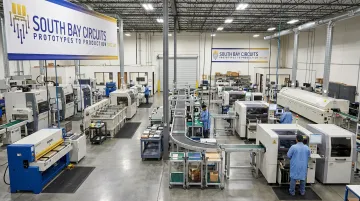
South Bay Circuits (SBC) addresses this by running fabrication and assembly under one roof at its Chandler, Arizona facility, with PCB fabrication turns as fast as 24 hours and same-day assembly capability. One vendor, one accountability chain: no shipping delays between fab and assembly, no guessing which supplier caused a tolerance issue.
This matters even more in regulated industries. Aerospace, medical, and automotive programs typically require suppliers certified across both fabrication and assembly, such as ISO 9001:2015, AS9100, ISO 13485, or ISO TS 16949. SBC holds ISO 9001:2015 certification and maintains compliance frameworks covering medical, automotive, and aerospace requirements, which means customers avoid re-qualifying multiple suppliers for a single build.
Conclusion
PCB and PCBA represent sequential stages of the same board, not competing options. The right choice isn't about which is "better." It's about where your project actually sits in its development lifecycle.
Match the service to the stage: bare PCB for early iteration or in-house assembly, turnkey PCBA for production-ready builds. This alignment delivers faster NPI, lower total cycle cost, and fewer quality risks. Partnering with a single-source provider like South Bay Circuits removes the vendor coordination headache entirely.
Frequently Asked Questions
Are PCB and PCBA the same?
No. A PCB is the bare board with no components. A PCBA is that same board fully assembled with soldered parts, meaning PCBA = PCB + parts + soldering.
How much does a PCBA cost?
Cost depends on PCB fabrication cost, BOM/component pricing, assembly labor or machine setup, and testing requirements. Request a quote based on your specific design and volume for an accurate figure.
What does PCBA stand for?
PCBA stands for Printed Circuit Board Assembly — a PCB once all components have been soldered onto it.
Can I order just a bare PCB without assembly?
Yes. Many manufacturers offer PCB fabrication as a standalone service, common for prototyping or for companies with in-house certified assembly lines.
Is PCBA more expensive than PCB fabrication alone?
Yes. The added cost comes from components, labor or automation setup, and inspection/testing steps that a bare board doesn't require.
How long does PCBA take compared to PCB fabrication?
PCBA generally takes longer because of component sourcing and multi-step assembly and testing. Bare PCB fabrication is a single streamlined process with a shorter, more predictable turnaround.