NASA's reliability research catalogs a long list of moisture-driven failure mechanisms in electronics, including copper oxidation, ionic corrosion, and steam-pressure cracking that develops after trapped moisture heats up during operation, according to NASA technical documentation on PCB reliability. None of that happens gradually. It happens the first time your board gets hit with the wrong combination of humidity, heat, and vibration.
This guide breaks down how PCB encapsulation methods work, which materials perform best under which conditions, and how to pick the right protective approach for your specific application.
Key Takeaways
- Encapsulation (potting) fully submerges a PCB in resin; conformal coatings only skim the surface
- Potting, dam-and-fill, and glob top fit different protection levels and budgets
- Epoxy, polyurethane, or silicone choice drives flexibility, heat tolerance, and durability
- Choose the method by environment, weight limits, rework needs, and production volume
What Is PCB Encapsulation?
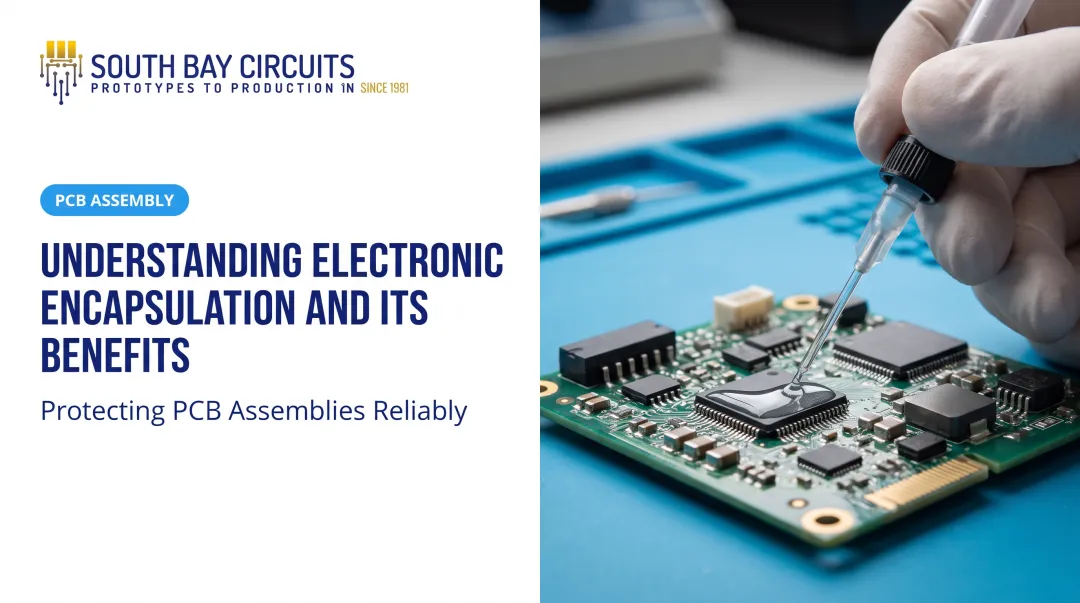
PCB encapsulation, often called potting, means building a mold or shell around a printed circuit board and pouring liquid resin until the entire assembly is sealed in a solid polymer mass. Components, solder joints, connectors — all of it gets buried.
Most potting compounds work as two-part chemistries. Resin (Part A) mixes with a hardener (Part B) at a fixed ratio, triggering a cross-linked polymer reaction that turns liquid into solid. This differs from conformal coating, which applies a single-layer film directly onto the board surface.
The thickness gap is the clearest way to tell the two apart. Conventional conformal coatings run 25 to 100 microns in dry film thickness. Encapsulation resin starts at a minimum of 0.5 millimeters and is usually far thicker, according to Electrolube's comparison of conformal coatings and potting compounds. That's roughly a 5x to 20x jump in material depth.
Where Full Encapsulation Matters Most
Most potting resins cure at room temperature, though heat can speed the process along. Solvent content and VOC ratings vary by formulation, so check the specific product data sheet rather than assuming every resin on the market qualifies as solvent-free.
Full encapsulation tends to show up in:
- Military and defense electronics facing shock, humidity, and temperature swings
- Off-road and mining equipment exposed to constant vibration and dust
- Underwater or submersible electronics requiring total moisture exclusion
- Any high-vibration assembly without a protective housing of its own
Common PCB Encapsulation Methods
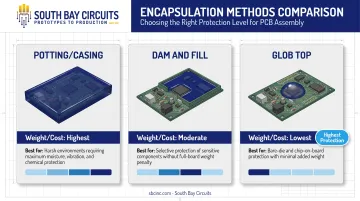
Not every board needs the same level of resin coverage. These three approaches sit on a spectrum from whole-board immersion to targeted, component-specific protection.
Potting or Casing Encapsulation
This is full-board encapsulation. A temporary or permanent barrier goes up around the entire PCB, then resin gets poured until the whole assembly is buried in polymer.
- Delivers the highest level of protection against water intrusion and mechanical shock
- Adds the most weight and cost of any encapsulation method
- Best suited to harsh environments that demand maximum board-level reliability
South Bay Circuits includes potting in its PCB assembly services, applying thermosetting plastics or silicone gels to completed assemblies when full-board protection is required.
Dam and Fill Encapsulation
Instead of encasing the whole board, applicators draw a quick-drying dam wall around specific components that need protection. Typical targets include power regulators, sensitive connectors, and parts prone to corrosion.
Resin then fills inside that boundary only. This gives you:
- Selective protection only where the board needs it
- Lower added weight than full potting
- Middle-ground cost between conformal coating and full encapsulation
Glob Top (Glop Top) Encapsulation
A small, highly viscous glob of resin gets placed directly over an individual component, allowed to dome naturally, and cured in place. The resin has to be thick enough to hold its shape without flowing across the board.
This method shows up most often on chip-on-board (COB) assemblies, where a bare die sits exposed on the substrate and needs a protective cap before the product ships.
Typical tradeoffs:
- Single-component coverage rather than a region or full board
- Lowest added weight and material use of the three methods
- Standard choice for bare-die COB protection before shipment
Materials Used in PCB Encapsulation
Three chemistries cover most full-board potting applications. Each one trades off differently between hardness, flexibility, and thermal range.
| Material | Best For | Trade-Off |
|---|---|---|
| Epoxy | Rigidity, chemical resistance, high physical protection | Hard and brittle, harder to rework |
| Polyurethane | Balanced flexibility and durability | Softer than epoxy, shorter pot life |
| Silicone | Extreme temperature tolerance, flexibility | Lower mechanical strength than epoxy |
In assembly and protection workflows, South Bay Circuits commonly works with thermosetting plastics and silicone gels from the epoxy and silicone families engineers specify for shock and moisture protection.
Fillers and Compliance Factors
Manufacturers often blend mineral fillers into the base resin to fine-tune performance:
- Thermally conductive fillers help pull heat away from hot components
- Specialty fillers can lower dielectric constant, usually at the cost of higher viscosity
Beyond chemistry, factor in operating temperature range, flexibility needs, and regulatory compliance.
RoHS and REACH restrict specific hazardous substances in electronics. Request current declarations for any pottant you specify. These are legal requirements, not performance certifications.
Top Benefits of PCB Encapsulation
The case for encapsulation comes down to how much protection you need versus how much weight and cost you can absorb.
Environmental sealing. Resin blocks moisture, dust, and chemical ingress far more effectively than a thin conformal coating, particularly for prolonged immersion or condensation.
Mechanical protection. The resin mass dissipates shock and vibration across the board rather than concentrating stress on individual solder joints. That matters for automotive, aerospace, and defense programs that require certified reliability.
Thermal performance. Thermally conductive fillers let some encapsulants pull heat away from power components while maintaining electrical insulation, which matters for power electronics running hot for extended periods.
Electrical insulation. Cured resin acts as a dielectric barrier, preventing short circuits from condensation or conductive particulates on exposed traces.
Longevity and fewer field failures. Robust environmental and mechanical protection translates directly into fewer warranty claims over the product life.
Design security. Dark-colored, opaque resin fill is a common industry practice for obscuring internal components, adding intellectual property protection for proprietary or defense-related designs.
Working with a single-source manufacturer that handles design through assembly under one roof further cuts handoff-related defects when encapsulation is part of the full build.
Choosing the Right Encapsulation Method and Manufacturing Partner
Weigh these inputs before you lock a method:
- Operating environment
- Weight tolerance
- Budget
- Rework requirements
- Production volume
Then match the protection level to the job:
- Light moisture or dust, and you may need rework later? Conformal coating — thin, reworkable, low weight penalty.
- Extreme shock, submersion, or chemicals, with no housing to rely on? Full encapsulation is worth the added weight and cost.
- Somewhere in between, with a few sensitive components? Dam and fill protects those areas without potting the entire board.
In one comparison under condensing conditions, urethane potting delivered the strongest overall result. A two-component conformal coating reached comparable protection at roughly one-tenth the material thickness, according to an iConnect007 analysis of conformal coating versus encapsulation resin. Context still beats any universal rule.
Rework is the factor people underestimate most. Once a board is fully potted, removing the resin without damaging components or traces is difficult—sometimes impossible. If your product line needs field-level repairs, weigh that against the protection gain before committing to full encapsulation.
Why the Manufacturing Partner Matters
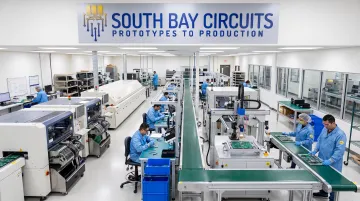
Encapsulation works best when it's built into the assembly workflow from the start, not bolted on as an afterthought. South Bay Circuits has operated as a single-source PCB manufacturer since 1981, running design, fabrication, assembly, and potting from one 60,000 square foot facility in Chandler, Arizona.
That integration matters for regulated programs:
- ISO 9001:2015 certified quality management across fabrication and assembly
- ISO 13485 compliance for medical device production
- ISO/TS 16949 compliance for automotive programs, including PPAP support
- AS 9100 aerospace compliance, plus ITAR registration and CMMC Level 1 for defense work
Keeping every step in-house eliminates the shipping and queue time that piles up when potting gets outsourced to a separate vendor. Assembly drawings carry potting requirements, tolerances, and testing instructions straight through the build, reducing the chance that encapsulation specs get lost in a handoff.
Frequently Asked Questions
What material is used for PCB encapsulation?
Epoxy, polyurethane, and silicone are the primary encapsulant chemistries. Epoxy offers the most rigidity and chemical resistance, polyurethane balances flexibility with durability, and silicone handles the widest temperature extremes.
What testing is done after PCB encapsulation?
Post-encapsulation testing typically includes visual inspection, X-ray inspection for hidden solder joints and voids, and electrical continuity testing. Specific test requirements should be defined in your assembly documentation and qualification plan.
How thick is PCB encapsulation compared to conformal coating?
Conformal coatings run 25 to 100 microns thick, while encapsulation resin starts at a minimum of 0.5 millimeters and is usually much thicker.
Can an encapsulated PCB be repaired or reworked?
Full encapsulation is largely permanent. Removing cured resin without damaging the board or components is difficult, so rework is far harder than with conformal coating, which can usually be stripped and reapplied.
Is PCB encapsulation the same as potting?
Yes. Potting and encapsulation are used interchangeably for fully immersing a PCB assembly in resin to protect the entire board.
How do I choose between encapsulation and conformal coating for my PCB?
Base the decision on environmental severity, weight tolerance, and rework needs. Extreme moisture, shock, or chemical exposure calls for encapsulation; lighter protection with easier rework favors conformal coating.