Conformal coating is the industry's answer: a thin protective film applied over a fully assembled PCB that follows every contour of the board, shielding components, solder joints, and traces without interfering with function.
This article walks through the different coating materials, the real benefits they deliver, how they're applied, and how to pick the right one for your application, plus why the manufacturing partner you choose matters as much as the coating itself.
Key Takeaways
- Conformal coating shields PCBs from moisture, dust, and chemicals with minimal added thickness.
- Five resin families dominate: acrylic, silicone, urethane, epoxy, and parylene, each with different tradeoffs.
- Coating thickness is chemistry-specific, so match material to your spec, not a universal range.
- Application method (brush, spray, dip, or robotic) depends on volume and masking needs.
- IPC-CC-830 and UL 746E certify the coating material, not the finished assembly.
What Is Conformal Coating & Why It's Essential for PCBs
Conformal coating is a thin, non-conductive polymeric film applied over a finished PCB assembly. It "conforms" to the board's physical features, covering components, solder joints, and copper traces without altering how the circuit performs.
Thickness varies by chemistry rather than a single blanket figure. According to NASA's workmanship standard for polymeric applications on electronic assemblies, cured coatings typically fall into these ranges:
| Coating Type | Typical Cured Thickness |
|---|---|
| Acrylic, epoxy, urethane | 25–127 micrometers (1–5 mils) |
| Silicone | 50–203 micrometers (2–8 mils) |
| Parylene | 13–51 micrometers (0.5–2 mils) |
Source: NASA-STD-8739.1B, 2016
That's far thinner than potting or encapsulation, which fully encases a component in resin and typically starts around 0.5mm. Conformal coating isn't waterproofing or hermetic sealing, either. Most traditional coatings are semi-permeable moisture barriers, not built for continuous submersion.
Key Benefits of Conformal Coating
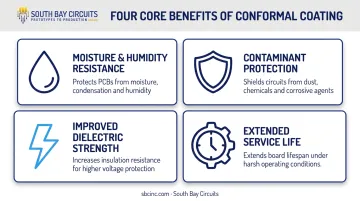
The core value of conformal coating comes down to a handful of protective functions:
- Moisture and humidity resistance — prevents corrosion and short circuits in damp or high-humidity environments
- Contaminant protection — blocks dust, debris, oils, solvents, and corrosive gases common on industrial floors
- Improved dielectric strength — lets boards handle higher voltages without breakdown, useful in high-voltage or high-frequency designs
- Extended service life — reduces the electrochemical migration and dendrite formation that cause opens or shorts over time
The stakes are real. Test data cited by IPC shows that raising moisture content in PCB material from 0 to just 0.98% increased the dielectric constant by 5.13% and the dissipation factor by 74.5%. Small amounts of moisture measurably change how a board behaves electrically, which is exactly what conformal coating is designed to prevent.
Types of Conformal Coating Materials
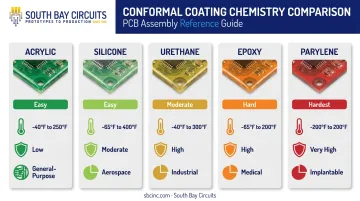
Five resin types dominate the market: acrylic, silicone, urethane, epoxy, and parylene. Each suits a different environment, and each comes with a different rework tradeoff. Choosing wrong doesn't just cost performance. It can also make future repairs painful.
Acrylic-Based Coatings
Acrylic is the low-cost, easy-to-apply option. It offers decent moisture and UV resistance and cures simply as its solvent carrier evaporates.
Rework is its biggest advantage. Acrylic dissolves with mild solvents like isopropanol, making it the easiest chemistry to strip for repair. The tradeoff: limited solvent resistance and a practical temperature ceiling around 250°F (125°C). It's best treated as general-purpose or entry-level protection, not a solution for harsh industrial exposure.
Silicone-Based Coatings
Silicone is flexible and rubbery, and it tolerates a wider temperature swing than any other common coating chemistry, with sustained performance from roughly -45°C to 150°C (-49°F to 302°F) and some specialty grades briefly withstanding 250°C (482°F). It also resists vibration, moisture, and chemical exposure well.
The catch: silicone is genuinely hard to rework. Removal requires chemical solvents plus physical agitation, and its rubbery structure can act as a thermal insulator, which matters for high-power components that need to shed heat.
Urethane (Polyurethane) Coatings
Urethane brings tough, abrasion- and chemical-resistant protection. It shows up often in aerospace and FDA-approved medical devices exposed to fuel vapors or harsh solvents.
Curing requires oven heat or UV exposure, which pushes urethane toward commercial production lines rather than in-house rework benches. Once cured, it's very difficult to remove, so plan for that upfront if the board will need future service.
Epoxy-Based Coatings
Epoxy is the rigid, two-part option. It delivers strong abrasion and chemical resistance for harsh industrial settings, and once cured, it's not going anywhere.
That permanence cuts both ways. Epoxy is the hardest of the five to rework or remove, and its rigidity can create mechanical stress on boards that flex or go through repeated thermal cycling. Reserve it for assemblies that won't need field service.
Parylene Coatings
Parylene stands apart because it's applied through chemical vapor deposition rather than spraying or dipping. The result is an ultra-thin, pinhole-free film with excellent dielectric strength and chemical resistance, which is why it's common in implantable medical devices and dense aerospace assemblies.
The practical downside: parylene requires specialized vacuum equipment, making it impractical for low-volume runs or any shop without dedicated CVD capability.
How Conformal Coating Is Applied to PCBs
Four application methods cover nearly every production scenario, and the right one depends on volume, board complexity, and how much masking the design requires.
- Brushing: reserved for small-batch touch-up or rework, where precision matters more than speed
- Manual or automated spraying: flexible for low-to-mid volume runs, though overspray control and masking take discipline
- Dipping: whole-board immersion that delivers consistent, repeatable coverage at higher throughput
- Selective robotic coating: programmed, high-precision deposition suited to medium and high-volume production where masking needs to be minimized
Dipping and selective robotic coating dominate high-volume manufacturing because they produce consistent film thickness run after run. Brushing stays relevant mainly for prototype work or spot repairs where a full re-dip isn't practical.
Cure method depends on the material and directly affects line speed. Acrylics air-dry as the solvent evaporates, while silicones, urethanes, and epoxies typically need heat or UV exposure to cure fully.
Once cured, thickness verification confirms the applied film matches specification. Wet film gauges check thickness before cure, while non-destructive eddy current or ultrasonic probes inspect the hardened coating without damaging the board.
How to Choose the Right Conformal Coating for Your Application
Coating selection should start with the operating environment, not the price sheet. Ask what the board will actually face in the field:
- Temperature extremes: will it see sustained heat, cold, or thermal cycling?
- Humidity and moisture exposure: indoor, outdoor, or marine environment?
- Chemical exposure: fuel vapors, solvents, or corrosive gases?
- Vibration and mechanical stress: automotive or aerospace duty cycles?
From there, check industry standards. IPC-CC-830 qualifies the coating compound itself, and UL 746E evaluates the polymeric material used, but neither standard alone certifies a finished product for aerospace, medical, or automotive use. Sector-specific requirements from your customer or regulatory body still apply on top of the base material qualification. Compliance covers material performance and certification, not what happens when a board needs service later.
Don't skip the rework question. If a board will need field service or diagnostic access later, epoxy and parylene make that dramatically more expensive and time-consuming. Acrylic and, to a lesser degree, silicone leave more room for future repair.
Why Partner with an Experienced PCB Assembly Provider for Conformal Coating
Picking the right chemistry is only half the job. Applying it correctly, at the right thickness, with the right masking, and verifying it afterward, takes equipment and process discipline that most in-house teams simply don't have on hand.
This is where a single-source contract manufacturer earns its keep. South Bay Circuits (SBC) has run PCB fabrication and assembly out of its Chandler, Arizona facility since 1981. The company holds ISO 9001:2015 certification, AS9100 aerospace compliance, ISO 13485 compliance for medical devices, and ITAR registration for defense work.
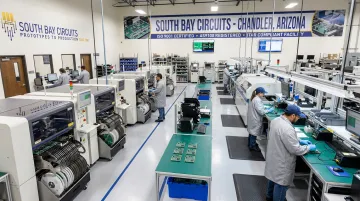
SBC offers acrylic, silicone, and urethane conformal coating as part of its assembly capabilities, alongside potting for applications that need heavier-duty environmental sealing. Because coating is handled within the same facility as SMT and through-hole assembly, boards don't leave the building between processes.
That single-source structure matters for a few reasons:
- Fewer handoffs between fabrication, assembly, and coating means fewer chances for miscommunication or spec drift
- Shorter turnaround, since coated boards don't sit in a queue waiting to ship to a separate vendor
- Consistent quality documentation across the entire build, from design through the coated final assembly
For OEMs building for aerospace, medical, automotive, or industrial environments, working with a provider that controls the full process, rather than farming coating out to a third party, reduces both risk and lead time.
Frequently Asked Questions
What are the different types of PCB coatings?
The five main types are acrylic, silicone, urethane, epoxy, and parylene. Each suits different environmental demands and rework requirements, from acrylic's easy solvent removal to parylene's vapor-deposited, pinhole-free barrier.
What is the waterproof coating for PCBs?
No traditional conformal coating is fully waterproof or hermetic. They're moisture-resistant barriers, with silicone and parylene offering the strongest protection. For submersion-level needs, potting compounds are the appropriate choice instead.
What are PCBs coated with?
PCBs are typically coated with a thin polymeric resin, such as acrylic, silicone, urethane, epoxy, or parylene. Application happens through spraying, dipping, brushing, or, for parylene, chemical vapor deposition.
Is conformal coating necessary for every PCB?
It isn't mandatory for every board, but it's strongly recommended for devices facing harsh environments, high reliability demands, or repair locations that are difficult to reach once deployed.
How thick should conformal coating be?
Thickness varies by chemistry: acrylic, epoxy, and urethane typically run 25–127 micrometers, silicone runs thicker at 50–203 micrometers, and parylene stays thin at 13–51 micrometers. Anything applied much thicker falls into the potting category instead.
Can conformal coating be removed for PCB rework?
Yes, though ease varies widely by material. Acrylic comes off easily with common solvents, while silicone, urethane, epoxy, and parylene require specialized solvents, heat, or mechanical abrasion to remove.