This breakdown is written for OEMs and engineering or procurement teams working in aerospace, medical, automotive, and industrial electronics. For these groups, understanding how PCBA actually works isn't academic — it affects quality outcomes, regulatory compliance, and how fast a product gets to market.
The term "PCBA contract manufacturing" gets used loosely across the industry, often as a catch-all for anything involving outsourced board assembly. Here's what the process actually involves, what factors change the outcome, and when it's the right call versus when it isn't.
Key Takeaways
- PCBA contract manufacturing outsources sourcing, assembly, inspection, and testing to deliver a working board from a bare PCB
- Typical flow covers design review, sourcing, SMT/through-hole assembly, inspection, and final integration
- Component availability, board complexity, and volume directly shape cost, quality, and lead time
- Full turnkey isn't right for every program; partial turnkey or in-house builds can fit better
What Is PCBA Contract Manufacturing?
PCBA contract manufacturing happens when a third-party manufacturer takes a customer's design files and bill of materials and delivers a fully assembled, tested circuit board. The customer provides the intent (specs, files, requirements); the manufacturer provides the execution.
The goal is straightforward: a reliable, repeatable, ready-to-integrate assembly: without the customer having to invest in SMT lines, test equipment, or a sourcing department to chase components.
Two services often get confused with full PCBA contract manufacturing:
- Bare PCB fabrication — produces only the unpopulated board (copper traces, no components)
- Partial/consignment assembly — the customer supplies some or all components, and the manufacturer handles labor and process only
Full turnkey PCBA covers everything: procurement, placement, soldering, inspection, and test. That distinction matters when you're comparing quotes, because "PCB manufacturer" and "PCBA contract manufacturer" aren't interchangeable terms.
Why PCBA Contract Manufacturing Is Used in Electronics Industries
Most OEMs don't outsource assembly because it's trendy. They do it because building in-house rarely makes financial or operational sense.
Capital Avoidance and Access to Equipment
SMT lines, AOI systems, X-ray inspection, and ICT testers represent serious capital investment, and they need to run at volume to justify the cost. Outsourcing gives OEMs access to that equipment without owning it.
The scale of this shift is significant. The global electronics manufacturing services market reached roughly $658 billion in 2024 and is projected to grow at a 4.6% CAGR, according to the Global Electronics Association. That's a lot of assembly work moving to specialized partners rather than staying in-house.
What Regulated Industries Demand
Medical, aerospace, and automotive programs don't just need boards assembled. They need documented proof of how they were assembled. That means:
- Component and process traceability
- Consistent process control across builds
- Certification compliance (ISO 13485, AS9100, IATF 16949)
A qualified contract manufacturer builds these requirements into the process instead of bolting them on after the fact.
What Goes Wrong Without a Qualified Partner
Skip the vetting step, and problems show up fast:
- Inconsistent soldering from poorly controlled reflow profiles
- Unapproved component substitutions that pass visually but fail in the field
- Defects that only surface at final test — or worse, after shipment
Many of those failures trace back to split responsibility between separate fab and assembly vendors.
Single-source providers that handle fabrication and assembly under one roof remove that handoff. South Bay Circuits builds boards and assembles them at the same 60,000-square-foot Chandler, Arizona facility. That cuts the shipping and queue time between stages, and the finger-pointing that follows when something goes wrong between vendors.
How the PCBA Contract Manufacturing Process Works
At a high level: design files and a BOM go in, components get sourced and placed, boards get soldered and inspected, and a tested assembly comes out. Simple to describe, less simple to execute consistently.
What the manufacturer needs from the customer upfront:
- Gerber files (complete 274X data set)
- Bill of materials
- Assembly drawings
- Testing and compliance requirements
From there, the board goes through a controlled sequence: DFM review, in-process inspection (AOI/X-ray), and acceptance testing against IPC-A-610 criteria. The end result is a non-functional bare board transformed into an application-ready assembly.
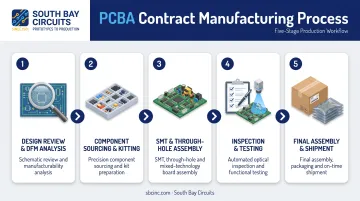
Step 1: Design Review and DFM Analysis
Before anything gets built, engineers review the BOM, Gerbers, and assembly drawings to catch manufacturability problems early. This typically works off a documented check sheet covering schematic accuracy, layout, tolerances, and file completeness. The goal is catching an issue on paper instead of on the line.
Step 2: Component Sourcing and Kitting
Approved suppliers source and verify every part on the BOM, flagging long-lead or obsolete components before they become a scheduling problem. Many contract manufacturers, including South Bay Circuits (SBC), run this through VMI, JIT, or Kanban inventory programs so replenishment happens based on consumption rather than reactive ordering.
Step 3: SMT and Through-Hole Assembly
This is the physical transformation step:
- Solder paste application: precisely deposited onto pads
- Automated placement: pick-and-place equipment sets components, including fine-pitch and BGA packages
- Reflow or wave soldering: bonds components to the board permanently
Fine-pitch and BGA work is where equipment capability really separates providers. Some lines simply can't handle 0.4mm pitch or smaller without engineering review.
Step 4: Inspection and Testing
No single test method catches everything, which is why most builds combine several:
| Method | What it catches |
|---|---|
| AOI | Misalignment, solder shorts/opens, visible defects |
| X-ray (AXI) | Hidden joints under BGAs and other obscured solder connections |
| ICT | Electrical faults like shorts, opens, and incorrect values |
| Functional test | Whether the finished board actually operates as designed |
Combining methods matters more than picking one. According to a test-strategy analysis published by Circuits Assembly, ICT alone caught 22% of defects in one study, while pairing ICT with X-ray inspection pushed detection to 95%. A board can sail through AOI and still fail functionally. Visual pass and functional reliability aren't the same thing.
Step 5: Final Assembly and Shipment
The last stage closes out the build: conformal coating (silicone, acrylic, or urethane) for environmental protection, box-build integration where required, final packaging, and documentation (traceability records, inspection data, and certificates as needed).
Providers with in-house fab-to-assembly capability move faster here simply because there's no shipping gap between stages. SBC's Chandler facility can move from finished layout through fabrication and loaded assembly in as little as 48 hours for quick-turn programs, versus the days or weeks that stack up when boards travel between separate vendors.
Where PCBA Contract Manufacturing Is Applied
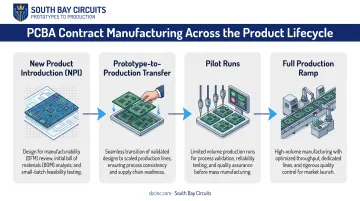
PCBA outsourcing applies across the full product lifecycle, not just at high-volume production:
- New product introduction (NPI) — first builds of a new design or variant
- Prototype-to-production transfer — moving from a validated prototype into repeatable manufacturing
- Pilot runs — small batches used to confirm process before scaling
- Full production ramp — sustained volume manufacturing
Common triggers include a product launch, a supplier transfer, a cost-reduction initiative, or simply outgrowing in-house capacity.
What Shapes Builds at Every Stage
Across NPI through full production, a handful of variables determine how a build actually performs:
- Component availability — A 2021 IPC survey found 88% of manufacturers faced longer lead times; 31% saw delays of eight weeks or more
- Process conditions — reflow profiles and solder paste quality directly affect defect rates
- Equipment capability — SMT lines need to support fine-pitch and BGA work, not just standard components
- Scale and volume — prototype-style builds and high-throughput production use different methods entirely
- Regulatory requirements — ISO 13485, AS9100, and IATF 16949 constrain which processes are acceptable for medical, aerospace, and automotive builds
Common Issues, Misconceptions, and When It May Not Be the Right Fit
The biggest misconception: PCBA contract manufacturing is "just putting parts on a board." In reality, sourcing strategy, documentation control, and test planning matter as much as the physical assembly.
A related mistake is assuming any manufacturer can handle any complexity level. Fine-pitch and high-layer-count boards need specific equipment and process controls. Hand that work to a provider without those capabilities, and yield problems follow.
There's also a gap between passing inspection and proving reliability. A board can look flawless under AOI and still fail under functional or environmental testing. Visual inspection and functional validation answer different questions.
When It May Not Be the Right Fit
Full turnkey outsourcing isn't always the right model:
- Extremely low-volume, one-off prototypes are often faster and cheaper when built in-house or through a quick-turn prototype service
- Highly proprietary or IP-sensitive designs may call for a tightly vetted domestic partner rather than broad outsourcing
- Existing supplier relationships may make partial turnkey (where the customer supplies some components) a better fit than full outsourcing
South Bay Circuits supports consignment and partial turnkey programs alongside full turnkey builds. That flexibility lets customers keep control over specific components while still outsourcing the labor-intensive parts of assembly.
Conclusion
PCBA contract manufacturing takes a bare board through sourcing, placement, soldering, and inspection until it becomes a tested, functional assembly. Each step in that chain — DFM review, component sourcing, SMT execution, inspection, final integration — has its own failure points.
Understanding those steps changes how you evaluate a manufacturer. Capability, documentation practices, and quality control matter more than price alone.
An experienced single-source partner that handles fabrication and assembly under one roof, like South Bay Circuits, removes the handoff risk of coordinating separate vendors and typically shortens the path from design file to shipped assembly.
Frequently Asked Questions
What is PCBA contract manufacturing?
PCBA contract manufacturing is the outsourced process of sourcing components, assembling them onto a PCB, and testing the finished board for the customer. The manufacturer handles procurement, placement, soldering, and quality verification.
How much does PCBA contract manufacturing cost?
Cost depends on board complexity, component selection, order volume, and testing requirements. Outsourcing generally reduces total cost compared to building in-house, since it avoids capital investment in SMT and test equipment.
What is the difference between a PCB and a PCBA?
A PCB is the bare, unpopulated board — just copper traces on a substrate. A PCBA is that same board after components have been soldered on and it functions as a working assembly.
How long does the PCBA contract manufacturing process take?
Timelines vary with board complexity and component sourcing. Quick-turn builds can ship in days; standard production runs usually take several weeks, driven by volume and part lead times.
What is turnkey PCBA assembly?
Turnkey means the manufacturer handles all sourcing, assembly, and testing from start to finish. Partial turnkey means the customer supplies some components while the manufacturer manages the rest of the process.
What industries rely most on PCBA contract manufacturing?
Industrial, medical, aerospace and defense, and automotive sectors rely on it most. Those markets demand strict quality, full traceability, and high reliability across every build.