Picking the wrong one isn't a minor mistake. It can add unnecessary weight to a handheld product, drive up production cost on a high-volume run, or leave a board exposed to the exact failure mode it was supposed to prevent. This guide breaks down what separates conformal coating from potting, where each one fits, and how to decide which method suits your application.
Key Takeaways
- Conformal coating suits moderate environments and designs that need thin, lightweight protection with rework access.
- Potting fully encapsulates assemblies in resin for stronger shock, vibration, and moisture protection—at the cost of weight and reworkability.
- Cost, thickness limits, and inspection needs usually decide which method wins.
- Aerospace, medical, and automotive lines often mix both methods by assembly exposure risk.
Conformal Coating vs Potting: Quick Comparison
Here’s how conformal coating and potting compare on the factors that usually drive a design review.
| Factor | Conformal Coating | Potting |
|---|---|---|
| Cost | Lower material and labor cost; faster processing | Higher cost from material volume, mixing, and longer cure times |
| Thickness | Thin film, generally under a few hundred microns depending on chemistry | Bulk fill; up to ~0.25 in (6.35 mm) per Assembly Magazine |
| Weight | Minimal added weight | Adds significant bulk and mass |
| Protection level | Moderate defense against moisture, dust, and corrosion | Strong resistance to physical shock, vibration, and chemical or moisture ingress |
| Reworkability | Can be stripped via solvent, mechanical abrasion, or thermal methods | Difficult; removal often damages the board or components underneath |
Conformal coating trades some protection for flexibility and lower cost. Potting trades rework flexibility for maximum durability. The right choice depends on what the assembly has to survive.
What Is Conformal Coating?
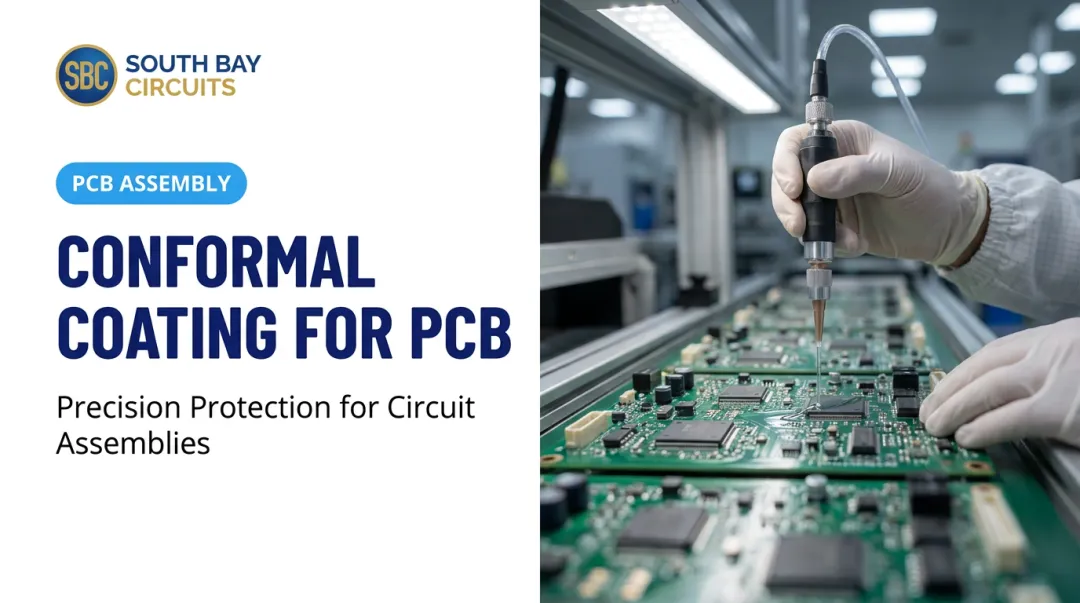
Conformal coating is a thin, non-conductive dielectric film that follows the exact contours of a PCB. It's applied by spraying, dipping, or brushing, and it cures into a protective layer that conforms (hence the name) to every component and trace on the board.
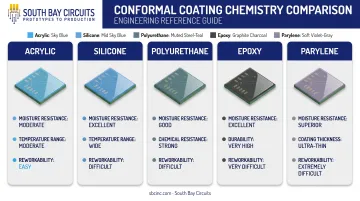
The main chemistries each bring different strengths:
- Acrylic: low moisture absorption, easy to apply, and one of the simplest coatings to strip for rework
- Silicone: absorbs shock and vibration, stays stable from roughly -65°C to 200°C, but offers weaker mechanical strength
- Polyurethane: tough, flexible, and resistant to oils and solvents, with some formulations rated for continuous use near 160°C
- Epoxy: rigid with excellent chemical resistance, but notoriously hard to remove without risking damage
- Parylene: vapor-deposited, chemically resistant, and biocompatible, though it requires specialized rework equipment
For contract manufacturers, coating matters because it protects against moisture, dust, and corrosion without changing a board's form factor. Since many coatings remain translucent, inspectors can visually check solder joints and components after the coating cures, which helps quality control.
Where Conformal Coating Fits in Production
Conformal coating is typically the last protective step, applied after assembly and functional testing but before final box-build or shipment. That sequencing matters: coating a board too early can interfere with test probes or rework access.
Common applications include:
- Consumer electronics and wearables, where every gram counts
- Handheld and mobile devices operating in variable humidity
- Automotive control modules mounted in tight, weight-sensitive spaces
A 2012 IPC study tested silicone conformal coatings on printed circuit coupons under accelerated humidity conditions (500 hours at 85°C and 85% relative humidity with a 50V DC bias). Insulation resistance measured in the range of 3.5 to 4.5 x 10^9 ohms across the tested formulations.
That is laboratory evidence of how well coated boards resist moisture-driven current leakage, not a field-failure percentage. It still shows why coating remains a go-to defense against humidity-related degradation.
What Is Potting?
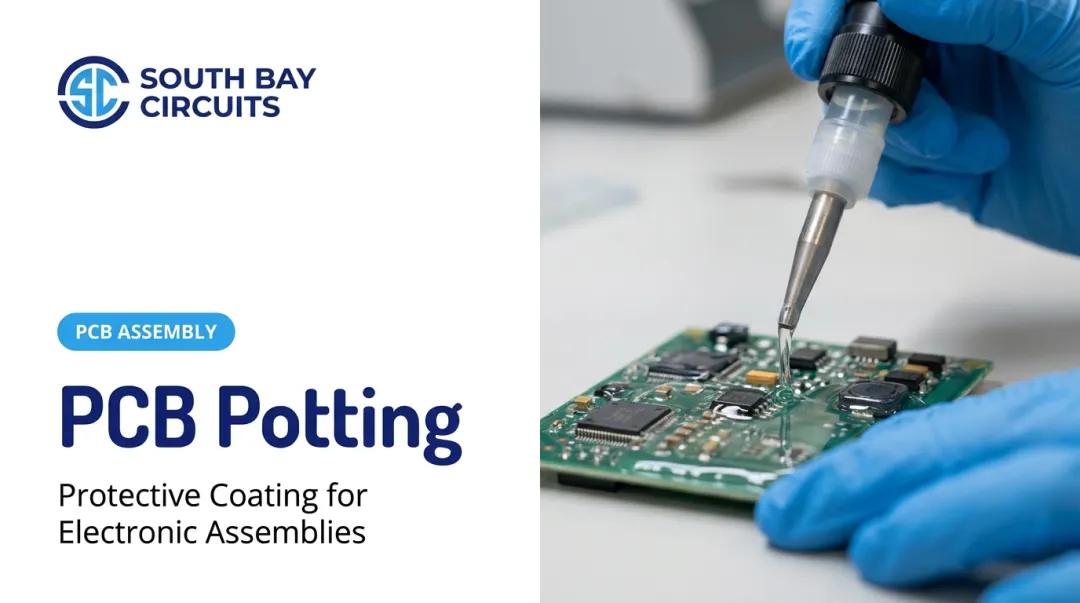
Potting, sometimes called encapsulation, embeds the full assembly rather than coating it. The entire PCB goes into a mold (a "pot") filled with a liquid compound that cures into a solid block. Once cured, the board is essentially embedded inside the material.
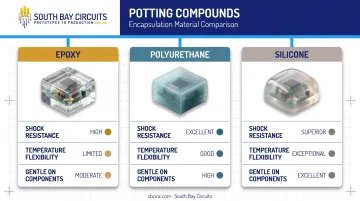
The three most common potting compounds:
- Epoxy: tough, chemically resistant block with strong shock protection; rigid grades for impact, flexible grades for thermal cycling
- Polyurethane: stays elastic at very low temperatures and resists water ingress; suited to submersion applications
- Silicone: wide operating-temperature range and low modulus, so it is gentler on delicate surface-mount parts
Potting matters most for harsh-environment hardware. It shields components from extreme vibration, chemical exposure, and moisture.
The opaque resin also makes reverse-engineering a finished assembly much harder—a real advantage for defense and proprietary designs.
Where Potting Fits in the Supply Chain
Unlike conformal coating, potting is usually specified upfront during design, not added as an afterthought. It's built into the assembly plan for mission-critical hardware.
Industries where potting dominates:
- Aerospace and marine electronics exposed to constant vibration and salt moisture
- Automotive sensors mounted near engines or in wheel wells
- High-voltage industrial equipment operating in dusty, chemically aggressive settings
Manufacturer guidance from Henkel and MG Chemicals consistently describes potting as adding mechanical strength while protecting against humidity, salt water, and chemical exposure. Those benefits show up across decades of military and industrial hardware.
SBC's in-house assembly capabilities cover both conformal coating and potting as part of a single-source turnkey model. Operationally, that means a board can move from prototype through protected production without a second vendor for coating or potting. You cut handoff risk and calendar time in one move.
Conformal Coating vs Potting: Which Is Better?
There's no universal winner here. The right call depends on four factors:
- Environmental exposure — How severe is the moisture, temperature swing, or chemical contact the board will face?
- Weight and thickness limits — Does the enclosure or product spec allow for added bulk?
- Rework and inspection needs — Will engineers need to access components after coating for repair or testing?
- Production volume and cost targets — Can the program absorb potting's higher material and labor cost?
HZO's comparison of the two methods frames it simply: potting wins when water exposure and physical shock are severe, while coating wins when weight, space, and serviceability are the priority.
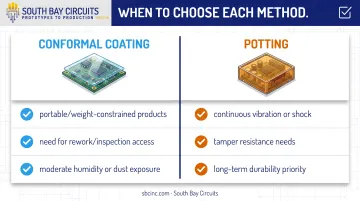
Choose conformal coating when:
- The product is portable, handheld, or otherwise weight- or space-constrained
- Engineers need to inspect or rework the board after protection is applied
- The environment involves moderate humidity or dust, not submersion or heavy impact
Choose potting when:
- The assembly faces continuous vibration, mechanical shock, or submersion
- Tamper resistance or design security is a requirement
- Long-term durability outweighs the need for future rework access
A Common Real-World Scenario
This scenario shows up often in industrial control manufacturing. A control module passes bench testing, then develops intermittent failures in the field near pumps or compressors that generate constant vibration and occasional moisture.
A conformal-coated board might handle the moisture fine but can't absorb sustained mechanical shock the way a solid resin block can. Teams in this spot often switch the assembly from coating to potting. They accept the added weight and cost for a design that survives the vibration profile.
The decision usually comes down to a straightforward comparison: does the observed failure mode match a moisture problem (favoring coating) or a shock/vibration problem (favoring potting)? Getting that diagnosis right the first time avoids a second design cycle.
If you're facing a similar trade-off, SBC's engineering team can review your assembly drawings and exposure requirements to recommend the right protection method before production starts, so failures never show up in the field.
Conclusion
Neither conformal coating nor potting is the universally "better" option. The right choice depends on environmental exposure, weight and thickness constraints, rework needs, and production budget. Understanding these trade-offs upfront helps manufacturers avoid expensive redesigns and premature field failures later.
The right call means less downtime, lower long-term repair costs, and a more reliable product in the field. Partnering with a single-source PCB assembly provider like SBC means the chosen protection method — whether that's coating, potting, or both — gets applied correctly and consistently across every production run, from prototype through high-volume manufacturing.
Frequently Asked Questions
What is the difference between conformal coating and potting?
Conformal coating is a thin protective film that follows the board's contours, while potting fully encases the assembly in a thick resin block. The result is different protection levels, added weight, and rework difficulty between the two methods.
Is conformal coating worth it?
For most moderate-environment applications, yes — its low cost and added reliability make it a worthwhile investment, especially when weight and future rework access matter to the design.
What is the best potting material for electronics?
It depends on the requirement. Epoxy offers the best chemical resistance and rigidity; polyurethane handles water ingress and low-temperature flexibility well; silicone covers the widest temperature range and stresses delicate components the least.
Can conformal coating and potting be combined on the same PCB assembly?
Yes, some assemblies use conformal coating on sensitive or serviceable components while potting protects the overall enclosure, depending on localized protection needs defined in the assembly drawings.
How does the cost of conformal coating compare to potting?
Conformal coating is generally less expensive due to lower material use, simpler application, and faster processing. Potting costs more because of higher material volume, mixing steps, and longer cure times.
Does conformal coating or potting make PCB rework harder?
Potting significantly complicates rework since removing the cured resin can damage the board underneath. Conformal coating, by contrast, can typically be stripped using solvent, mechanical, or thermal methods with far less disruption.