Introduction
PCB assembly, or PCBA, is the process of populating a bare printed circuit board with electronic components to create a functional, ready-to-integrate module. That's the short version.
For engineers, procurement managers, and product teams in aerospace, medical, automotive, and industrial sectors, the details behind that definition matter. In these regulated industries, understanding the actual assembly process drives quality, compliance, and deadlines that customers and regulators won't move.
"PCB assembly" gets used loosely in conversation. The real operational steps, controls, and quality checkpoints behind that phrase are frequently misunderstood outside the manufacturing floor. Confusing them leads to bad specs, missed defects, and expensive rework.
This article breaks down how the process works step-by-step, what affects assembly quality, and where it's applied across product lifecycles.
Key Takeaways
- PCBA transforms a bare board into a tested, functional circuit through soldering, placement, and inspection
- Regulated industries need traceability and repeatable quality under AS9100, ISO 13485, and IATF 16949
- A controlled path runs from DFM checks through SMT, reflow, through-hole work, and final test
- Component quality, solder paste control, and equipment calibration decide whether an assembly survives the field
- Turnkey and consigned models both work—partner fit drives cost, speed, and field reliability
What Is PCB Assembly?
PCB assembly is the process of attaching electronic components, such as resistors, integrated circuits, and connectors, to a bare printed circuit board using soldering techniques. The result is a functional circuit rather than just a piece of etched fiberglass and copper.
That finished board is a fully operational electronic module ready for testing, enclosure integration, or installation into a larger system. It's the point where a design finally becomes something that actually works.
Three terms get blurred together in procurement conversations:
- PCB fabrication creates the bare board itself, meaning the etched copper traces, drilled holes, and laminate layers, with no components attached
- PCB design/layout determines where components and traces will go on that board, happening entirely on a computer screen before manufacturing starts
- PCB assembly is the final production step, where a fabricated, bare board gets populated with parts and turned into a working module
IPC's rigid-board assembly checklist draws this same procurement line. Purchasing the printed board is treated separately from purchasing components, solder paste, and stencils, and separately again from the actual assembly, soldering, testing, and cleaning operations that follow (IPC PCBA Checklist).
Why PCB Assembly Is Critical in Regulated Industries
Aerospace, medical, automotive, and industrial equipment manufacturers can't tolerate inconsistent assembly. A defect that would be a minor annoyance in a consumer gadget can cause a safety incident, a costly recall, or a compliance failure in these sectors.
What Regulated Industries Actually Require
These industries need more than "it worked on the bench." They require:
- Traceability back to component lot codes, manufacturers, and production dates
- Controlled tolerances that hold steady across every unit, not just the first prototype
- Repeatable quality across high-mix, low-to-high volume production runs where conditions change constantly
What Goes Wrong Without Controlled Processes
Skip the controls, and problems surface, sometimes only after deployment:
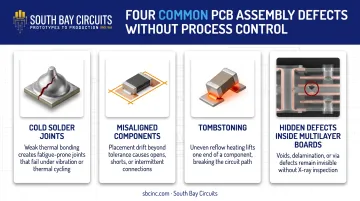
- Cold solder joints that pass a quick visual check but fail electrically
- Misaligned components from placement drift
- Tombstoning, where a small passive component stands on end instead of lying flat
- Hidden defects buried inside multilayer boards that no amount of squinting will catch
These aren't theoretical risks. In 2015, Fiat Chrysler recalled 23,629 Dodge Dart vehicles after internal solder joints inside transmission control module boards separated, with FCA estimating 15% of that population actually contained the defect. The failure could shift the transmission into neutral without warning (NHTSA Recall Report 15V-542).
Compliance Is the Baseline, Not a Bonus
Assembly quality in these sectors is regulatory-driven, not optional best practice:
- ISO 13485 for medical device manufacturing
- AS9100 for aerospace and defense
- IATF/TS 16949 for automotive
Manufacturers that hold multiple certifications under one roof reduce a specific risk: handoff errors between fabrication and assembly.
South Bay Circuits (SBC), for example, maintains ISO 9001:2015 alongside AS9100, ISO 13485, and ISO/TS 16949. Keeping design, fabrication, and assembly in one facility means boards don't move between vendors—and there's no ambiguity over who owns a defect when something goes wrong.
How the PCB Assembly Process Works (Step-by-Step)
A fabricated bare board enters assembly, receives its components, and leaves as a tested, functional assembly. Getting there requires:
- A fabricated PCB
- A bill of materials (BOM)
- Gerber or ODB++ design files
- Solder paste
- Sourced, verified components
During assembly, automated systems and technicians place components, solder them, and bond them electrically to the board's copper traces. DFM checks, solder paste inspection, placement accuracy monitoring, and post-solder inspection keep each stage in control. The result is a functional PCBA ready for testing and integration.
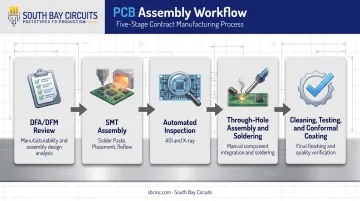
DFA/DFM Review and Material Preparation
Before production starts, engineers verify the BOM, Gerber/ODB++ files, footprint accuracy, and component spacing. Catching issues here prevents costly respins later.
SBC's team runs Design for Manufacturability and Design for Testability reviews using Valor front-end planning software. They confirm Excel BOMs include designators, manufacturer part numbers, and sourcing designations before anything touches the line.
SMT Assembly: Solder Paste, Placement, Reflow
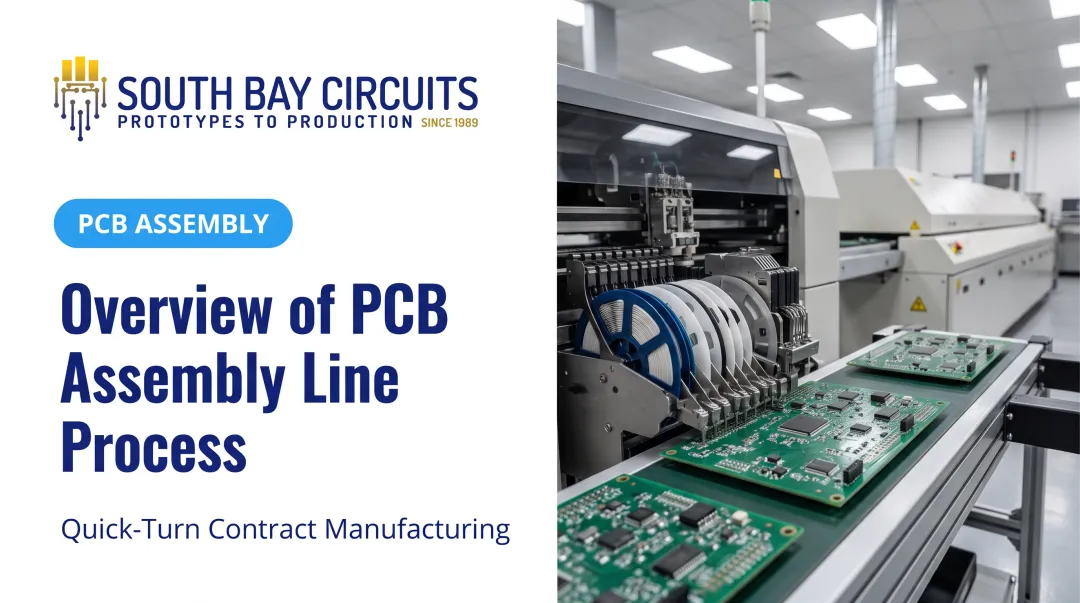
A stencil applies solder paste, then automated pick-and-place equipment mounts surface-mount components onto the paste. Reflow soldering permanently bonds the parts using controlled heat profiles. SBC runs this stage on Fuji SMT equipment—including CP-642 and CP-65 chipshooters and an IP-3 flexible placer—supporting placement down to fine-pitch geometries.
Automated Inspection (AOI and X-ray)
Optical inspection systems scan for missing components, solder bridges, and misalignment. X-ray inspection goes further, checking hidden joints on complex or multilayer boards, particularly under BGA packages where a visual camera simply can't see. SBC uses a Glenbrook Jewel Box 70T X-ray system for concealed-joint verification.
Through-Hole Assembly and Soldering
Operators insert leaded components and solder them with one of three methods, chosen by component sensitivity:
- Wave soldering for boards with a high volume of through-hole parts
- Selective soldering for mixed-technology boards needing targeted heat
- Manual hand soldering for delicate or low-volume components
Cleaning, Final Testing, and Conformal Coating
Cleaning removes flux residue, then functional and electrical testing confirm real-world performance. Optional conformal coating adds environmental protection for boards headed into harsh operating conditions. These final steps verify the assembly works as designed before it leaves the line.
Where PCB Assembly Is Applied and What Affects Its Quality
PCB assembly happens across a wide range of end products: consumer electronics, industrial controls, medical devices, aerospace avionics, and automotive control units. It occurs at several points in a product's lifecycle: after design finalization and PCB fabrication, during prototyping, and at full production scale-up.
Common triggers for a new assembly run include:
- New product introduction (NPI)
- Design revisions requiring a respin
- Recurring production orders on an existing design
Factors That Determine Assembly Outcomes
Assembly quality depends on several controllable factors:
- Component and material quality, including counterfeit-risk sourcing, footprint accuracy, and lot-level traceability (areas NASA supplier guidance flags as high risk)
- Operating conditions such as reflow oven temperature profiles and solder paste type (leaded vs. lead-free), per IPC-7530 thermal-profile guidance
- Equipment capability, including pick-and-place calibration accuracy and AOI/X-ray inspection
- Volume and mix: high-mix, low-volume runs need different setup controls than steady high-volume production
- Industry requirements, from IPC Class 3 for high-reliability aerospace and medical boards to IPC Class 2 for standard commercial products
SBC's assembly line supports both IPC-A-610 Class 2 and Class 3 workmanship based on customer specification, with fine-pitch placement down to 0.4mm (tighter geometries go through engineering review).
Single-source manufacturers that keep fabrication and assembly under one roof also cut queue and shipping time between these steps. SBC's Chandler, Arizona facility spans more than 60,000 square feet and runs both processes in-house.
Common Misconceptions and When In-House Assembly May Not Be the Right Fit
"It's Just Soldering Parts On"
This is probably the most persistent misconception in the industry. Real PCB assembly involves far more than placing parts with a soldering iron:
- DFM verification before builds start
- Controlled solder paste application
- Calibrated placement equipment
- Multi-stage inspection before boards ship
A Clean Visual Inspection Doesn't Mean a Working Board
Teams sometimes assume that if a board looks right under AOI, it is right. That's not always true. Electrical and functional testing exist precisely because a solder joint can look acceptable and still fail under load or over time.
PCB vs. PCBA: A Distinction That Affects Your Quote
Confusing "PCB" (bare board) with "PCBA" (assembled board) creates real problems when communicating specs to a contract manufacturer. A quote request for a "PCB" that actually needs full population and testing will come back wrong, or worse, get built wrong.
When In-House Assembly Stops Making Sense
Manual or small-batch in-house assembly can work fine for simple boards at low volume. It becomes risky in a few specific scenarios:
- High-complexity multilayer boards with tight component density
- Projects requiring IPC Class 3 tolerances for high-reliability applications
- Volume production that exceeds a team's equipment capacity
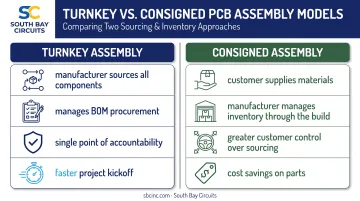
At that point, outsourcing to an experienced contract manufacturer becomes the more reliable path. Materials supply can flex with the project as well. SBC runs turnkey assembly, managing BOM procurement and component sourcing directly, and consigned assembly, where the customer supplies materials and SBC manages that inventory through the build.
Frequently Asked Questions
What is a PCBA assembly?
PCBA (Printed Circuit Board Assembly) refers to a bare PCB after all components have been soldered and mounted onto it. It's a complete, functional electronic module rather than an unpopulated board.
What is an example of a PCB?
Common examples include a car's engine control unit board, a household appliance's control board, and a smartphone motherboard. Each is a bare board before assembly and a PCBA once populated.
What is the difference between PCB fabrication and PCB assembly?
Fabrication creates the bare board with etched copper traces and drilled holes. Assembly is the later step of mounting and soldering components onto that finished board.
How long does the PCB assembly process typically take?
Turnaround depends on complexity and volume. Prototype builds can finish the same day once parts are in hand; high-volume or complex multilayer boards often need days to weeks.
What quality standards apply to PCB assembly?
IPC-A-610 sets acceptability criteria for solder joints and component placement. ISO 9001:2015, AS9100 for aerospace, and ISO 13485 for medical devices govern the quality management systems that support that work.
Can PCB assembly be done for both prototypes and full production runs?
Yes. Most contract manufacturers support both, typically using the same DFM and inspection processes while scaling equipment and staffing differently between quick-turn prototypes and full production volume.