Introduction
Every PCB assembly decision starts with the same fork in the road: mount the component on the surface, or push it through a drilled hole. Surface Mount Technology (SMT) and Through-Hole Technology (THT) remain the two foundational assembly methods across nearly every electronics-driven industry, from consumer gadgets to fighter jet avionics.
Get the choice wrong, and you inherit problems that compound fast:
- Slower production runs and higher unit cost
- Brittle solder joints that fail under stress
- Boards too bulky for their enclosures
The method you pick shapes mechanical durability and how the finished product performs years down the road.
Modern high-speed SMT placement machines can now run at up to 120,000 components per hour—a scale of automation that has made SMT the default for compact, high-volume electronics.
THT hasn't gone anywhere. It remains written into aerospace, military, and automotive acceptance standards where a soldered joint must survive vibration, shock, and years of thermal cycling.
This article breaks down how SMT and THT actually differ, where each earns its place on a bill of materials, and why many of today's best-performing boards use both.
Key Takeaways
- SMT mounts components on the board surface for automated, high-density builds in compact electronics.
- THT runs leads through drilled holes, forming strong mechanical bonds for high-stress and high-power use.
- Choose SMT or THT based on budget, volume, and durability—not preference alone.
- Most modern boards mix both: SMT for density, THT for structural strength.
SMT vs THT: Quick Comparison
Here's how SMT and THT stack up across the four factors that matter most on a production floor.
Cost
- SMT: Higher upfront investment in placement equipment and reflow ovens, but automation drives per-unit cost down sharply at volume.
- THT: Components and tooling are simpler and cheaper, but manual insertion and drilling add labor cost that grows with board count.
Neither method wins on cost by default. A prototype batch of 25 boards often favors THT's simplicity. A production run of 50,000 almost always favors SMT's automation.
Component Density
- SMT: Enables double-sided, high-density placement, which is critical for compact, feature-packed designs.
- THT: Requires more board real estate per component, limiting how small a design can get.
Manufacturers like Panasonic note that surface mounting allows higher component density and reduced board size compared to through-hole construction. That's one reason SMT dominates anything with a "compact" spec sheet.
Mechanical Durability
- SMT: Solder joints sit on the surface, making them more vulnerable to vibration, mechanical shock, and repeated thermal stress.
- THT: Leads pass through plated holes, creating a joint supported on both sides of the board that is harder to shear off under stress.
Assembly Speed & Automation
- SMT: Pick-and-place machines and reflow ovens run continuously with minimal human intervention, ideal for fast, high-volume runs.
- THT: Often relies on manual or semi-automated insertion followed by wave soldering, which is slower and more labor-intensive.
What is SMT?
Surface Mount Technology solders components directly onto pads on the PCB surface, no drilled holes required. That simple shift is what allows modern electronics to shrink from desktop-sized to pocket-sized.
Core benefits of SMT include:
- Higher component density, since parts don't need drilled holes or extra clearance
- Faster automated throughput on pick-and-place lines
- Lower material and labor cost per unit at scale
- Support for single- or double-sided assembly
SMT production runs through three linked steps:
- Print solder paste onto the pads
- Place components with sub-millimeter accuracy on a pick-and-place machine
- Melt the paste in a reflow oven to form permanent connections
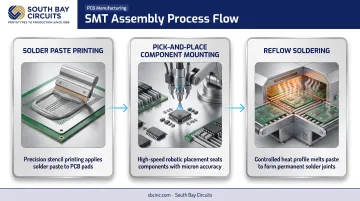
At South Bay Circuits' Chandler, Arizona facility, that flow runs on one automated line with no manual handoffs between steps. The line uses vision-guided Speedline Accuflex and MPM 125 solder printers, Fuji CP-642 and CP-65 chipshooters, a Fuji IP-3 flexible placer, and BTU VIP 70 and Conceptronic HVA-70 convection reflow ovens.
Use Cases of SMT
SMT is the go-to method anywhere density and volume matter more than mechanical toughness:
- Smartphones and wearables, where board real estate is measured in millimeters
- Computing and telecom hardware, which need dense, high-speed signal routing
- Medical instrumentation, where compact form factors matter without sacrificing precision
Placement speed is a major reason SMT scales so well. Current-generation mounters running well over 100,000 components per hour would take a manual assembler weeks to match.
SBC's SMT lines support standard placement down to 0201 packages, fine-pitch work down to 0.4 mm, and BGA and micro-BGA components verified through X-ray inspection. That range covers the density most medical, industrial, and telecom boards demand.
What is THT?
Through-hole technology (THT) inserts leaded components—axial resistors, radial capacitors, and connectors—through drilled holes in the board, then solders the leads on the opposite side. It's the older of the two methods, but it hasn't been phased out. The process is mature and fully standardized.
Core benefits of THT include:
- Strong mechanical bonds, since the lead is anchored through the board rather than sitting on its surface
- Easier rework and repair, because leaded components are simpler to desolder and replace
- Better performance under thermal or mechanical stress, which matters in harsh operating environments
Most THT lines rely on wave soldering, where the board passes over a wave of molten solder that coats all exposed leads at once. Some facilities also use selective soldering for boards that mix THT with heat-sensitive SMT parts, applying solder only where it's needed.
South Bay Circuits runs wave soldering through a Manncorp 28D400 dual-pot system, plus hand soldering for specialty or low-volume components.
Use Cases of THT
THT holds its ground wherever a board has to survive more than a gentle office environment:
- Aerospace and defense, where IPC-6012 Class III and MIL-PRF-31032 standards govern high-reliability builds
- Automotive electronics, exposed to constant vibration and temperature swings under the hood
- Industrial controls, running in dusty, high-vibration facility environments
- Medical devices, where a failed joint isn't an option
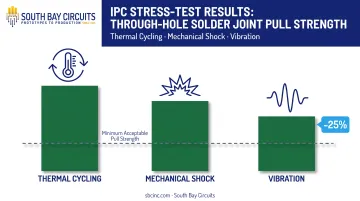
The mechanical case for THT has real test data behind it. An IPC-hosted study that stress-tested more than 3,500 through-hole solder joints under thermal cycling, mechanical shock, and vibration found that thermal cycling barely affected pull strength.
Vibration caused the largest reduction recorded, at 25%, yet joints still held well above the study's minimum strength threshold. That's the kind of margin engineers look for when a board is going into a vehicle, an aircraft, or factory equipment that can't afford a field failure.
SMT vs THT: Which Is Better for Your Project?
There's no universal winner. The right call depends on five factors:
- Production volume – prototypes and short runs often favor THT's simpler tooling; high-volume runs favor SMT's automation.
- Budget – SMT amortizes equipment cost across volume; THT keeps upfront costs low for small batches.
- Component type – some parts, like large transformers and heat-sinked power semiconductors, aren't made for surface mounting.
- Mechanical or environmental stress – vibration, shock, and thermal cycling push the decision toward THT.
- Time-to-market – SMT's automated lines generally move faster from design release to finished boards.
Choose SMT when: your design is compact, high-volume, cost-sensitive, or running at high frequencies where trace length and parasitic effects matter.
Choose THT when: components are high-power or high-stress, your run is small or still in prototype, or you need the flexibility to rework joints by hand.
Choose a hybrid approach when: your board needs both: dense signal-processing components on the surface and a handful of connectors or power components anchored through the board. This is how most production PCBs are actually built today.
Real-World Example: Single-Source Mixed Assembly in Action
Picture a common scenario for an industrial OEM: the bare board comes from one fabricator, SMT placement happens at a second shop, and THT insertion and wave soldering happen at a third. Every handoff adds a shipping leg, a queue, and a new chance for miscommunication about tolerances or component orientation.
When a board fails inspection, the fabricator blames the assembler, the assembler blames the fabricator, and the OEM waits for someone to take ownership.
Consolidating design, fabrication, and mixed-technology assembly under one roof removes those handoffs entirely.
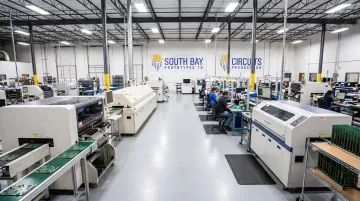
South Bay Circuits has run SMT and THT lines from the same Chandler, Arizona facility since adding its first Fuji SMT line in 2004. Boards move through automated SMT placement and wave- or hand-soldered THT on the same line, then AOI, X-ray, and functional testing before they ship.
In SBC's own new-product-introduction comparisons, moving from a fragmented multi-vendor timeline to a consolidated design-to-assembly process cut a typical 23-day schedule by roughly 43%. There's no blame game when one team owns fabrication and assembly, just a faster answer when something needs fixing.
If your next build mixes dense SMT sections with rugged THT connectors, it's worth talking to a single-source manufacturer before splitting the job across vendors.
Conclusion
SMT and THT aren't competitors so much as tools with different jobs. SMT wins on density, speed, and cost at volume. THT wins on mechanical strength and survivability in harsh environments. Boards that succeed in the field use whichever method fits each component, not whichever method is fashionable.
That decision gets easier, and less risky, when one manufacturer handles it end to end. South Bay Circuits has spent more than 40 years building fabrication and assembly expertise under one roof in Chandler, Arizona. They apply SMT, THT, or a mixed approach based on what a design actually needs rather than what a single production line happens to support.
That's the difference between a board that meets spec on paper and one that keeps working after years in the field.
Frequently Asked Questions
What is the difference between SMT and THT?
SMT mounts components directly onto the PCB surface for compact, automated assembly. THT inserts leaded components through drilled holes, creating stronger mechanical bonds at the cost of board space and speed.
What is a THT PCB board?
A THT PCB is designed with drilled holes where component leads are inserted and soldered on the opposite side. It's common in durable, high-stress applications like industrial and automotive electronics.
Can SMT and THT be combined on the same PCB?
Yes. Mixed-technology assembly is standard practice, with SMT handling dense, high-pin-count components and THT reserved for parts like connectors, transformers, or power components needing extra mechanical strength.
Which is more cost-effective, SMT or THT?
SMT is generally more cost-effective at high production volumes, since automation drives down per-unit labor cost. THT can be cheaper for low-volume or prototype runs where tooling investment isn't justified.
Is THT technology outdated?
No. THT remains standard in aerospace, automotive, and industrial sectors, where mechanical durability under vibration and thermal stress outweighs the miniaturization benefits SMT offers.
Which industries rely most on THT assembly?
Aerospace, defense, automotive, and medical device makers rely on THT when products face harsh conditions. Those sectors need the mechanical strength and reliability through-hole joints provide.