That gap matters most in industries where quality and traceability aren't negotiable: medical devices, aerospace, automotive, and industrial electronics. When an OEM assumes "assembled" means "tested," or expects a firm quote before submitting a complete BOM, mismatched expectations follow fast.
This article breaks down what contract PCB assembly actually involves, how the process flows from procurement through final testing, what drives cost and lead time, and when outsourcing makes more sense than keeping assembly in-house.
Key Takeaways
- Contract PCB assembly outsources component placement, soldering, and testing using the OEM's own design and BOM
- OEMs cut cost and time-to-market by accessing equipment most shops can't justify building in-house
- The process runs through procurement, placement, soldering, inspection, and testing before packaging
- Cost and lead time hinge on board complexity, sourcing, order volume, and certification needs
- Choose partners on certifications, capacity, and communication—not the lowest quote alone
What Is Contract PCB Assembly?
Contract PCB assembly is the outsourced process of turning a bare printed circuit board and a kit of components into a fully populated, soldered assembly. A third-party manufacturer handles the physical build using the OEM's design files and bill of materials.
The result is a PCB assembly, or PCBA: soldered, inspected, tested, and ready to drop into the finished product.
Contract PCB assembly differs from full contract manufacturing. It is a board-level service: the OEM supplies the design and BOM, and the manufacturer builds to spec. Full contract manufacturing goes further, adding sourcing strategy, design-for-manufacturability (DFM) input, box build, and support across the product's entire lifecycle.
Why Contract PCB Assembly Is Used in Electronics Manufacturing
OEMs outsource assembly for reasons that are largely financial and practical.
Building an SMT line in-house means budgeting for pick-and-place machines, reflow ovens, AOI systems, and the skilled operators to run them, plus the floor space to house it all. Most product companies would rather put that capital into engineering than equipment.
The scale argument holds up at the industry level too. In 2023, European EMS companies generated EUR 57.3 billion in PCBA production revenue, according to IPC's annual survey.
That figure shows how much assembly volume now runs through specialized contractors rather than internal lines. The same survey reported a 14% production drop in 2024, a reminder that outsourced capacity still tracks broader demand cycles.
Regulated industries add another layer of pressure. Medical, aerospace, and automotive customers typically require:
- Documented component and process traceability
- Workmanship built to IPC-A-610 acceptance criteria
- Repeatable quality across every production run, not just the first one
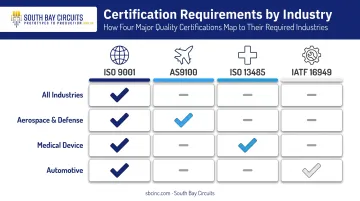
Certifications like ISO 9001, AS9100, ISO 13485, and IATF 16949 (the automotive standard that replaced ISO/TS 16949) often aren't optional extras. They're the qualifying line a manufacturer has to clear before it can even bid.
Where Contract PCB Assembly Fits in the Product Lifecycle
Most OEMs first outsource assembly after design validation, once a board has cleared prototyping and the design is locked, but before committing to production tooling.
Common trigger points include:
- New product introduction (NPI), when a design moves from schematic to first physical builds
- Scaling to production volume, when in-house capacity can't keep pace with demand
- Capacity overflow, when internal lines are full and a deadline won't wait
The relationship itself can take two shapes. Some OEMs need a single production run: a defined quantity, built once, shipped, done. Others build a recurring relationship with one manufacturer that spans years of revisions and reorders as the product matures. Neither approach is inherently better; the right fit depends on the product's expected life and how often the design changes.
How the Contract PCB Assembly Process Works
The process takes three inputs: a validated design file, a bill of materials, and a bare board. The output is a tested, functional assembly.
A complete build package typically includes Gerber files, the BOM, a netlist, pick-and-place coordinates, and any special instructions like approved component substitutes. From there, components get placed and soldered using surface-mount (SMT) and/or through-hole methods, with inspection checkpoints controlling consistency at every stage.
What starts as a bare, unpopulated board ends as a fully assembled PCBA ready for functional testing.
Step 1: Component Procurement and Kitting
Before anything gets placed on the board, the manufacturer verifies every BOM line item, checking for obsolete parts, long lead times, and approved substitutes, then kits the components for the line.
This is where inventory programs earn their value. Manufacturers running vendor-managed inventory (VMI), just-in-time, or Kanban systems can flag shortages before they become schedule risks rather than discovering a missing part mid-build.
SBC, for example, assigns an internal part number to every BOM line item and tracks it through its MRP system alongside manufacturer data, stock levels, and open work orders.
Step 2: Component Placement
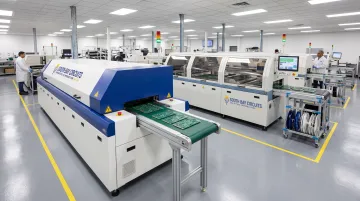
Pick-and-place machines position SMT components onto the board with high precision, guided by coordinate data pulled from the design file, while through-hole leads are staged separately for insertion.
Placement accuracy gets more demanding as component pitch shrinks. Fine-pitch parts and BGAs require tighter calibration and stencil control. SBC's Fuji CP-642 and IP-3 placement lines, for instance, support standard placement down to 0201 components and fine-pitch work to 0.4mm and smaller, subject to engineering review.
Step 3: Soldering
Reflow soldering melts solder paste to bond SMT components to their pads, while wave soldering secures through-hole leads by passing the board over molten solder. Both create permanent electrical and mechanical connections.
Temperature profile matters as much as the equipment itself. IPC-7530 provides thermal-profiling guidance because uneven heating causes cold joints, tombstoning, or component damage. SBC runs SMT reflow on BTU VIP 70 and Conceptronic HVA-70 ovens, paired with a Manncorp dual-pot wave system for through-hole work.
Step 4: Inspection and Testing
Once soldered, boards move through inspection before anyone calls the build complete.
- Automated Optical Inspection (AOI) scans for placement and solder defects visible on the surface
- X-ray inspection checks joints hidden underneath components, like BGAs, where visual inspection can't reach
- In-circuit testing (ICT) checks electrical parameters such as shorts, opens, and resistance
- Functional testing confirms the board actually performs its intended job
Assembly and testing aren't the same milestone. A board can be perfectly soldered and still fail functionally if a component value is wrong.
Step 5: Final Assembly, Packaging, and Shipping
Depending on the end application, boards may need conformal coating for protection against moisture and chemical exposure, or full integration into an enclosure as part of a box build.
From there, packaging follows the client's specifications, whether that's trays for internal staging or export-ready packaging for direct shipment. When components and enclosure materials are pre-staged, SBC lists a 72-hour turnaround from tested PCBA to packaged, shippable product.
Key Factors That Affect Contract PCB Assembly Outcomes
Several variables shape how smoothly a build goes and what it ends up costing:
- Component availability and BOM accuracy – shortages or BOM errors delay schedules. EE Times reports rising, less predictable discontinuation notices as semiconductor lifecycles shrink
- Board complexity – layer count, component density, and fine-pitch parts affect placement accuracy and yield
- Equipment capability – SMT line throughput and through-hole capacity determine batch size and speed
- Order volume and mix – prototype runs, high-mix/low-volume work, and high-volume production each need different line setups
- Compliance requirements – ITAR registration, AS9100, or ISO 13485 needs narrow the pool of manufacturers who even qualify for the job
Those variables only pay off when the manufacturer can actually manage them.
Choosing a Contract PCB Assembly Partner
Certifications are the fastest way to screen candidates:
- ISO 9001:2015 – baseline quality management
- AS9100 – aerospace and defense readiness
- ISO 13485 – medical devices
- IATF 16949 – automotive supply chains
A manufacturer missing the certification your industry requires simply isn't a fit, regardless of the quote.
Single-source manufacturers, those handling fabrication and assembly under one roof, remove a source of delay that's easy to underestimate: shipping, queuing, and file hand-offs between separate vendors. South Bay Circuits (SBC) is built around that model.
Its 60,000+ square foot Chandler, Arizona facility has run fabrication and assembly together since 1981, holds ISO 9001:2015 certification, and is ITAR registered and CMMC Level 1 compliant for defense work. When something goes wrong mid-build, one team is accountable instead of two companies pointing at each other.
Capacity is the check OEMs skip most often. A quote means little if the manufacturer can't actually run the volume on time. Before signing on, verify:
- Actual line capacity – how many SMT lines are running, and what's their current load?
- Prototype support – can they turn a fast prototype without treating it as an afterthought?
- Volume scalability – is there a documented path from prototype to full production, including offshore partnerships if volume requires it?
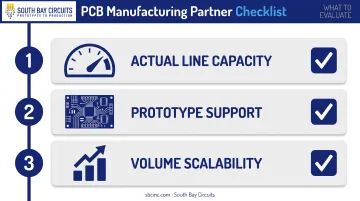
Getting these answers upfront prevents the scenario where a manufacturer wins the bid, then can't hit the delivery date it quoted.
Common Misconceptions and When Contract PCB Assembly May Not Be the Right Fit
A few misunderstandings cause more friction than the assembly process itself.
Assembly-only isn't full contract manufacturing. Contract PCB assembly covers the board-level build from an OEM's design and BOM. Full contract manufacturing adds sourcing strategy, DFM input, box build, and lifecycle support. Confusing the two leads OEMs to expect services a pure assembly shop was never set up to provide.
The cheapest quote rarely stays the cheapest. Rework from poor DFM feedback, missed lead times on obsolete parts, or a supply chain delay can erase whatever savings a low bid promised. A detailed quote based on the actual BOM and design files is the only fair way to compare providers.
"Assembled" and "tested" aren't interchangeable. A board can complete assembly and still fail in the field without proper in-circuit or functional testing. Confirm what testing is included before assuming a completed build means a working one.
Outsourcing also isn't always the right call:
- Idle in-house SMT capacity plus a low-volume proprietary build often favors keeping the work internal
- Recurring design changes, sourcing headaches, or integration issues across vendors signal a move to full contract manufacturing
- Highly classified or IP-sensitive programs that cannot leave your facility should stay in-house
Conclusion
Contract PCB assembly outsources one specific transformation: a bare board and a BOM become a tested, functional PCBA through procurement, placement, soldering, and inspection. Knowing what happens at each step, and what drives its cost and timeline, helps OEMs set expectations that actually match reality.
Choose the manufacturer whose certifications, capacity, and process match what the product needs, whether that's a one-time prototype run or a multi-year production relationship. Get that match right, and cost, quality, and timeline usually fall into place.
Frequently Asked Questions
What does contract PCB assembly mean?
Contract PCB assembly means outsourcing component placement, soldering, and testing onto a bare PCB to a specialized third-party manufacturer, using the OEM's design and BOM.
How much does contract PCB assembly cost?
Cost depends on order volume, board complexity, and component selection. A detailed quote based on your actual BOM and design files is the only reliable way to get an accurate number.
What is the typical turnaround time for contract PCB assembly?
Lead times range from same-day or 24-hour prototype turns to several weeks for complex, high-volume runs. The exact timeline depends on component sourcing and production setup.
What certifications should a contract PCB assembly provider have?
ISO 9001 is the baseline for any provider. Aerospace work calls for AS9100, medical devices need ISO 13485, automotive programs require IATF 16949, and US defense work often needs ITAR registration.
What's the difference between contract PCB assembly and full contract manufacturing?
Contract PCB assembly covers the board-level build from an OEM's existing design and BOM. Full contract manufacturing adds sourcing, DFM, box build, and lifecycle support on top of that.
Can a contract manufacturer handle both prototypes and high-volume production?
Many can, but confirm dedicated prototype capability and DFM feedback before committing to a volume ramp. Not every provider treats prototype work with the same priority.