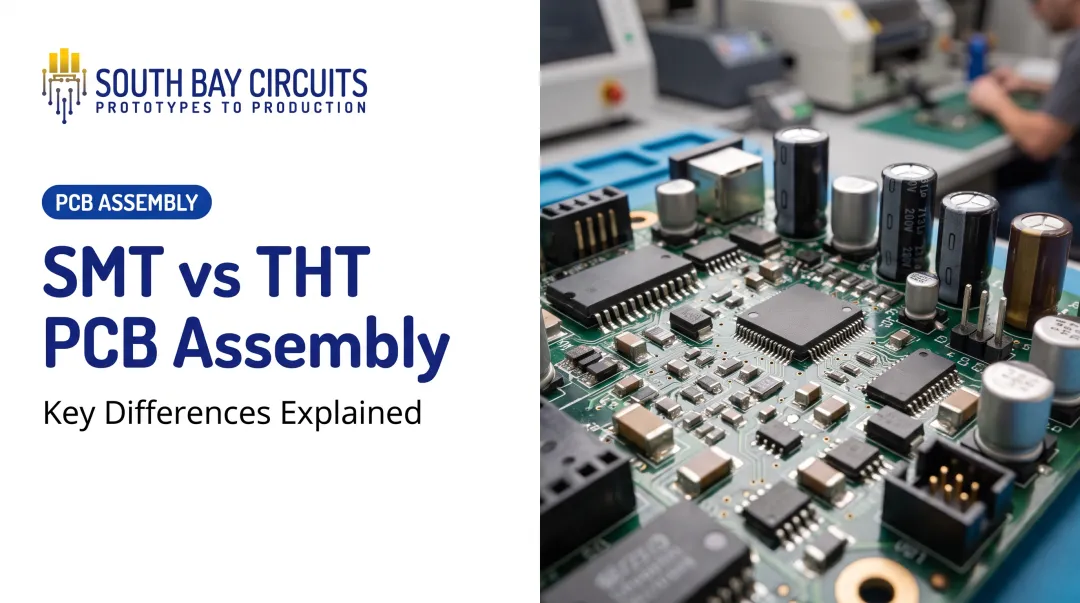
For OEMs, this isn't a technicality. The mix of SMT and THT you choose shapes unit cost, how much circuitry fits on a board, how well the finished product survives vibration and heat, and whether a technician can repair it in the field five years from now.
Circuits Assembly notes that high-mix production boards are frequently mixed-technology builds, pairing SMT density with THT strength on a single design. Get that balance wrong, and you either overpay for automation you don't need or end up with a board that can't survive its own use case.
This guide breaks down what each method does best, where they overlap, and how to decide.
TL;DR
- SMT mounts components on the board surface using solder-paste reflow for automated production.
- THT inserts leaded components through plated holes for maximum mechanical strength.
- Most commercial boards blend both methods, matching each component to its ideal mount.
- Choose based on volume, component type, and stress exposure, not technology age.
SMT vs THT: Quick Comparison
Before covering the details, here's how the two methods stack up across the factors that actually drive procurement decisions:
| Factor | SMT | THT |
|---|---|---|
| Cost at volume | Lower per-unit cost once automated; higher upfront tooling | Higher labor cost at scale; lower barrier for small runs |
| Density | Supports fine-pitch ICs, BGAs, micro-passives | Needs drilled holes and lead spacing — larger footprint |
| Mechanical strength | Relies on pad adhesion; vibration-sensitive | Leads pass through the board for a rivet-like joint |
| Assembly speed | Highly automated pick-and-place; suited to high volume | Slower manual/selective/wave soldering |
| Repairability | Moderate; BGA rework needs specialized gear | Excellent; visible joints simplify field repair |
Neither column wins outright. SMT wins on density and throughput; THT wins on mechanical anchoring and serviceability. Most real boards need both.
THT isn't automatically "tougher" under every stress type. An IPC APEX study testing more than 3,500 plated through-hole pins found thermal cycling from 25°C to 100°C over 2,000 cycles caused no apparent drop in solder pull strength.
Vibration testing told a different story, cutting pull strength by 25% for SAC305 joints. Durability depends on the stress you're designing against, not just the mounting technology.
What is SMT?
Surface Mount Technology places components directly onto copper pads using solder paste, then runs the board through a reflow oven to melt the paste and form the bond. No drilling. No leads threading through the board. Just precise placement and heat.
That simplicity is exactly why SMT became the default for dense, automated production. Because components sit flush on the surface, manufacturers can populate boards on both sides, shrinking overall footprint while packing in more circuitry per square inch.
Operational benefits include:
- Higher throughput from automated pick-and-place systems
- Lower per-unit labor cost as volume scales
- Double-sided placement that reduces board size
- Compatibility with fine-pitch ICs and micro-passives
Where SMT Fits
SMT dominates high-volume, logic-heavy designs — microcontrollers, memory chips, and the dense passive networks that surround them. It's the backbone of consumer electronics, computing hardware, industrial controls, and automotive ECUs, where board real estate is tight and production runs are large.
Modern placement equipment illustrates just how fast this process moves. Yamaha's YSM10 placement machine is rated at 46,000 components per hour, with the ability to handle parts as small as 0.3 x 0.15 mm. That's a machine specification, not guaranteed line output, but it shows why SMT scales so well for high-mix, high-volume production.
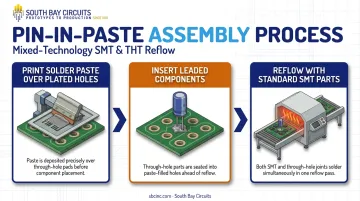
Not every board fits neatly into pure SMT, though. One important subtype worth knowing: pin-in-paste (through-hole reflow). It prints solder paste over plated holes, inserts leaded components, and reflows them alongside standard SMT parts, skipping a separate wave-soldering step entirely. It's a common bridge technique on mixed-technology boards.
What is THT?
Through-Hole Technology inserts component leads through drilled, plated holes and solders them on the opposite side of the board. It's older than SMT, but it's not going anywhere: some jobs simply need what THT does best.
The lead running through the board creates a mechanical anchor, almost like a rivet. That anchoring matters when a component faces repeated stress, whether from vibration, thermal expansion, or someone yanking on a cable.
Operational benefits include:
- Stronger mechanical anchoring for stress-prone components
- Easier field repair thanks to visible, accessible joints
- Better suitability for high-current and high-voltage parts
- Multiple soldering approaches depending on volume: wave, selective, or hand soldering
Where THT Fits
On an otherwise SMT-dominant board, THT typically shows up in a handful of predictable places: connectors, transformers, terminal blocks, and power components that need to handle real current without stressing a solder pad.
Entire industries still lean on it. Aerospace and defense avionics, automotive powertrain modules, industrial power equipment, and medical devices with long service-life requirements all favor THT where the joint has to outlast the product's warranty by a wide margin.
The reliability case isn't just anecdotal. The same IPC APEX research mentioned earlier tested PTH joints under combined thermal, shock, and vibration stress and found that pin wetting length correlated more strongly with pull strength than percentage hole fill. Process control, not just the mounting method itself, determines long-term durability. Full hole fill remains the industry's process target for good reason.
SMT vs THT: Which Is Better?
Neither. That's the honest answer. The better question is which method fits each component on your board.
Decision factors that actually matter:
- Production volume — Large runs favor automated SMT; small runs tolerate THT's manual labor cost.
- Component type and power rating — High-current connectors and power parts still need through-hole anchoring.
- Mechanical stress exposure — Vibration, shock, or cable-pull applications favor THT's rivet-like joint.
- Field-serviceability needs — If a technician needs to swap a part in the field, THT's visible joints make that realistic.
A common scenario: manufacturers who build exclusively THT products often hit a wall on cost and board density as designs get more complex.
Others who go all-SMT for cost reasons discover the hard way that a connector or power component fails under vibration testing, or worse, in the field. The fix in both cases is the same: move to a mixed build where each component gets the mounting method it actually needs.
Where the Manufacturing Model Matters
That's usually where the manufacturing model matters as much as the technology choice. When fabrication and assembly sit with separate vendors, every design revision means shipping boards back and forth.
Each stage adds its own queue, and the lead time piles up before any actual soldering happens.
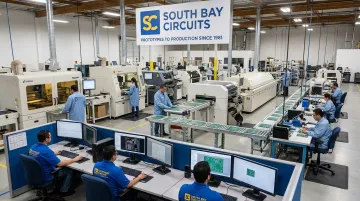
South Bay Circuits runs PCB design, fabrication, and assembly under one roof at its Chandler, Arizona facility, with 24-hour fabrication and same-day assembly capability for qualifying builds.
Consolidating both processes removes the queue and ship time that piles up between a fab house and a separate assembly shop. Internally, SBC's new product introduction process has shown meaningful cycle-time reductions for customers who move from fragmented, multi-vendor workflows to a single-source build — a real gain when lead time, not just per-unit cost, is the bottleneck.
If your design mixes SMT and THT components, which most real-world boards do, talk to a contract manufacturer with both capabilities in-house before you lock in your layout. It's far cheaper to plan for the right mounting method now than to redesign after a field failure.
Conclusion
Choosing between SMT and THT comes down to a matching exercise, pairing each component's mechanical, electrical, and lifecycle needs with the assembly method built for that job.
Get that matching right, and you control cost while building durability into every production run. Partnering with a manufacturer like South Bay Circuits, which handles both technologies from design through fabrication and assembly, takes the guesswork out of that decision and keeps your board moving through one shop instead of three.
Frequently Asked Questions
What is THT in manufacturing?
THT (Through-Hole Technology) is a PCB assembly method where component leads are inserted through drilled, plated holes and soldered on the opposite side. This creates a strong, rivet-like mechanical bond.
What is the difference between THT and SMT?
THT inserts leaded components through the board for mechanical strength, while SMT mounts components directly on the surface for higher density and automated speed. Most boards use both.
Can SMT and THT be used on the same PCB?
Yes. Mixed-technology boards are the industry norm — SMT handles dense logic components while THT handles connectors, power parts, and anything facing mechanical stress.
Which is cheaper, SMT or THT?
SMT is generally cheaper at high volumes thanks to automation. THT can have a lower barrier to entry for small runs but costs more per unit in labor as volume scales.
Is THT still used today?
Yes. THT remains essential in aerospace, automotive, industrial, and medical applications where mechanical strength, high power handling, or field repair are priorities.
How do I decide between SMT and THT for my PCB design?
Evaluate production volume, component type and power rating, environmental stress exposure, and serviceability needs. Consult a manufacturer like South Bay Circuits with in-house SMT and THT capability early in the design process.