This explanation is for engineers, NPI managers, and procurement teams working in regulated industries: medical, aerospace, defense, automotive, and industrial electronics. In these fields, quality, traceability, and compliance aren't negotiable.
Hand assembly gets dismissed as the "lesser" process compared to automated SMT lines. That reputation is largely undeserved. Done correctly, it remains critical for prototyping, new product introduction (NPI), and low-volume production.
This article covers how hand PCB assembly actually works, when it's the right call, and what separates a reliable build from a risky one.
Key Takeaways
- Hand assembly suits prototypes, low-volume runs, rework, and components irregular for automated placement
- Quality depends on technician skill and workmanship standards like IPC-A-610, not the assembly method itself
- Regulated industries hold hand-built boards to the same certification bar as automated production
- Fine-pitch, high-density designs eventually outgrow hand assembly, both in cost and consistency
What Is Hand Assembly of PCBs and Why It's Used
Hand PCB assembly is the manual placement and soldering of through-hole and surface-mount components using hand tools, rather than automated equipment. A technician works from an assembly drawing, positions each part by hand, and solders it using an iron, hot air tool, or in some small-batch cases, solder paste with localized reflow.
The goal is straightforward: produce a functional, tested assembly without the setup time and cost of programming an automated line.
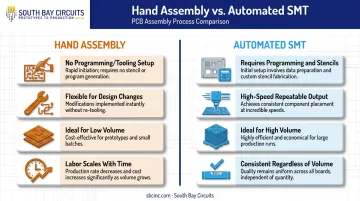
Hand assembly versus automated SMT, in brief: Automated pick-and-place systems handle speed and repeatability at scale but require programming, feeder setup, and stencil creation. Hand assembly skips that setup entirely, trading raw throughput for flexibility.
Why Manufacturers Choose Hand Assembly
Several practical reasons drive this choice:
- Cost efficiency for small batches: No programming or tooling investment needed for a handful of boards
- Flexibility for design iterations: Engineers can make last-minute changes without reprogramming a machine
- Handling of bulky or unusual components: Large transformers, heat-sinked power semiconductors, and oversized connectors often don't suit surface mounting at all and require through-hole or hand soldering instead
What Regulated Industries Demand
Medical, aerospace, defense, and automotive customers expect consistent workmanship, full traceability, and complete documentation, regardless of assembly method. IPC-A-610 remains the workmanship standard against which hand-assembled joints get judged.
The current revision, IPC-A-610J (published March 2024), defines visual acceptability criteria for solder joints, including cold joints, insufficient wetting, and bridging. It doesn't dictate which assembly process to use, only how the finished result should look, and it's meant to be applied alongside J-STD-001 for full soldering requirements.
What Goes Wrong Without Discipline
Skip proper technique, and you'll see solder bridges, cold joints, contamination, overheating, and misaligned polarity. IPC's guidance on reducing hand-soldering defects identifies these as the recurring failure modes in manual work.
No dated, apples-to-apples study exists comparing hand-soldering defect rates against automated reflow, so treat any specific percentage claim you see elsewhere with skepticism. What's certain: these defects are preventable with trained technicians and disciplined process control, not inherent to the method.
How Hand PCB Assembly Works (Conceptual Flow)
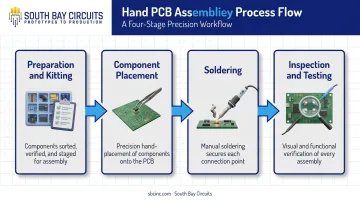
At a high level, hand assembly follows four stages: kitting and preparation, component placement, soldering, and inspection/testing. Each stage feeds the next.
What goes into the process:
- A bare PCB
- A verified bill of materials (BOM)
- A parts kit organized by reference designator
- An assembly drawing showing polarity and pin-1 markers
Technicians manually position each component according to that drawing, then apply solder using an iron, hot air tool, or paste-and-reflow for small batches. Technicians control the process through adherence to IPC-A-610 workmanship criteria, ESD-safe workstations, magnification tools, and documented soldering parameters like temperature and dwell time.
The result: a bare board becomes a functional, electrically verified assembly ready for further testing or production.
Step 1: Preparation and Kitting
Technicians gather every component and check it against the BOM before touching the board. They label parts with reference designators, clean the board, and set up the workstation with proper ESD controls.
A genuine ESD-safe setup requires more than a single wrist strap. Per ANSI/ESD S20.20, it needs a dissipative worksurface, grounded personnel, and a common point ground working together as a system.
Step 2: Component Placement and Soldering
Technicians place through-hole and SMD components according to the assembly drawing, checking orientation and polarity before any solder touches the board. They then solder using the appropriate temperature and solder type, leaded or RoHS-compliant, depending on customer and industry requirements.
Step 3: Inspection and Testing
Technicians inspect every joint under magnification, looking for shiny, concave solder fillets that indicate proper wetting. Continuity or functional testing follows. Any flagged joint goes back for rework before the board ships.
Where Hand Assembly Is Applied and What Affects Its Quality
Hand assembly shows up at specific points in a product's life, not randomly across every build.
Common contexts include:
- Prototype builds and first-article validation
- New product introduction (NPI) runs
- Short-run production
- R&D lab work
- Field rework and repair
These typically occur during early design validation, engineering change orders, or when an urgent turnaround leaves no time for automated tooling setup. Sometimes it's simply that components, like large connectors or coils, are too irregular for pick-and-place equipment to handle.
What Actually Drives Quality Outcomes
Several variables determine whether a hand-assembled board meets spec:
- Component package size: through-hole is far more forgiving than fine-pitch SMD
- Solder composition: leaded versus RoHS-compliant affects flow characteristics and joint appearance
- Technician experience: skill level directly correlates with consistency
- Workstation conditions: lighting and magnification quality matter more than most teams assume
Hand assembly stays cost-effective at low unit counts, but the tradeoff is real: assembly time scales linearly with labor. Automated lines don't have that problem once they're set up and running.
Regulatory Constraints in Practice
Cost and scaling aren't the only constraints. Regulated industries add a documentation requirement that no amount of automation can replace.
Aerospace, medical, and automotive customers need more than a good-looking board. They need documentation proving it was built to standard.
Manufacturers holding certifications like AS9100 (aerospace), ISO 13485 (medical), and IATF 16949 (automotive) can validate hand-assembled builds to the same compliance level required for automated production. SBC, for example, maintains ISO 9001:2015 certification alongside AS9100, ISO 13485, and IATF 16949 compliance, meaning a hand-built board for a defense customer gets the same documentation rigor as one coming off an SMT line.
When Hand Assembly Makes Sense (and Common Misconceptions)
Two misconceptions cause the most confusion around this topic.
Misconception one: hand assembly is inherently lower quality. It isn't. Quality comes from technician skill and design-for-assembly practices, not from whether a machine or a person placed the part. A poorly programmed SMT line produces worse results than a skilled technician working a clean board.
Misconception two: hand assembly scales well. It doesn't, past a certain point. Beyond a given volume or complexity threshold, labor cost and inconsistency make automated SMT the more practical choice.
Where Hand Assembly Falls Short
Avoid hand assembly for:
- High-volume production runs
- Boards with BGA, QFN, or fine-pitch components requiring reflow precision
- Tightly packed, high-density designs where hidden joints need controlled thermal profiling
If your team keeps hand-building medium-volume orders on repeat, that's a signal you're defaulting to a familiar process rather than choosing the right one. A single-source manufacturer solves this problem directly.
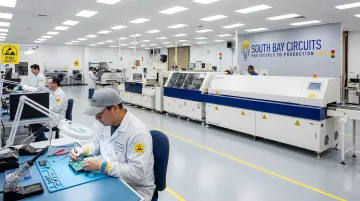
SBC offers both hand assembly for prototypes and automated SMT lines under one roof at its Chandler, Arizona facility. Projects move from prototype to full production without switching vendors or requalifying processes.
Conclusion
Hand PCB assembly is a manual, skill-dependent process best applied to prototypes, low-volume runs, and components that don't suit automation. Understanding when and how to apply it correctly protects both quality and cost efficiency, especially in regulated industries where compliance isn't optional.
The real decision matches the method to your project's volume, complexity, and timeline, not a choice between hand assembly and automated SMT as competing philosophies. Partnering with a certified, single-source manufacturer like South Bay Circuits that supports both approaches means that decision doesn't have to be permanent as your project scales.
Frequently Asked Questions
What is a PCB assembly?
PCB assembly means populating a bare printed circuit board with electronic components and soldering them in place to create a functional circuit. This differs from bare-board fabrication, which produces only the unpopulated board.
How much does it cost to assemble a PCB?
Cost depends on component count, board complexity, order volume, and whether you choose hand assembly or automated SMT. Request a quote for accurate pricing tailored to your specific design.
What's the difference between hand assembly and SMT assembly?
Hand assembly relies on manual placement and soldering, while SMT uses automated pick-and-place machines and reflow ovens. SMT wins on speed and repeatability at volume; hand assembly wins on flexibility for small, unusual builds.
Is hand-soldered PCB assembly reliable for production use?
Yes, when performed to IPC-A-610 standards by trained technicians. It's particularly reliable for low-volume runs, prototypes, and components that don't tolerate automated reflow.
What certifications matter for hand-assembled PCBs in regulated industries?
Look for ISO 9001, AS9100 (aerospace), ISO 13485 (medical), and IATF 16949 (automotive). These confirm the manufacturer's quality system covers hand assembly at the same rigor as automated lines.
How long does hand PCB assembly typically take compared to automated assembly?
Hand assembly can be faster for very small quantities since it skips machine programming and setup. Automated methods overtake it in speed as order volume and placement density increase.