That's the reality of aerospace electronics: there's no service truck, no warranty call, no second try at 30,000 feet or in orbit.
Manufacturers face a tough triangle: meet AS9100 and IPC Class 3 requirements, build boards that survive radiation, vibration, and thermal extremes, and still hit the turnaround times OEMs demand. This guide walks through the standards, materials, and assembly practices that separate flight-ready boards from everything else — plus what to look for in a manufacturing partner.
Key Takeaways
- AS9100 and IPC Class 3 form the non-negotiable baseline for any aerospace PCB program.
- High-Tg laminates, heavy copper, and the right conformal coating decide whether a board survives years of thermal cycling.
- Environmental testing and mechanical reinforcement separate flight-ready boards from commercial-grade ones.
- A single-source, AS9100-certified manufacturer cuts handoff risk and shortens design-to-loaded-assembly time.
What Is Aerospace PCB Assembly & Why It's Different
Aerospace PCB assembly is the process of populating, soldering, and testing printed circuit boards built for aircraft, satellites, UAVs, and defense systems, all to IPC Class 3 reliability standards. The bar is higher than commercial work, and the paperwork is only a fraction of what changes.
Commercial boards get replaced when they fail. Aerospace boards often can't be touched again once installed.
What sets aerospace assembly apart:
- Near-zero failure tolerance: a defect that's a minor annoyance in a consumer device can be catastrophic at altitude or in orbit
- Extreme environmental exposure: sustained vibration, mechanical shock, radiation, and thermal swings from -55°C to 125°C or beyond
- Long service life with no field repair: programs often specify years of continuous operation; satellites, once deployed, can't be serviced at all
These boards show up in avionics, navigation and flight control systems, satellite communications, UAV payloads, and ground station equipment. Demand for this kind of work isn't slowing down. IPC data shows EU defense-electronics production grew 5.9% in 2022 and 4.4% in 2023, a signal of steadily rising output across the sector (IPC, 2024).
That growth lands on a manufacturing base held to a stricter reliability bar than almost any other electronics segment.
Industry Standards & Certifications You Must Know
Before evaluating a single laminate or SMT process, confirm the certifications. This is where most aerospace PCB programs succeed or stall.
AS9100 and ISO 9001
AS9100 builds directly on ISO 9001, adding aviation, space, and defense-specific requirements around risk management, configuration control, product safety, and oversight of external suppliers. South Bay Circuits maintains AS9100 aerospace compliance alongside ISO 9001:2015 certification (Certificate #10000903 QM15, valid through August 2027). That dual credential is what buyers should expect from any serious aerospace supplier.
IPC Class 3 Requirements
IPC Class 3 is reserved for high-performance products where continued operation is critical and downtime simply isn't acceptable. That is a higher bar than IPC Class 2, which covers dedicated-service commercial products where occasional failure is tolerable.
Aerospace boards fall under IPC-6012 with the Space and Military Avionics addendum (now in Revision F). It sets tighter acceptance criteria for plating, annular rings, and internal layer registration.
ITAR, CMMC, and Documentation
Defense-related programs bring their own layer of compliance:
- ITAR registration covers U.S. persons who manufacture, export, or handle technical data for defense articles on the U.S. Munitions List (including shops that never export directly)
- CMMC compliance protects Federal Contract Information and Controlled Unclassified Information; required level (1, 2, or 3) depends on the contract
- AS9102 First Article Inspection reports document that a first production unit conforms to design requirements
- AS5553 counterfeit-part prevention standardizes sourcing, authenticity checks, and disposition of suspect components
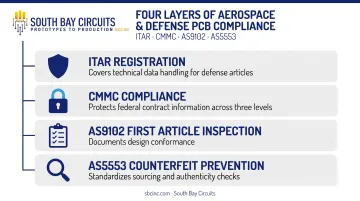
South Bay Circuits is ITAR registered and CMMC Level 1 compliant for defense and military programs. For counterfeit prevention, SBC assigns each BOM line its own part number and tracks manufacturer data through its MRP system back to approved vendors.
FAA and EASA certify finished aircraft, not individual PCBs. A PCB supplier provides the conformity documentation (AS9100 compliance, IPC Class 3 criteria, First Article reports) that the certificate holder uses to demonstrate airworthiness.
Material Selection Guidelines for Aerospace-Grade Boards
Material choice is where long-term reliability gets decided, long before the first component gets placed.
Laminates: Managing Thermal Cycling
High-Tg materials resist the barrel cracking and delamination that repeated thermal cycling causes. Isola's P95/P25 polyimide, for example, specifies a 260°C glass transition temperature and can withstand six 260°C reflow cycles, giving useful headroom for boards that see extreme thermal swings. High-Tg FR-4 variants (around 180°C Tg) offer a lower-cost alternative for less extreme profiles.
Qualifying options commonly include 170Tg high-temperature FR4, polyimide substrates, Nelco N4000 series, and Rogers 3000/4000 series, chosen for the design’s thermal and electrical demands. South Bay Circuits works across this range when aerospace builds call for it.
Heavy Copper for Heat and Current
Heavy copper (generally 2 to 6 oz/ft² or higher) improves current-carrying capacity and heat dissipation without extra cooling hardware. Foil weight should follow the current and thermal load under IPC-2152, not a generic default. South Bay Circuits fabricates up to 3 oz copper foil weight before plating when the design requires it.
Surface Finishes and Coatings
| Finish | Strengths | Consideration |
|---|---|---|
| ENIG | Excellent solderability, flat surface | Higher cost; process control matters (black pad risk) |
| ENEPIG | Strong wetting performance, BGA-friendly | Slightly higher process cost |
| HASL | Widely used, economical | Harder to hold flatness on fine-pitch boards |
ENIG is a common RoHS-compliant default for high-reliability builds, and it is South Bay Circuits’ standard finish for that class of work.
Conformal coatings add another layer of protection:
- Acrylic: easy rework, good humidity resistance, limited above 150°C
- Silicone: strong vibration and thermal protection, though more moisture-permeable
- Parylene: thin, vapor-deposited barrier with excellent chemical and moisture resistance
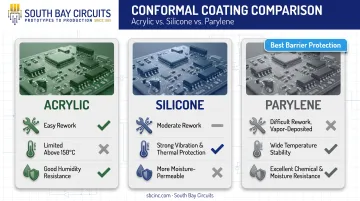
For builds that need coating in-house, South Bay Circuits applies acrylic, silicone-type, and urethane systems matched to the environment.
When Flex and Rigid-Flex Make Sense
Flex and rigid-flex boards, typically on polyimide, fit avionics and satellite use cases where weight, space, and vibration resistance all matter at once. Constructions can run to 22+ layers with controlled impedance and HDI interconnects for compact, high-density aerospace layouts—capabilities South Bay Circuits supports when the architecture calls for flex or rigid-flex.
Design & Assembly Best Practices for Mission-Critical Reliability
Good materials mean little without design and assembly practices built around the same failure modes.
Thermal Management & Component Placement
Managing heat starts with layout. Thermal vias pull heat away from hot components, heavy copper planes spread it laterally, and heat sinks handle what's left.
Best practice also keeps high-power components spaced apart and away from thermally sensitive parts. That spacing limits localized hotspots that accelerate solder-joint fatigue over time.
Vibration & Mechanical Resilience
CTE mismatch, board flex, and warp rank among the top contributors to BGA failure in aerospace environments. NASA-backed testing found that properly applied full underfill delivered a 5x to 10x improvement in mean time between failures for fully populated BGA packages, compared to unreinforced assemblies (NASA, 2006).
Common reinforcement techniques include:
- Corner bonding or full underfill for BGA and fine-pitch packages
- Edge-clear placement that keeps parts off board edges, where flex stress concentrates
- Potting in thermosetting plastic or silicone gel to resist shock, vibration, and moisture
South Bay Circuits pots completed assemblies for shock and vibration resistance and verifies BGA placement with X-ray inspection.
SMT Assembly Processes for Aerospace Volumes
Aerospace production tends to be high-complexity and lower-volume, a mix that rarely fits a pure automation or pure manual model. Automated placement handles repeatability at scale, while hand soldering covers specialty or sensitive components that don't suit automated lines.
South Bay Circuits runs Fuji CP-642 and CP-65 chipshooters alongside a Fuji IP-3 flexible placer, supporting fine-pitch placement down to 0.3mm and BGA packages as small as 0.4mm, with manual assembly for components that still need a hand process.
Testing & Quality Verification
Flight readiness depends on layered verification. No single test is enough on its own. A typical program combines:
- Environmental stress screening to flag latent defects through thermal cycling and vibration before integration
- AOI for visible workmanship checks against documented acceptance criteria
- X-ray inspection for hidden BGA solder joints and internal defects
- Flying probe testing for continuity and isolation on bare boards
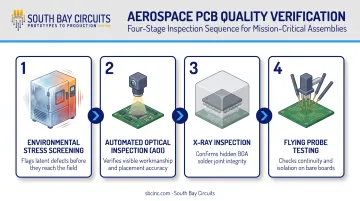
South Bay Circuits scans 100% of inner layers with AOI, uses X-ray systems for BGA and component verification, and runs flying-probe electrical testing alongside vibration, burn-in, and high/low-temperature screening.
Choosing the Right Aerospace PCB Assembly Partner
Certifications on a website aren't proof of anything. Verify them directly.
What to check before signing a contract:
- AS9100 and ISO 9001:2015 certification — confirm current status, not just a logo
- ITAR registration — required for any defense-related technical data handling
- Track record — ask for specifics on aerospace or defense programs completed, not general claims
- Documentation and traceability systems — how are BOM line items tracked from receipt to work order?
- NPI/NPD turnaround history — how fast can they move a new design from prototype to production?
Single-source manufacturing (design, fabrication, and assembly under one roof) removes a common failure point: finger-pointing between vendors when something goes wrong mid-program.
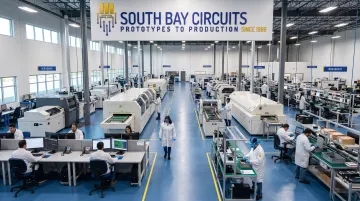
South Bay Circuits has run this model for over 40 years, with PCB design, 24-hour fabrication, same-day assembly, and box builds in its 60,000-square-foot Chandler, Arizona facility. In-house control means fewer handoffs, less queue time between processes, and a faster path from prototype to loaded assembly.
Traceability matters just as much as speed. SBC assigns every BOM line item a dedicated part number, tracked through its MRP/ERP system from receipt through work-order assignment. That documentation trail matters when a program manager needs answers six months after delivery.
Frequently Asked Questions
What does PCB mean?
PCB stands for Printed Circuit Board — a board that mechanically supports and electrically connects electronic components using etched copper pathways instead of point-to-point wiring.
What is IPC Class 3 and why does it matter for aerospace PCBs?
IPC Class 3 is the highest reliability classification in the IPC standard, reserved for products where continuous, failure-free performance is mandatory. Aerospace and defense electronics fall squarely into this category because downtime or failure isn't an acceptable outcome.
How long must aerospace PCBs last without failure?
Many aerospace and satellite programs specify years of continuous, failure-free operation, since in-field repair is rarely possible once a system is deployed. The exact requirement depends on the mission profile and should be defined in the program specification.
What's the difference between AS9100 and ISO 9001?
AS9100 includes every ISO 9001 requirement, then adds aviation, space, and defense-specific clauses covering risk management, configuration control, and counterfeit-parts prevention. Think of ISO 9001 as the foundation and AS9100 as the aerospace-specific layer on top.
Why is heavy copper used in aerospace PCB assembly?
Heavy copper (2 oz/ft² and up) improves heat dissipation and current-carrying capacity without requiring external cooling hardware. That matters in aerospace systems where space and weight for cooling components are both limited.
What testing is required for aerospace PCB assembly?
Typical qualification includes environmental stress screening, thermal cycling, vibration and shock testing, plus inspection methods like AOI, X-ray, and flying probe. The exact combination depends on the mission environment and the customer's specific flow-down requirements.